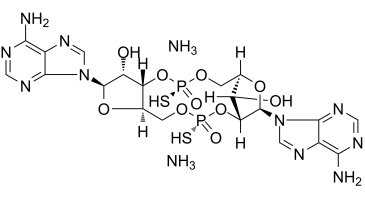
ADU-S100 ammonium salt (ADUS100; ML RR-S2 CDA; MIW815) is potent STING agonist with anticancer and immunomodulatory activities. STING (stimulator of interferon genes) signaling pathway has attracted considerable attention in cancer immunotherapy due to its capacity to boost vigorous antitumor immunity. ADU-S100 leads to potent and systemic tumor regression and immunity. ADU-S100 has the potential to be used in cancer immunotherapy. It elicits potent and durable anti-tumor immunity when administered intratumorally in pre-clinical syngeneic tumor models. As of 2018, it has entered phase I clinical trials for the treatment of cancer. Clinical candidate STING agonist ADU-S100 (S100) is used in an intratumoral dosing regimen optimized for adaptive immunity to uncover requirements for a T cell-driven response compatible with checkpoint inhibitors (CPIs).
Physicochemical Properties
| Molecular Formula | C₂₀H₃₀N₁₂O₁₀P₂S₂ |
| Molecular Weight | 724.60 |
| Exact Mass | 724.112 |
| CAS # | 1638750-96-5 |
| Related CAS # | ADU-S100 disodium salt;1638750-95-4;ADU-S100 enantiomer ammonium salt;ADU-S100;1638241-89-0 |
| PubChem CID | 123131801 |
| Appearance | White to off-white solid powder |
| Hydrogen Bond Donor Count | 6 |
| Hydrogen Bond Acceptor Count | 20 |
| Rotatable Bond Count | 2 |
| Heavy Atom Count | 46 |
| Complexity | 1180 |
| Defined Atom Stereocenter Count | 7 |
| SMILES | C1[C@@H]2[C@H]([C@H]([C@@H](O2)N3C=NC4=C(N=CN=C43)N)O)OP(=S)(OC[C@@H]5C([C@H]([C@@H](O5)N6C=NC7=C(N=CN=C76)N)OP(=O)(O1)[S-])O)[O-].[NH4+].[NH4+] |
| InChi Key | VZYXAGGQHVUTHM-LJFXOJISSA-N |
| InChi Code | InChI=1S/C20H24N10O10P2S2.2H3N/c21-15-9-17(25-3-23-15)29(5-27-9)19-12(32)13-8(38-19)2-36-42(34,44)40-14-11(31)7(1-35-41(33,43)39-13)37-20(14)30-6-28-10-16(22)24-4-26-18(10)30;;/h3-8,11-14,19-20,31-32H,1-2H2,(H,33,43)(H,34,44)(H2,21,23,25)(H2,22,24,26);2*1H3/t7-,8-,11?,12-,13-,14-,19-,20-,41?,42?;;/m1../s1 |
| Chemical Name | diazanium;(1R,6R,8R,9R,10S,15R,17R)-8,17-bis(6-aminopurin-9-yl)-12-oxido-3-oxo-12-sulfanylidene-3-sulfido-2,4,7,11,13,16-hexaoxa-3λ5,12λ5-diphosphatricyclo[13.2.1.06,10]octadecane-9,18-diol |
| Synonyms | ADU-S100; ML RR-S2 CDA; MIW-815; ML RR-S2 CDA ammonium salt; ADU-S100 ammonium salt; 1638750-96-5; diazanium;(1R,6R,8R,9R,10S,15R,17R)-8,17-bis(6-aminopurin-9-yl)-3,12-dioxido-3,12-bis(sulfanylidene)-2,4,7,11,13,16-hexaoxa-3lambda5,12lambda5-diphosphatricyclo[13.2.1.06,10]octadecane-9,18-diol; MIW815 ammonium salt; MIW815 (ammonium salt); ML RR-S2 CDA (ammonium salt; MIW815 ammonium salt |
| HS Tariff Code | 2934.99.9001 |
| Storage |
Powder-20°C 3 years 4°C 2 years In solvent -80°C 6 months -20°C 1 month Note: Please store this product in a sealed and protected environment, avoid exposure to moisture. |
| Shipping Condition | Room temperature (This product is stable at ambient temperature for a few days during ordinary shipping and time spent in Customs) |
Biological Activity
| Targets | STING/stimulator of interferon genes |
| ln Vitro | ADU-S100 ammonium salts have several characteristics that improve stability and lipophilicity in comparison to endogenous and pathogen-derived cyclic dinucleotides (CDNs), thereby significantly enhancing STING signals [1]. In THP-1 human monocytes, ADU-S100 produced more type I IFN than CDA. Disulfide mixed-linked cyclic dinucleotide (CDN) derivatives, on the other hand, effectively activated all five hSTING alleles, including the refractory hSTINGREF and hSTINGQ alleles (ML RR-CDA, ML RR-S2 CDG, and ML RR-S2 cGAMP). In comparison to endogenous ML cGAMP and the TLR3 agonist Poly I:C, ADU-S100 induced the highest expression of IFN-β and the proinflammatory cytokines TNF-α, IL-6, and MCP-1 on a molar equivalent basis. In mouse bone marrow macrophages (BMM), ADU-S100 was also found to induce STING aggregation and induce TBK1 and IRF3 phosphorylation. When compared to ML cGAMP, ADU-S100 induces noticeably higher levels of IFN-α [1]. |
| ln Vivo | ADU-S100 outperformed endogenous ML cGAMP in its anti-tumor control capacity. In B16 tumor-bearing mice, a dose response study of ADU-S100 compounds was carried out to ascertain the best anti-tumor dose level that would maximize tumor antigen-specific CD8+ T cell responses and increase long-term survival to 50%[1]. |
| Enzyme Assay |
Luciferase Assay[1] 104 HEK293T cells were seeded in 96-well plates and transiently transfected with human IFN-β firefly reporter plasmid(Fitzgerald et al., 2003) and TK-Renilla luciferase reporter for normalization. The following day, cells were stimulated with 10 μM of eachADU-S100 or 100 μg/ml DMXAA using digitonin permeabilization (50 mM HEPES, 100 mM KCL, 3 mM MgCl2, 0.1 mM DTT, 85 mM Sucrose, 0.2% BSA, 1 mM ATP, 0.1 mM GTP, 10 ug/ml digitonin) to ensure uniform uptake. After 20 min, stimulation mixtures were removed and normal media was added. After a total of 6 hours, cell lysates were prepared and reporter gene activity measured using the Dual Luciferase Assay System on a Spectramax M3 luminometer. Differential Scanning Fluorimetry[1] Thermal shift assays were performed as (Cavlar et al., 2013). Assays were conducted with STING ligand binding domain at 1 mg/ml with or without various ADU-S100 at 1 mM in 20mM Tris-HCL, 150 mM NaCl, pH 7.5 and 1:500 dilution of SYPRO Orange Dye. The fluorescence as a function of temperature was recorded in a CFX 96 real time PCR machine reading on the HEX channel EX 450–490 EM 560–580 nm. The temperature gradient was from 15–80°C ramping 0.5°C per 15 seconds. Curves were fit to a Boltzmann sigmoidal to establish the midpoint of thermal unfolding (Tm). |
| Cell Assay |
BM-DCs from WT or STING−/− mice were stimulated with 25 μg/ml DMXAA or 100 ng/ml LPS for 4 hours. Total RNA was isolated using the RNeasy® kit and incubated with Deoxyribonuclease I, Amplification Grade. cDNA was synthesized using High Capacity cDNA Reverse Transcription Kit and expression of cytokines was measured by real-time qRT-PCR using specific primers/probes for mouse INF-β, TNF-α, IL-6 and IL12p40, and pan-specific primers were to quantify expression of the IFN-α family. Primer sequences are listed in Table 1 in Supplementary Materials. PCR reactions were performed in the 7300 Real Time PCR system. The results are expressed as 2−ΔCt using 18s as endogenous control.
WT BMM were stimulated with ADU-S100 at 5 μM in HBSS with the addition of Effectene transfection reagent (per kit protocol). Human PBMCs were stimulated as indicated. Stimulated cells were and assessed by real-time qRT-PCR for gene expression of IFN-β1, MCP-1, TNF-α and IL-6 using the PrimePCR RNA purification and cDNA analysis system, and run on the CFX96 gene cycler. Relative normalized expression was determined by comparing induced target gene expression to unstimulated controls, using the reference genes Gapdh and Ywhaz (mouse) and GusB and Pgk1 (human), genes confirmed to have a coefficient variable (CV) below 0.5 and M value below 1, and thus did not vary with different treatment conditions. |
| Animal Protocol | 10~6 of B16-SIY tumor cells, 5 × 10~4 B16.F10 tumor cells, 10~5 4T-1 and CT26, or 106 other tumor cells were injected s.c. in 100 μl DPBS or HBSS on the right flank of mice. Following tumor implantation, mice were randomized into treatment groups. When tumors were 100–200 mm3 in volume (5–7 mm wide), either one single or three doses of DMXAA resuspended in 7.5% of NaHCO3, or CDNs formulated in HBSS or vehicle control, were injected IT. Measurements of tumors were performed twice per week using calipers, and the tumor volume was calculated with the formula: V= (length × width2)/2. In some experiments, tumor-free survivors were rechallenged with tumor cells on the opposite flank several weeks after the injection of the primary tumor. Naïve mice were used as controls. For the contralateral experiments, mice were implanted on both flanks and only one tumor was treated. For the B16 melanoma lung metastasis experiments, mice were implanted on the flank with 5 × 10⁴ cells B16.F10 on day 0, and then injected intravenously with 1 × 10⁵ cells on day 7. Lungs were harvested on day 28. Administration of compounds, measurements of tumors and counting of lung tumors were performed in a blinded fashion.[1] |
| References |
[1]. Direct Activation of STING in the Tumor Microenvironment Leads to Potent and Systemic Tumor Regression and Immunity. Cell Rep. 2015 May 19;11(7):1018-30. |
| Additional Infomation |
ADU-S100 (MIW815) is a synthetic cyclic dinucleotide (CDN) agonist (activator) of Stimulator of Interferon Genes (STING), a receptor crucial to activate the innate (endogenous) immune system. ADU-S100 (MIW815) activates all known human and mouse STINGs, and effectively induces the expression of cytokines and chemokines, leading to a robust and durable antigen-specific T-cell mediated immune response against cancer cells.
DrugBank
STING-activating Cyclic Dinucleotide Agonist MIW815 is a synthetic, cyclic dinucleotide (CDN) and agonist of stimulator of interferon genes protein (STING; transmembrane protein 173; TMEM173), with potential immunomodulating and antineoplastic activities. Upon intratumoral administration, the STING agonist MIW815 binds to STING and stimulates STING-mediated pathways. This activates the immune response through the activation of certain immune cells, including dendritic cells (DCs), which induces the expression of cytokines and chemokines, and leads to an antigen-specific T-cell mediated immune response against cancer cells. STING, a transmembrane protein that activates immune cells in the tumor microenvironment, plays a key role in the activation of the innate immune system. Spontaneous tumor-initiated T cell priming is dependent on IFN-β production by tumor-resident dendritic cells. On the basis of recent observations indicating that IFN-β expression was dependent upon activation of the host STING pathway, we hypothesized that direct engagement of STING through intratumoral (IT) administration of specific agonists would result in effective anti-tumor therapy. After proof-of-principle studies using the mouse STING agonist DMXAA showed a potent therapeutic effect, we generated synthetic cyclic dinucleotide (CDN) derivatives that activated all human STING alleles as well as murine STING. IT injection of STING agonists induced profound regression of established tumors in mice and generated substantial systemic immune responses capable of rejecting distant metastases and providing long-lived immunologic memory. Synthetic CDNs have high translational potential as a cancer therapeutic.[1] |
Solubility Data
| Solubility (In Vitro) |
H2O : ~100 mg/mL (~138.01 mM) DMSO : ~15 mg/mL (~20.70 mM) MEthanol : ~5 mg/mL (~6.90 mM) |
| Solubility (In Vivo) |
Solubility in Formulation 1: ≥ 50 mg/mL (69.00 mM) (saturation unknown) in PBS (add these co-solvents sequentially from left to right, and one by one), clear solution. (Please use freshly prepared in vivo formulations for optimal results.) |
| Preparing Stock Solutions | 1 mg | 5 mg | 10 mg | |
| 1 mM | 1.3801 mL | 6.9004 mL | 13.8007 mL | |
| 5 mM | 0.2760 mL | 1.3801 mL | 2.7601 mL | |
| 10 mM | 0.1380 mL | 0.6900 mL | 1.3801 mL |