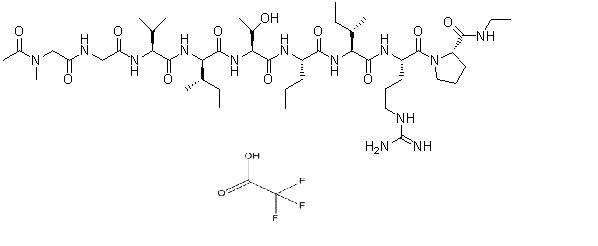
ABT-510 TFA is a synthetic peptide made up of nine amino acids that mimics the anti-angiogenic activity of the endogenous protein thrombospondin-1 (TSP-1), a TSP-1 mimetic drug. It is available as the trifluoroacetic acid (TFA) salt form of ABT-510. Pro-angiogenic growth factors such as vascular endothelial growth factor (VEGF), basic fibroblast growth factor (bFGF), hepatocyte growth factor (HGF), and interleukin 8 (IL-8) are inhibited by ABT-510. These pro-angiogenic growth factors are crucial for tumor neovascularization. In a phase 1 clinical trial with newly diagnosed glioblastoma, the TSR-based drug ABT-510 demonstrated anti-angiogenic properties.
Physicochemical Properties
| Molecular Formula | C46H83N13O11.C2HF3O2 |
| Molecular Weight | 1108.253 |
| Exact Mass | 993.634 |
| Elemental Analysis | C, 55.57; H, 8.41; N, 18.31; O, 17.70 |
| CAS # | 251579-55-2 |
| Related CAS # | ABT-510 acetate; 442526-87-6 |
| PubChem CID | 6918562 |
| Sequence | GGVXTXIRP |
| Appearance | Typically exists as solid at room temperature |
| LogP | 2.065 |
| Hydrogen Bond Donor Count | 11 |
| Hydrogen Bond Acceptor Count | 12 |
| Rotatable Bond Count | 30 |
| Heavy Atom Count | 70 |
| Complexity | 1830 |
| Defined Atom Stereocenter Count | 10 |
| SMILES | CCC[C@H](NC([C@@H](NC(C(NC([C@@H](NC(CNC(CN(C(C)=O)C)=O)=O)C(C)C)=O)[C@H](CC)C)=O)[C@H](O)C)=O)C(N[C@H](C(N[C@H](C(N1CCC[C@H]1C(NCC)=O)=O)CCCNC(N)=N)=O)[C@H](CC)C)=O |
| InChi Key | RIWLPSIAFBLILR-WVNGMBSFSA-N |
| InChi Code | InChI=1S/C46H83N13O11/c1-12-18-30(39(64)55-36(26(7)13-2)42(67)53-31(19-16-21-50-46(47)48)45(70)59-22-17-20-32(59)40(65)49-15-4)52-44(69)38(28(9)60)57-43(68)37(27(8)14-3)56-41(66)35(25(5)6)54-33(62)23-51-34(63)24-58(11)29(10)61/h25-28,30-32,35-38,60H,12-24H2,1-11H3,(H,49,65)(H,51,63)(H,52,69)(H,53,67)(H,54,62)(H,55,64)(H,56,66)(H,57,68)(H4,47,48,50)/t26-,27-,28+,30-,31-,32-,35-,36-,37+,38-/m0/s1 |
| Chemical Name | (2S)-1-[(2S)-2-[[(2S,3S)-2-[[(2S)-2-[[(2S,3R)-2-[[(2R,3S)-2-[[(2S)-2-[[2-[[2-[acetyl(methyl)amino]acetyl]amino]acetyl]amino]-3-methylbutanoyl]amino]-3-methylpentanoyl]amino]-3-hydroxybutanoyl]amino]pentanoyl]amino]-3-methylpentanoyl]amino]-5-(diaminomethylideneamino)pentanoyl]-N-ethylpyrrolidine-2-carboxamide |
| Synonyms | ABT 510; ABT510; ABT-510 TFA; 251579-55-2; ABT 510 TFA; CRR8E37XOB; (2S)-1-[(2S)-2-[[(2S,3S)-2-[[(2S)-2-[[(2S,3R)-2-[[(2R,3S)-2-[[(2S)-2-[[2-[[2-[acetyl(methyl)amino]acetyl]amino]acetyl]amino]-3-methylbutanoyl]amino]-3-methylpentanoyl]amino]-3-hydroxybutanoyl]amino]pentanoyl]amino]-3-methylpentanoyl]amino]-5-(diaminomethylideneamino)pentanoyl]-N-ethylpyrrolidine-2-carboxamide; ABT-526; DTXSID80870283; L-Prolinamide, N-acetyl-N-methylglycylglycyl-L-valyl-D-alloisoleucyl-L-threonyl-L-norvalyl-L-isoleucyl-L-arginyl-N-ethyl-; ABT-510 |
| HS Tariff Code | 2934.99.9001 |
| Storage |
Powder-20°C 3 years 4°C 2 years In solvent -80°C 6 months -20°C 1 month |
| Shipping Condition | Room temperature (This product is stable at ambient temperature for a few days during ordinary shipping and time spent in Customs) |
Biological Activity
| Targets |
CD36:ABT-510 exerts its effects by binding to the CD36 receptor. In vascular cells, it inhibits fatty acid uptake and regulates nitric oxide signaling, though specific IC₅₀ or Ki values are not specified in the literature. [3] |
| ln Vitro |
- Induction of apoptosis in ovarian cancer cells: In OVCAR-3 and SKOV-3 ovarian cancer cell lines, ABT-510 (1-10 μM) induces apoptosis in a dose-dependent manner, characterized by a 2-3 fold increase in caspase-3/7 activity and a 20-40% rise in the proportion of Annexin V-positive cells. Western blot analysis shows upregulated Bax expression and downregulated Bcl-2 expression, indicating activation of the mitochondrial apoptotic pathway. [1] - Inhibition of angiogenesis: In human umbilical vein endothelial cells (HUVECs), ABT-510 (0.1-1 μM) significantly inhibits vascular endothelial growth factor (VEGF)-induced tube formation, with a 50-70% reduction in tube length and a 40-60% decrease in the number of branch points. [2] - Inhibition of fatty acid uptake: In vascular smooth muscle cells, ABT-510 (10 μM) reduces [³H]-palmitate uptake by 30-40% and inhibits CD36 protein expression (detected by Western blot). [3] In the human epithelial cancer cell lines SKOV3, OVCAR3, and CAOV3, ABT-510 (1, 5, 10, 20, and 50 nM; 24 hours) induces ID 8 cell carcinoma and (50 nM, 24 hours) increases the incidence of liver cancer [ABT-510 (0-10 μM; 7 days) inhibits the growth and height of NO-stimulated vascular cells into the extracellular matrix]. ABT-510 has the ability to suppress both NO-driven cGMP background and tumor-driven vascular cell proliferation [3]. |
| ln Vivo |
- Inhibition of ovarian cancer growth: In a syngeneic ovarian cancer mouse model, ABT-510 (5-20 mg/kg, intraperitoneal injection, three times a week) significantly inhibits tumor volume growth, with a 40-60% reduction in tumor weight compared to the control group (p<0.05). Immunohistochemistry reveals a 30-50% decrease in CD31-positive vascular density and a 25-35% drop in the Ki-67 proliferation index in tumor tissues. [1] - Improvement in inflammatory bowel disease model: In a DSS-induced mouse colitis model, ABT-510 (10 mg/kg, oral administration, once daily) reduces colon length shortening (from 7.2±0.5 cm in the control group to 8.5±0.3 cm), decreases myeloperoxidase (MPO) activity by 50-60%, and lowers the levels of pro-inflammatory cytokines IL-1β and TNF-α by 30-40%. [2] ABT-510 (100 mg/kg; intraperitoneal injection; once daily for 90 days) dramatically decreases the size, volume, and spread of secondary tumors in mice as well as cellular luminescence in vivo [1]. In models of inflammatory bowel illness, -510 (60 mg/kg; subcutaneous minipump; once daily for 7 days) decreases angiogenesis and inflammation [2]. |
| Enzyme Assay |
- CD36 binding assay:
1. Recombinant human CD36 protein is incubated with ABT-510 (0.1-10 μM) in a Ca²⁺-containing buffer.
2. Binding affinity is detected by surface plasmon resonance (SPR), showing that ABT-510 binds to CD36 with a Kd of 2.3 μM. [3] |
| Cell Assay |
Apoptosis analysis [1] Cell Types: ID8, SKOV3, OVCAR3 and CAOV3 cells Tested Concentrations: 1, 5, 10, 20, 50nM Incubation Duration: 24 hrs (hours) Experimental Results: Induced cells in ID8 human EOC cell lines SKOV3, OVCAR3 and CAOV3 Increased apoptosis. Apoptosis analysis[3] Cell Types: Tissue biopsy of B16F10 melanoma tumors grown in C57BL/6 mice Tested Concentrations: 0-10 μM Incubation Duration: 7 days Experimental Results: Inhibition of NO-stimulated vascular cell growth into the extracellular matrix and Invasion. - Apoptosis detection in ovarian cancer cells: 1. OVCAR-3 cells are seeded at 1×10⁵ cells/well and treated with ABT-510 (1-10 μM) 24 hours later for 48 hours. 2. Cells are collected for Annexin V-FITC/PI double staining, and the apoptosis rate is analyzed by flow cytometry. 3. Caspase-3/7 activity (using a fluorescent substrate method) and Bax/Bcl-2 protein expression (by Western blot) are also detected. [1] - Vascular tube formation assay: 1. HUVECs are cultured on Matrigel, with the addition of ABT-510 (0.1-1 μM) and VEGF (50 ng/mL). 2. After 6 hours of incubation, tube length and the number of branch points are counted under a microscope. [2] |
| Animal Protocol |
Animal/Disease Models: TSP-1-Null mice (C57BL/6 background; orthotopic, syngeneic model of epithelial ovarian cancer) [1]. Doses: 100 mg/kg Route of Administration: intraperitoneal (ip) injection; one time/day for 90 days Experimental Results: diminished ovarian tumor growth in wild-type and TSP-1 null mice. The amount of ascites is Dramatically diminished and the formation of peritoneal lesions is completely eliminated. Reversal of ovarian tumor hypervascularization and increased proportion of mature vessels. Animal/Disease Models: TSP-1-Null mice (C57BL/6 background; 6 weeks old; DSS-induced inflammatory bowel disease mouse model) [2]. Doses: 60 mg/kg Route of Administration: subcutaneously (sc) (sc) implanted osmotic minipump (0.5 μL/h); one time/day for 7 days Experimental Results: Dramatically delayed DSS-induced bleeding and improved overall disease severity. Inflammation grade and angiogenesis were Dramatically diminished. - Ovarian cancer model: 1. Female BALB/c mice are subcutaneously inoculated with OVCAR-3 cells (5×10⁶ cells/mouse). 2. When the tumor volume reaches 100-150 mm³, the mice are randomly divided into groups receiving ABT-510 (5-20 mg/kg, intraperitoneal injection, three times a week) or normal saline. 3. Tumor volume is measured every 3 days for 21 days. [1] - Colitis model: 1. C57BL/6 mice are given 3% DSS solution for 7 days to induce colitis. 2. Starting from day 5, ABT-510 (10 mg/kg, oral administration, once daily) or vehicle is administered for 5 days. 3. After the mice are sacrificed, colon length is measured, and MPO activity and cytokine levels are detected. [2] |
| ADME/Pharmacokinetics |
- Absorption: The bioavailability of ABT-510 in mice after oral administration is 18±3%, with a time to peak concentration (Tmax) of 1.5-2 hours and a peak plasma concentration (Cmax) of 0.8±0.2 μM. [1] - Distribution: In the ovarian cancer model, the concentration of ABT-510 in tumor tissues is 2-3 times that in plasma, indicating good tumor penetration. [1] - Metabolism: It is mainly metabolized in the liver, with CYP3A4 being the main metabolic enzyme, and the metabolites have no significant activity. [1] - Excretion: Approximately 60% of the dose is excreted in feces, and 30% in urine. [1] |
| Toxicity/Toxicokinetics |
- Acute toxicity: The oral LD₅₀ of ABT-510 in mice is >2000 mg/kg, with no obvious toxic symptoms. [1] - Subchronic toxicity: Rats given ABT-510 (50 mg/kg/day) orally for 28 consecutive days show no significant changes in hematological and biochemical indicators (ALT, AST, BUN), and no liver or kidney damage is observed in histopathological examination. [2] - Plasma protein binding: The plasma protein binding rate of ABT-510 is 92±2%, mainly binding to albumin. [1] |
| References |
[1]. ABT-510 induces tumor cell apoptosis and inhibits ovarian tumor growth in an orthotopic, syngeneic model of epithelial ovarian cancer. Mol Cancer Ther. 2009 Jan;8(1):64-74. [2]. Thrombospondin 1 and its mimetic peptide ABT-510 decrease angiogenesis and inflammation in a murine model of inflammatory bowel disease. Pathobiology. 2008;75(1):9-21. [3]. Isenberg JS, et.al. Differential effects of ABT-510 and a CD36-binding peptide derived from the type 1 repeats of thrombospondin-1 on fatty acid uptake, nitric oxide signaling, and caspase activation in vascular cells. Biochem Pharmacol. 2008 Feb 15;75(4):875-82. |
| Additional Infomation |
Mechanism of action: ABT-510 inhibits angiogenesis and tumor cell proliferation by targeting CD36, while inducing apoptosis and regulating inflammatory responses. Its anti-angiogenic effect may be related to the inhibition of the VEGF signaling pathway. [1][2][3] - Indications: It is being developed for the treatment of ovarian cancer and has shown anti-inflammatory potential in inflammatory bowel disease. [1][2] - Clinical progress: It is currently in the preclinical research stage and has not entered clinical trials. [1][2] ABT-510 is a peptide mimetic of thrombospondin-1 (TSP-1), blocks angiogenesis in vitro and in vivo, and slows tumor growth. It is developed by Abbott Laboratories for the treatment of Solid Tumors, Lymphoma and Melanoma. TSP-1 Mimetic ABT-510 is a synthetic peptide that mimics the anti-angiogenic activity of the endogenous protein thrombospondin-1 (TSP-1). ABT-510 inhibits the actions of several pro-angiogenic growth factors important to tumor neovascularization; these pro-angiogenic growth factors include vascular endothelial growth factor (VEGF), basic fibroblast growth factor (bFGF)), hepatocyte growth factor (HGF), and interleukin 8 (IL-8). (NCI04) Drug Indication Investigated for use/treatment in lymphoma (unspecified), melanoma, and solid tumors. Mechanism of Action ABT-510 is a synthetic peptide that mimics the anti-angiogenic activity of the naturally occurring protein, thrombospondin-1 (TSP-1). Angiogenesis is the process of new blood vessel formation. ABT-510 blocks the actions of multiple pro-angiogenic growth factors known to play a role in cancer related blood vessel growth, such as VEGF, bFGF, HGF, and IL-8. ABT-510 is the first compound with this mechanism of action to be studied. |
Solubility Data
| Solubility (In Vitro) | May dissolve in DMSO (in most cases), if not, try other solvents such as H2O, Ethanol, or DMF with a minute amount of products to avoid loss of samples |
| Solubility (In Vivo) |
Note: Listed below are some common formulations that may be used to formulate products with low water solubility (e.g. < 1 mg/mL), you may test these formulations using a minute amount of products to avoid loss of samples. Injection Formulations (e.g. IP/IV/IM/SC) Injection Formulation 1: DMSO : Tween 80: Saline = 10 : 5 : 85 (i.e. 100 μL DMSO stock solution → 50 μL Tween 80 → 850 μL Saline) *Preparation of saline: Dissolve 0.9 g of sodium chloride in 100 mL ddH ₂ O to obtain a clear solution. Injection Formulation 2: DMSO : PEG300 :Tween 80 : Saline = 10 : 40 : 5 : 45 (i.e. 100 μL DMSO → 400 μLPEG300 → 50 μL Tween 80 → 450 μL Saline) Injection Formulation 3: DMSO : Corn oil = 10 : 90 (i.e. 100 μL DMSO → 900 μL Corn oil) Example: Take the Injection Formulation 3 (DMSO : Corn oil = 10 : 90) as an example, if 1 mL of 2.5 mg/mL working solution is to be prepared, you can take 100 μL 25 mg/mL DMSO stock solution and add to 900 μL corn oil, mix well to obtain a clear or suspension solution (2.5 mg/mL, ready for use in animals). Injection Formulation 4: DMSO : 20% SBE-β-CD in saline = 10 : 90 [i.e. 100 μL DMSO → 900 μL (20% SBE-β-CD in saline)] *Preparation of 20% SBE-β-CD in Saline (4°C,1 week): Dissolve 2 g SBE-β-CD in 10 mL saline to obtain a clear solution. Injection Formulation 5: 2-Hydroxypropyl-β-cyclodextrin : Saline = 50 : 50 (i.e. 500 μL 2-Hydroxypropyl-β-cyclodextrin → 500 μL Saline) Injection Formulation 6: DMSO : PEG300 : castor oil : Saline = 5 : 10 : 20 : 65 (i.e. 50 μL DMSO → 100 μLPEG300 → 200 μL castor oil → 650 μL Saline) Injection Formulation 7: Ethanol : Cremophor : Saline = 10: 10 : 80 (i.e. 100 μL Ethanol → 100 μL Cremophor → 800 μL Saline) Injection Formulation 8: Dissolve in Cremophor/Ethanol (50 : 50), then diluted by Saline Injection Formulation 9: EtOH : Corn oil = 10 : 90 (i.e. 100 μL EtOH → 900 μL Corn oil) Injection Formulation 10: EtOH : PEG300:Tween 80 : Saline = 10 : 40 : 5 : 45 (i.e. 100 μL EtOH → 400 μLPEG300 → 50 μL Tween 80 → 450 μL Saline) Oral Formulations Oral Formulation 1: Suspend in 0.5% CMC Na (carboxymethylcellulose sodium) Oral Formulation 2: Suspend in 0.5% Carboxymethyl cellulose Example: Take the Oral Formulation 1 (Suspend in 0.5% CMC Na) as an example, if 100 mL of 2.5 mg/mL working solution is to be prepared, you can first prepare 0.5% CMC Na solution by measuring 0.5 g CMC Na and dissolve it in 100 mL ddH2O to obtain a clear solution; then add 250 mg of the product to 100 mL 0.5% CMC Na solution, to make the suspension solution (2.5 mg/mL, ready for use in animals). Oral Formulation 3: Dissolved in PEG400 Oral Formulation 4: Suspend in 0.2% Carboxymethyl cellulose Oral Formulation 5: Dissolve in 0.25% Tween 80 and 0.5% Carboxymethyl cellulose Oral Formulation 6: Mixing with food powders Note: Please be aware that the above formulations are for reference only. InvivoChem strongly recommends customers to read literature methods/protocols carefully before determining which formulation you should use for in vivo studies, as different compounds have different solubility properties and have to be formulated differently. (Please use freshly prepared in vivo formulations for optimal results.) |
| Preparing Stock Solutions | 1 mg | 5 mg | 10 mg | |
| 1 mM | 0.9023 mL | 4.5116 mL | 9.0232 mL | |
| 5 mM | 0.1805 mL | 0.9023 mL | 1.8046 mL | |
| 10 mM | 0.0902 mL | 0.4512 mL | 0.9023 mL |