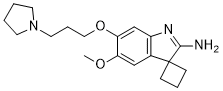
A-366 (A366) is a novel, potent and peptide-competitive inhibitor of the histone methyltransferase G9a with anticancer activity. It inhibits G9a with an IC50 3 nM and > 100-fold selectivity over other methyltransferases and other non-epigenetic targets. A-366 has been shown to inhibit H3K9 methylation in cells with an IC50 of 100 nM and exhibits minimal cellular toxicity compared with previous quinazoline-based probes. A-366 selectively inhibits G9a and the closely related GLP (EHMT1), but not other histone methyltransferases. A-366 has significantly less cytotoxic effects on the growth of tumor cell lines compared to other known G9a/GLP small molecule inhibitors despite equivalent cellular activity on methylation of H3K9me2.
Physicochemical Properties
| Molecular Formula | C19H27N3O2 |
| Molecular Weight | 329.4366 |
| Exact Mass | 329.21 |
| CAS # | 1527503-11-2 |
| PubChem CID | 76285486 |
| Appearance | Light yellow to yellow solid powder |
| LogP | 3.057 |
| Hydrogen Bond Donor Count | 1 |
| Hydrogen Bond Acceptor Count | 4 |
| Rotatable Bond Count | 6 |
| Heavy Atom Count | 24 |
| Complexity | 471 |
| Defined Atom Stereocenter Count | 0 |
| InChi Key | BKCDJTRMYWSXMC-UHFFFAOYSA-N |
| InChi Code | InChI=1S/C19H27N3O2/c1-23-16-12-14-15(21-18(20)19(14)6-4-7-19)13-17(16)24-11-5-10-22-8-2-3-9-22/h12-13H,2-11H2,1H3,(H2,20,21) |
| Chemical Name | 5'-methoxy-6'-(3-(pyrrolidin-1-yl)propoxy)spiro[cyclobutane-1,3'-indol]-2'-amine |
| Synonyms | A 366A-366 A366 |
| HS Tariff Code | 2934.99.9001 |
| Storage |
Powder-20°C 3 years 4°C 2 years In solvent -80°C 6 months -20°C 1 month |
| Shipping Condition | Room temperature (This product is stable at ambient temperature for a few days during ordinary shipping and time spent in Customs) |
Biological Activity
| ln Vitro | A-366 (0.01-10 μM; 14 days) impacts the viability of MV4;11 cells and causes differentiation [4]. In PC-3 prostate cancer cells, A-366 (0.3-3 μM; 72 hours) decreases overall H3K9me2 levels in a concentration- and time-dependent manner, with a cellular EC50 of roughly 300 nM. A-366 (0.01-10 μM; 4 days; HL-60 cells) decreased differentiation and concomitant proliferation in a dose-dependent manner. A-366-treated HL-60 cells' DNA content analysis revealed an increase of G1 phase cells, which is consistent with cell arrest [4]. |
| ln Vivo | Growth suppression occurs when MV4;11 xenografts are treated with A-366 (30 mg/kg; osmotic minipump; once daily for 14 days) [4]. |
| Cell Assay |
Cell Viability Assay [4] Cell Types: MV4; 11 cells Tested Concentrations: 0.01-10 μM Incubation Duration: 14 days Experimental Results: Resulted in inhibition of proliferation and diminished viability, corresponding to the dose response observed by CD11b staining. |
| Animal Protocol |
Animal/Disease Models: 6-8 weeks old SCID beige female mice (MV4; 11 xenografts) [4] Doses: 30 mg/kg Route of Administration: via mini-osmotic pump; one time/day for 14 days Experimental Results: In In the model, A-366 treatment produced a modest 45% tumor growth inhibition. |
| References |
[1]. Epigenetics meets GPCR: inhibition of histone H3 methyltransferase (G9a) and histamine H3 receptor for Prader-Willi Syndrome. Sci Rep. 2020;10(1):13558. Published 2020 Aug 11. [2]. Identification of a small-molecule ligand of the epigenetic reader protein Spindlin1 via a versatile screening platform. Nucleic Acids Res. 2016;44(9):e88. [3]. Discovery and development of potent and selective inhibitors of histone methyltransferase g9a. ACS Med Chem Lett. 2014;5(2):205-209. Published 2014 Jan 2. [4]. The Histone Methyltransferase Inhibitor A-366 Uncovers a Role for G9a/GLP in the Epigenetics of Leukemia. PLoS One. 2015;10(7):e0131716. Published 2015 Jul 6. |
Solubility Data
| Solubility (In Vitro) | DMSO : ~50 mg/mL (~151.77 mM) |
| Solubility (In Vivo) |
Solubility in Formulation 1: ≥ 2.5 mg/mL (7.59 mM) (saturation unknown) in 10% DMSO + 40% PEG300 + 5% Tween80 + 45% Saline (add these co-solvents sequentially from left to right, and one by one), clear solution. For example, if 1 mL of working solution is to be prepared, you can add 100 μL of 25.0 mg/mL clear DMSO stock solution to 400 μL PEG300 and mix evenly; then add 50 μL Tween-80 to the above solution and mix evenly; then add 450 μL normal saline to adjust the volume to 1 mL. Preparation of saline: Dissolve 0.9 g of sodium chloride in 100 mL ddH₂ O to obtain a clear solution. Solubility in Formulation 2: ≥ 2.5 mg/mL (7.59 mM) (saturation unknown) in 10% DMSO + 90% (20% SBE-β-CD in Saline) (add these co-solvents sequentially from left to right, and one by one), clear solution. For example, if 1 mL of working solution is to be prepared, you can add 100 μL of 25.0 mg/mL clear DMSO stock solution to 900 μL of 20% SBE-β-CD physiological saline solution and mix evenly. Preparation of 20% SBE-β-CD in Saline (4°C,1 week): Dissolve 2 g SBE-β-CD in 10 mL saline to obtain a clear solution. (Please use freshly prepared in vivo formulations for optimal results.) |
| Preparing Stock Solutions | 1 mg | 5 mg | 10 mg | |
| 1 mM | 3.0355 mL | 15.1773 mL | 30.3545 mL | |
| 5 mM | 0.6071 mL | 3.0355 mL | 6.0709 mL | |
| 10 mM | 0.3035 mL | 1.5177 mL | 3.0355 mL |