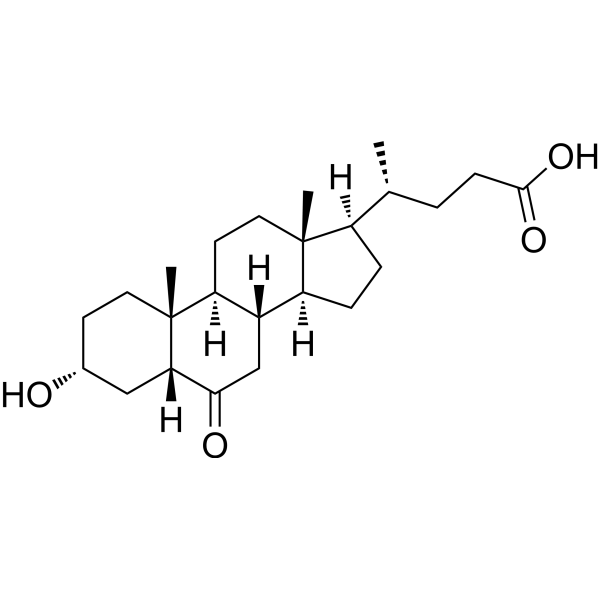
Physicochemical Properties
| Molecular Formula | C24H38O4 |
| Molecular Weight | 390.56 |
| CAS # | 2393-61-5 |
| Appearance | White to off-white solid powder |
| Vapour Pressure | 3.42E-14mmHg at 25°C |
| LogP | 4.686 |
| SMILES | [C@@]12(C(C[C@]3([H])[C@@](CC[C@@]4([C@@]([H])([C@@H](CCC(O)=O)C)CC[C@]43[H])C)([H])[C@]1(CC[C@@H](O)C2)C)=O)[H] |
| Synonyms | 6-Ketolithocholic acid; 2393-61-5; 5?-Cholanic Acid-3?-ol-6-one; 3-ALPHA-HYDROXY-6-KETOCHOLANIC ACID; 5alpha-CHOLANIC ACID-3alpha-OL-6-ONE; 4-(3-hydroxy-10,13-dimethyl-6-oxo-1,2,3,4,5,7,8,9,11,12,14,15,16,17-tetradecahydrocyclopenta[a]phenanthren-17-yl)pentanoic acid; CHEBI:182882; 5-Beta-cholanic acid-3-alpha-ol-6-one; |
| HS Tariff Code | 2934.99.9001 |
| Storage |
Powder-20°C 3 years 4°C 2 years In solvent -80°C 6 months -20°C 1 month |
| Shipping Condition | Room temperature (This product is stable at ambient temperature for a few days during ordinary shipping and time spent in Customs) |
Biological Activity
| Targets | Lithocholic acid metabolite |
| ln Vitro | The hydroxylation of lithocholic acid (3 alpha-hydroxy-5 beta-cholanoic acid) by adult male Sprague-Dawley rat liver microsomes supplemented with NADPH was studied. Metabolites were separated by a combination of thin-layer chromatography and high pressure liquid chromatography, both with and without prior methylation and acetylation of the samples. The resulting products were characterized by thin-layer, gas-liquid, and high pressure liquid chromatography by comparison with authentic bile acid standards; final structure determination was by proton nuclear magnetic resonance spectroscopy and by mass spectrometry. The following reaction products were found: 3 alpha, 6 beta-dihydroxy-5 beta-cholanoic acid (80% of total metabolites) and 3 alpha, 6 alpha-dihydroxy-5 beta-cholanoic, 3 alpha, 7 alpha-dihydroxy-5 beta-cholanoic, 3 alpha, 6 beta,7 beta-trihydroxy-5 beta-cholanoic, and 3 alpha-hydroxy-6-oxo-5 beta-cholanoic acids (less than or equal to 5% each). In addition, one unidentified trihydroxylic bile acid and several minor compounds were present. It is concluded that four different hydroxylation reactions of lithocholic acid, namely the predominant 6 beta as well as the minor 6 alpha, 7 alpha, and 7 beta hydroxylations, are catalyzed by rat hepatic microsomes; 7 beta-hydroxylation may occur only with dihydroxylated bile acids but not with lithocholate itself. The presence of the 6-oxo bile acid can be explained either by direct oxidation of a hydroxyl group by cytochrome P-450, or by the action of microsomal dehydrogenase(s) which could also catalyze the epimerization of hydroxyl groups via their oxidation. The results form the basis of a proposed scheme of the oxidative metabolism of lithocholic acid in rat liver microsomes [1]. |
| References |
[1]. Zimniak P, et al. Detoxification of lithocholic acid. Elucidation of the pathways of oxidative metabolism in rat liver microsomes[J]. Journal of lipid research, 1989, 30(6): 907-918. |
| Additional Infomation | 4-(3-Hydroxy-10,13-dimethyl-6-oxo-1,2,3,4,5,7,8,9,11,12,14,15,16,17-tetradecahydrocyclopenta[a]phenanthren-17-yl)pentanoic acid is a bile acid. |
Solubility Data
| Solubility (In Vitro) | DMSO : ~100 mg/mL (~256.04 mM; with ultrasonication) |
| Solubility (In Vivo) |
Solubility in Formulation 1: ≥ 2.5 mg/mL (6.40 mM) (saturation unknown) in 10% DMSO +40% PEG300 +5% Tween-80 +45% Saline (add these co-solvents sequentially from left to right, and one by one), clear solution。 Preparation of saline: Dissolve 0.9 g of sodium chloride in 100 mL ddH₂ O to obtain a clear solution. Solubility in Formulation 2: ≥ 2.5 mg/mL (6.40 mM) (saturation unknown) in 10% DMSO +90% (20% SBE-β-CD in Saline) (add these co-solvents sequentially from left to right, and one by one), clear solution。 For example, if 1 mL of working solution is to be prepared, You can add 100 μL of the 25.0 mg/mL clear DMSO stock solution to 900 μL of 20% SBE-β-CD in saline and mix well. Preparation of 20% SBE-β-CD in Saline (4°C,1 week): Dissolve 2 g SBE-β-CD in 10 mL saline to obtain a clear solution. Solubility in Formulation 3: ≥ 2.5 mg/mL (6.40 mM) (saturation unknown) in 10% DMSO +90% Corn Oil (add these co-solvents sequentially from left to right, and one by one), clear solution。 For example, if 1 mL of working solution is to be prepared, You can add 100 μL of the 25.0 mg/mL clear DMSO stock solution to 900 μL corn oil and mix well. " (Please use freshly prepared in vivo formulations for optimal results.) |
| Preparing Stock Solutions | 1 mg | 5 mg | 10 mg | |
| 1 mM | 2.5604 mL | 12.8021 mL | 25.6043 mL | |
| 5 mM | 0.5121 mL | 2.5604 mL | 5.1209 mL | |
| 10 mM | 0.2560 mL | 1.2802 mL | 2.5604 mL |