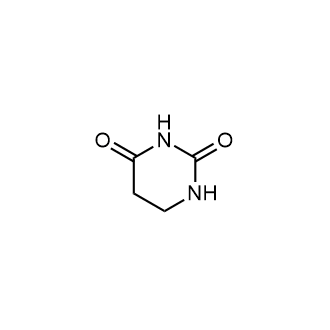
Physicochemical Properties
| Molecular Formula | C4H6N2O2 |
| Molecular Weight | 114.1026 |
| Exact Mass | 114.042 |
| CAS # | 504-07-4 |
| Related CAS # | Dihydrouracil-13C4,15N2;360769-22-8;Dihydrouracil-d4;334473-41-5 |
| PubChem CID | 649 |
| Appearance | Typically exists as white to off-white solids at room temperature |
| Density | 1.6±0.1 g/cm3 |
| Boiling Point | 337.0±25.0 °C at 760 mmHg |
| Melting Point | 279-281 °C(lit.) |
| Flash Point | 208.5±12.4 °C |
| Vapour Pressure | 0.0±1.7 mmHg at 25°C |
| Index of Refraction | 1.649 |
| LogP | -1.83 |
| Hydrogen Bond Donor Count | 2 |
| Hydrogen Bond Acceptor Count | 2 |
| Rotatable Bond Count | 0 |
| Heavy Atom Count | 8 |
| Complexity | 132 |
| Defined Atom Stereocenter Count | 0 |
| SMILES | O=C1C([H])([H])C([H])([H])N([H])C(N1[H])=O |
| InChi Key | OIVLITBTBDPEFK-UHFFFAOYSA-N |
| InChi Code | InChI=1S/C4H6N2O2/c7-3-1-2-5-4(8)6-3/h1-2H2,(H2,5,6,7,8) |
| Chemical Name | 1,3-diazinane-2,4-dione |
| Synonyms | 5,6-Dihydrouracil; dihydrouracil; 5,6-dihydrouracil; 504-07-4; Hydrouracil; DIHYDROPYRIMIDINE-2,4(1H,3H)-DIONE; 5,6-Dihydro-2,4-dihydroxypyrimidine; Dihydrouracile; 2,4(1H,3H)-Pyrimidinedione, dihydro-; |
| HS Tariff Code | 2934.99.9001 |
| Storage |
Powder-20°C 3 years 4°C 2 years In solvent -80°C 6 months -20°C 1 month |
| Shipping Condition | Room temperature (This product is stable at ambient temperature for a few days during ordinary shipping and time spent in Customs) |
Biological Activity
| Targets | Endogenous Metabolite |
| ln Vitro |
5,6-dihydrouracil is a pyrimidine obtained by formal addition of hydrogen across the 5,6-position of uracil. It has a role as a metabolite, a human metabolite, an Escherichia coli metabolite and a mouse metabolite. It is functionally related to a uracil.
Dihydrouracil is a metabolite found in or produced by Escherichia coli (strain K12, MG1655). Dihydrouracil is a natural product found in Daphnia pulex, Arabidopsis thaliana, and other organisms with data available. |
| ln Vivo |
Aims: This study aimed to determine the effect of food intake on uracil and dihydrouracil plasma levels. These levels are a promising marker for dihydropyrimidine dehydrogenase activity and for individualizing fluoropyrimidine anticancer therapy[1]. Methods: A randomized, cross-over study in 16 healthy volunteers was performed, in which subjects were examined in fasted and fed state on two separate days. In fed condition, a high-fat, high-caloric breakfast was consumed between 8:00 h and 8:30 h. Whole blood for determination of uracil, dihydrouracil and uridine plasma levels was drawn on both test days at predefined time points between 8:00 h and 13:00 h. Results: Uracil levels were statistically significantly different between fasting and fed state. At 13:00 h, the mean uracil level in fasting state was 12.6 ± 3.7 ng ml-1 and after a test meal 9.4 ± 2.6 ng ml-1 (P < 0.001). Dihydrouracil levels were influenced by food intake as well (mean dihydrouracil level at 13:00 h in fasting state 147.0 ± 36.4 ng ml-1 and in fed state 85.7 ± 22.1 ng ml-1 , P < 0.001). Uridine plasma levels showed curves with similar patterns as for uracil. Conclusions: It was shown that both uracil and dihydrouracil levels were higher in fasting state than in fed state. This is hypothesized to be an direct effect of uridine plasma levels, which were previously shown to be elevated in fasting state and reduced after intake of food. These findings show that, when assessing plasma uracil and dihydrouracil levels for adaptive fluoropyrimidine dosing in clinical practice, sampling should be done between 8:00 h and 9:00 h after overnight fasting to avoid bias caused by circadian rhythm and food effects. |
| References |
[1]. Food-effect study on uracil and dihydrouracil plasma levels as marker for dihydropyrimidine dehydrogenase activity in human volunteers. Br J Clin Pharmacol. 2018 Dec;84(12):2761-2769. [2]. The impact of liver resection on the dihydrouracil:uracil plasma ratio in patients with colorectal liver metastases. Eur J Clin Pharmacol. 2018 Jun;74(6):737-744. |
| Additional Infomation |
5,6-dihydrouracil is a pyrimidine obtained by formal addition of hydrogen across the 5,6-position of uracil. It has a role as a metabolite, a human metabolite, an Escherichia coli metabolite and a mouse metabolite. It is functionally related to a uracil. Dihydrouracil is a metabolite found in or produced by Escherichia coli (strain K12, MG1655). Dihydrouracil has been reported in Daphnia pulex, Arabidopsis thaliana, and other organisms with data available. |
Solubility Data
| Solubility (In Vitro) |
DMSO : ~14.29 mg/mL (~125.24 mM) H2O : ~10 mg/mL (~87.64 mM) |
| Solubility (In Vivo) |
Solubility in Formulation 1: ≥ 1.43 mg/mL (12.53 mM) (saturation unknown) in 10% DMSO + 40% PEG300 + 5% Tween80 + 45% Saline (add these co-solvents sequentially from left to right, and one by one), clear solution. For example, if 1 mL of working solution is to be prepared, you can add 100 μL of 14.3 mg/mL clear DMSO stock solution to 400 μL PEG300 and mix evenly; then add 50 μL Tween-80 to the above solution and mix evenly; then add 450 μL normal saline to adjust the volume to 1 mL. Preparation of saline: Dissolve 0.9 g of sodium chloride in 100 mL ddH₂ O to obtain a clear solution. Solubility in Formulation 2: ≥ 1.43 mg/mL (12.53 mM) (saturation unknown) in 10% DMSO + 90% (20% SBE-β-CD in Saline) (add these co-solvents sequentially from left to right, and one by one), clear solution. For example, if 1 mL of working solution is to be prepared, you can add 100 μL of 14.3 mg/mL clear DMSO stock solution to 900 μL of 20% SBE-β-CD physiological saline solution and mix evenly. Preparation of 20% SBE-β-CD in Saline (4°C,1 week): Dissolve 2 g SBE-β-CD in 10 mL saline to obtain a clear solution. Solubility in Formulation 3: ≥ 1.43 mg/mL (12.53 mM) (saturation unknown) in 10% DMSO + 90% Corn Oil (add these co-solvents sequentially from left to right, and one by one), clear solution. For example, if 1 mL of working solution is to be prepared, you can add 100 μL of 14.3 mg/mL clear DMSO stock solution to 900 μL of corn oil and mix evenly. (Please use freshly prepared in vivo formulations for optimal results.) |
| Preparing Stock Solutions | 1 mg | 5 mg | 10 mg | |
| 1 mM | 8.7642 mL | 43.8212 mL | 87.6424 mL | |
| 5 mM | 1.7528 mL | 8.7642 mL | 17.5285 mL | |
| 10 mM | 0.8764 mL | 4.3821 mL | 8.7642 mL |