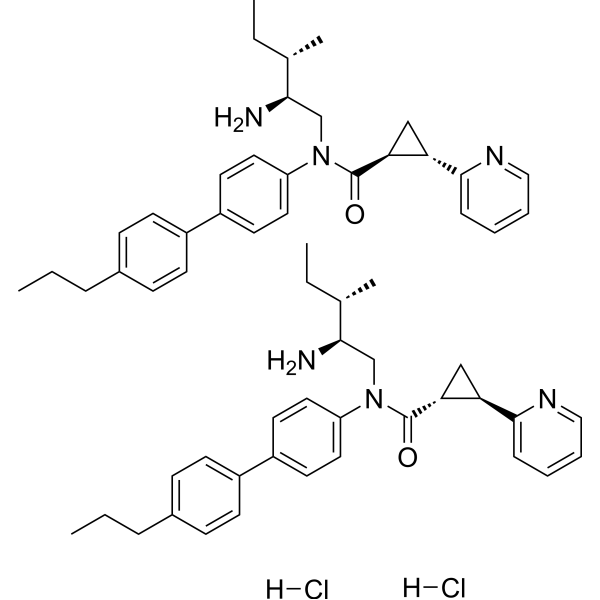
Physicochemical Properties
| Molecular Formula | C30H38CLN3O |
| Molecular Weight | 492.10 |
| Related CAS # | (1R,2R)-2-PCCA hydrochloride;1609563-71-4 |
| Appearance | White to light yellow solid powder |
| HS Tariff Code | 2934.99.9001 |
| Storage |
Powder-20°C 3 years 4°C 2 years In solvent -80°C 6 months -20°C 1 month Note: Please store this product in a sealed and protected environment, avoid exposure to moisture. |
| Shipping Condition | Room temperature (This product is stable at ambient temperature for a few days during ordinary shipping and time spent in Customs) |
Biological Activity
| Targets | EC50: 116 nM (GPR88 receptor, HEK293 cells)[1] |
| ln Vitro | 2-PCCA hydrochloride, with an EC50 of 116 nM in HEK293 cells that stably express the human GPR88 receptor and the GloSensor-22F cAMP construct, inhibits GPR88-mediated cAMP generation via a Gαi-coupled pathway[2]. |
| ln Vivo | 2-PCCA (0.1-3.2 mg/kg, ip) reduces rat locomotor activity in a way that is dose-dependent. 2-PCCA also dose-dependently lessens methamphetamine-induced hyperactivity when paired with 1.0 mg/kg methamphetamine. 2-When tested in combination, PCCA (1-3.2 mg/kg, ip) neither produces nor modifies the discriminative stimulus effects of methamphetamine that are similar to those of methamphetamine[1]. |
| References |
[1]. The GPR88 receptor agonist 2-PCCA does not alter the behavioral effects of methamphetamine in rats. Eur J Pharmacol. 2013 Jan 5;698(1-3):272-7. [2]. Effect of Substitution on the Aniline Moiety of the GPR88 Agonist 2-PCCA: Synthesis, Structure-Activity Relationships, and Molecular Modeling Studies. ACS Chem Neurosci. 2016 Oct 19;7(10):1418-1432. |
Solubility Data
| Solubility (In Vitro) |
DMSO :~100 mg/mL (~203.21 mM) H2O :~20 mg/mL (~40.64 mM) |
| Solubility (In Vivo) |
Solubility in Formulation 1: ≥ 2.5 mg/mL (5.08 mM) (saturation unknown) in 10% DMSO + 40% PEG300 + 5% Tween80 + 45% Saline (add these co-solvents sequentially from left to right, and one by one), clear solution. For example, if 1 mL of working solution is to be prepared, you can add 100 μL of 25.0 mg/mL clear DMSO stock solution to 400 μL PEG300 and mix evenly; then add 50 μL Tween-80 to the above solution and mix evenly; then add 450 μL normal saline to adjust the volume to 1 mL. Preparation of saline: Dissolve 0.9 g of sodium chloride in 100 mL ddH₂ O to obtain a clear solution. Solubility in Formulation 2: ≥ 2.5 mg/mL (5.08 mM) (saturation unknown) in 10% DMSO + 90% (20% SBE-β-CD in Saline) (add these co-solvents sequentially from left to right, and one by one), clear solution. For example, if 1 mL of working solution is to be prepared, you can add 100 μL of 25.0 mg/mL clear DMSO stock solution to 900 μL of 20% SBE-β-CD physiological saline solution and mix evenly. Preparation of 20% SBE-β-CD in Saline (4°C,1 week): Dissolve 2 g SBE-β-CD in 10 mL saline to obtain a clear solution. Solubility in Formulation 3: ≥ 2.5 mg/mL (5.08 mM) (saturation unknown) in 10% DMSO + 90% Corn Oil (add these co-solvents sequentially from left to right, and one by one), clear solution. For example, if 1 mL of working solution is to be prepared, you can add 100 μL of 25.0 mg/mL clear DMSO stock solution to 900 μL of corn oil and mix evenly. (Please use freshly prepared in vivo formulations for optimal results.) |
| Preparing Stock Solutions | 1 mg | 5 mg | 10 mg | |
| 1 mM | 2.0321 mL | 10.1605 mL | 20.3211 mL | |
| 5 mM | 0.4064 mL | 2.0321 mL | 4.0642 mL | |
| 10 mM | 0.2032 mL | 1.0161 mL | 2.0321 mL |