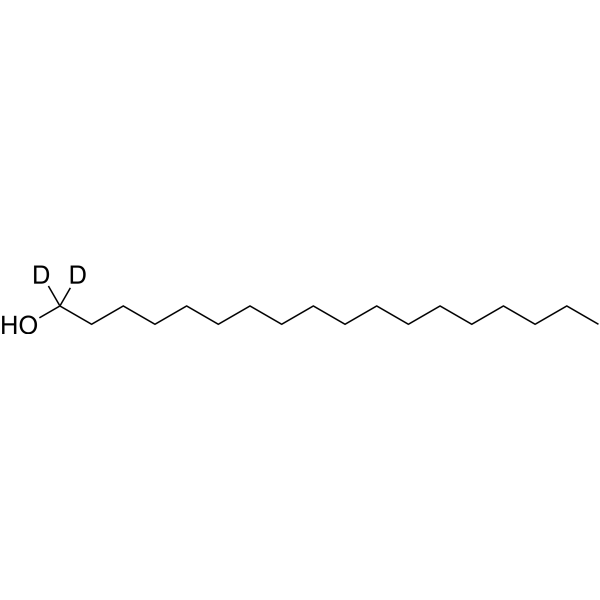
Physicochemical Properties
| Molecular Formula | C18H36D2O |
| Molecular Weight | 272.51 |
| Exact Mass | 272.305 |
| CAS # | 86369-69-9 |
| Related CAS # | 1-Hydroxyoctadecane;112-92-5 |
| PubChem CID | 8221 |
| Appearance |
Leaflets from ethanol Unctuous white flakes or granules |
| Melting Point |
59.5 °C Heat of fusion at melting point = 7.4057X10+7 J/kmol (for the gamma phase, no selection of the alpha phase, crystal I can be made). 59.5 °C 59.8 °C |
| LogP | 6.24 |
| Hydrogen Bond Donor Count | 1 |
| Hydrogen Bond Acceptor Count | 1 |
| Rotatable Bond Count | 16 |
| Heavy Atom Count | 19 |
| Complexity | 145 |
| Defined Atom Stereocenter Count | 0 |
| SMILES | CCCCCCCCCCCCCCCCCCO |
| InChi Key | GLDOVTGHNKAZLK-UHFFFAOYSA-N |
| InChi Code | InChI=1S/C18H38O/c1-2-3-4-5-6-7-8-9-10-11-12-13-14-15-16-17-18-19/h19H,2-18H2,1H3 |
| Chemical Name | octadecan-1-ol |
| HS Tariff Code | 2934.99.9001 |
| Storage |
Powder-20°C 3 years 4°C 2 years In solvent -80°C 6 months -20°C 1 month |
| Shipping Condition | Room temperature (This product is stable at ambient temperature for a few days during ordinary shipping and time spent in Customs) |
Biological Activity
| ln Vitro | Drug compounds have included stable heavy isotopes of carbon, hydrogen, and other elements, mostly as quantitative tracers while the drugs were being developed. Because deuteration may have an effect on a drug's pharmacokinetics and metabolic properties, it is a cause for concern [1]. |
| ADME/Pharmacokinetics |
Absorption, Distribution and Excretion Stearyl alcohol is found naturally in various mammalian tissues ... Results from several studies indicate that stearyl alcohol is poorly absorbed from the gastrointestinal tract. Several studies indicate that /1-octadecanol/ is poorly absorbed from the gastrointestinal tract. The entry of 14C-octadecanol into the thoracic lymph duct of the Sprague-Dawley rat was reported. Lymph flows and blood were monitored for radioactivity in different intervals following dosing. Intestinal radioactivity was determined in the intestinal homogenate which showed the percent absorbed radioactivity in the lymph was 56.6 +/- 14.0. Of this, more than half was found in the triglycerides of the lymph, 6 to 13 % in the phospholipids, 2 to 8% as the cholesterol esters, and 4 to 10% unchanged octadecanol. 90% of octadecanol was found in the lipomicrom fraction of the blood. The absorption of the compound appeared to be a function of its lipid solubility. Metabolism / Metabolites Stearyl alcohol ... is used in the biosynthesis of lipids and other naturally occurring cellular constituents and enters metabolic pathways for energy production. This fatty alcohol is readily converted to stearic acid, another common constituent of mammalian tissue. From the absorbed fraction more than half was metabolized to triglycerides, 6-13% to phospholipids, 2- 8% to cholesterol esters, and 4-10% remained as unchanged octadecanol after 24h period, from dosing. |
| Toxicity/Toxicokinetics |
Non-Human Toxicity Values LD50 Rat oral >5000 - 8000 mg/kg LD50 Rabbit dermal >3 g/kg LD50 Rat oral 20 g/kg |
| References |
[1]. Impact of Deuterium Substitution on the Pharmacokinetics of Pharmaceuticals. Ann Pharmacother. 2019 Feb;53(2):211-216. |
| Additional Infomation |
Octadecan-1-ol is a long-chain primary fatty alcohol consisting of a hydroxy function at C-1 of an unbranched saturated chain of 18 carbon atoms. It has a role as a plant metabolite, a human metabolite and an algal metabolite. It is a long-chain primary fatty alcohol and an octadecanol. Stearyl alcohol has been reported in Camellia sinensis, Apis, and other organisms with data available. See also: Alcohols, C18-32 (annotation moved to). Mechanism of Action ... Ethanol, 1-propanol, 1-butanol, 1-pentanol and 1-octanol had essentially the same effects on the mitochondrial ultrastructure: a mixed population of small and enlarged mitochondria with poorly developed cristae; 1-dodecanol induced ultrastructural changes of mitochondria of two distinct types: a mixed population of small and enlarged mitochondria with poorly developed cristae in some hepatocytes and remarkably enlarged mitochondria with well-developed cristate in others; and 1-octadecanol induced remarkably enlarged mitochondria in all hepatocytes. ... The reactivity of the fatty alcohols with cetrimide decreased with increasing chain length although branching on the tetradecanol and hexadecanol resulted in a higher reactivity. Adding 1-octadecanol to 1-hexadecanol resulted in an increased reactivity rising to a maximum for mixtures containing 20-40% w/w 1-octadecanol. ... Peak inhibition was recorded with saturated primary alcohols (64 microM) varying in chain length from 16 to 19 carbon atoms. The unsaturated alcohols (oleyl, linoleyl, and linolenyl) and the secondary alcohol (pentadecan-2-ol) were considerably less effective growth inhibitors. Stearic and palmitic acids were also ineffective. After incubation of stationary phase Leishmania donovani with [1-14C]octadecanol, about 70% of the precursor was taken up within 3 hr. Wax esters and acyl moieties of glycerolipids contained most of the 14C-activity from 3 to 6 hr, because octadecanol was partly oxidized to stearate. Ether moieties were only weakly labeled. After 40 hr, 1-0-alkyl and 1-0-alk-1'-enyl diacylglycerols as well as 1-0-alkyl and 1-0-alk-1'-enyl-2-acyl-sn-glycero-3-phosphoethanolamines contained nearly all of the radioactivity. Most of the label in the neutral ether lipids was located in the alkyl ether side chain, whereas, in the phosphatidylethanolamine fraction, most of the label was found in the alkenyl ether side chain. |
Solubility Data
| Solubility (In Vitro) | May dissolve in DMSO (in most cases), if not, try other solvents such as H2O, Ethanol, or DMF with a minute amount of products to avoid loss of samples |
| Solubility (In Vivo) |
Note: Listed below are some common formulations that may be used to formulate products with low water solubility (e.g. < 1 mg/mL), you may test these formulations using a minute amount of products to avoid loss of samples. Injection Formulations (e.g. IP/IV/IM/SC) Injection Formulation 1: DMSO : Tween 80: Saline = 10 : 5 : 85 (i.e. 100 μL DMSO stock solution → 50 μL Tween 80 → 850 μL Saline) *Preparation of saline: Dissolve 0.9 g of sodium chloride in 100 mL ddH ₂ O to obtain a clear solution. Injection Formulation 2: DMSO : PEG300 :Tween 80 : Saline = 10 : 40 : 5 : 45 (i.e. 100 μL DMSO → 400 μLPEG300 → 50 μL Tween 80 → 450 μL Saline) Injection Formulation 3: DMSO : Corn oil = 10 : 90 (i.e. 100 μL DMSO → 900 μL Corn oil) Example: Take the Injection Formulation 3 (DMSO : Corn oil = 10 : 90) as an example, if 1 mL of 2.5 mg/mL working solution is to be prepared, you can take 100 μL 25 mg/mL DMSO stock solution and add to 900 μL corn oil, mix well to obtain a clear or suspension solution (2.5 mg/mL, ready for use in animals). Injection Formulation 4: DMSO : 20% SBE-β-CD in saline = 10 : 90 [i.e. 100 μL DMSO → 900 μL (20% SBE-β-CD in saline)] *Preparation of 20% SBE-β-CD in Saline (4°C,1 week): Dissolve 2 g SBE-β-CD in 10 mL saline to obtain a clear solution. Injection Formulation 5: 2-Hydroxypropyl-β-cyclodextrin : Saline = 50 : 50 (i.e. 500 μL 2-Hydroxypropyl-β-cyclodextrin → 500 μL Saline) Injection Formulation 6: DMSO : PEG300 : castor oil : Saline = 5 : 10 : 20 : 65 (i.e. 50 μL DMSO → 100 μLPEG300 → 200 μL castor oil → 650 μL Saline) Injection Formulation 7: Ethanol : Cremophor : Saline = 10: 10 : 80 (i.e. 100 μL Ethanol → 100 μL Cremophor → 800 μL Saline) Injection Formulation 8: Dissolve in Cremophor/Ethanol (50 : 50), then diluted by Saline Injection Formulation 9: EtOH : Corn oil = 10 : 90 (i.e. 100 μL EtOH → 900 μL Corn oil) Injection Formulation 10: EtOH : PEG300:Tween 80 : Saline = 10 : 40 : 5 : 45 (i.e. 100 μL EtOH → 400 μLPEG300 → 50 μL Tween 80 → 450 μL Saline) Oral Formulations Oral Formulation 1: Suspend in 0.5% CMC Na (carboxymethylcellulose sodium) Oral Formulation 2: Suspend in 0.5% Carboxymethyl cellulose Example: Take the Oral Formulation 1 (Suspend in 0.5% CMC Na) as an example, if 100 mL of 2.5 mg/mL working solution is to be prepared, you can first prepare 0.5% CMC Na solution by measuring 0.5 g CMC Na and dissolve it in 100 mL ddH2O to obtain a clear solution; then add 250 mg of the product to 100 mL 0.5% CMC Na solution, to make the suspension solution (2.5 mg/mL, ready for use in animals). Oral Formulation 3: Dissolved in PEG400 Oral Formulation 4: Suspend in 0.2% Carboxymethyl cellulose Oral Formulation 5: Dissolve in 0.25% Tween 80 and 0.5% Carboxymethyl cellulose Oral Formulation 6: Mixing with food powders Note: Please be aware that the above formulations are for reference only. InvivoChem strongly recommends customers to read literature methods/protocols carefully before determining which formulation you should use for in vivo studies, as different compounds have different solubility properties and have to be formulated differently. (Please use freshly prepared in vivo formulations for optimal results.) |
| Preparing Stock Solutions | 1 mg | 5 mg | 10 mg | |
| 1 mM | 3.6696 mL | 18.3480 mL | 36.6959 mL | |
| 5 mM | 0.7339 mL | 3.6696 mL | 7.3392 mL | |
| 10 mM | 0.3670 mL | 1.8348 mL | 3.6696 mL |