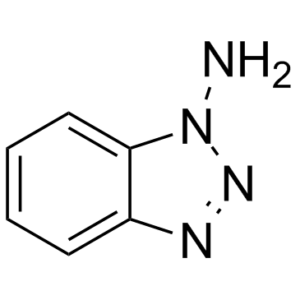
1-Aminobenzotriazole (also known as ABT; 3-Aminobenzotriazole) has been used widely as a nonselective in vitro and in vivo inhibitor of cytochrome P450 enzymes. To date, however, it has not been evaluated as an inhibitor of UDP-glucuronosyltransferase (UGT), sulfotransferase (SULT), and N-acetyltransferase (NAT). ABT was shown not to inhibit UGT and SULT activity (acetaminophen and 7-hydroxycoumarin as substrates) in rat liver microsomes and rat liver 9000 g supernatant fraction (RLS9), respectively. However, it did inhibit the RLS9-catalyzed N-acetylation of procainamide (IC(50) ∼ 30 μM), and no preincubation time dependence was evident. In agreement, oral ABT (100 mg/kg, 2 h predose) decreased the clearance of intravenous procainamide (45%) in rats, accompanied by a decreased N-acetylprocainamide-to-procainamide ratio in urine (0.74 versus 0.21) and plasma (area under the curve ratio 0.59 versus 0.11). Additional studies with human forms of NAT (hNAT1 and hNAT2) revealed that ABT is a more potent inhibitor of hNAT2 compared with hNAT1 (IC(50) 158 μM versus > 1 mM). Consistent with the IC(50) estimate, formal inhibition studies revealed that inhibition of hNAT2 was competitive with an inhibition constant of 67 μM. In accordance with the competitive inhibition, ABT was shown to undergo N-acetylation in the presence of both human NAT forms, with hNAT1 exhibiting less activity under the same assay conditions (∼40% of hNAT2). In summary, the results described herein indicate that ABT is a substrate and inhibitor of NAT. Such an interaction should be considered when using ABT as a nonselective inhibitor of P450, especially when NAT-dependent metabolism is also involved.
Physicochemical Properties
| Molecular Formula | C6H6N4 |
| Molecular Weight | 134.1386 |
| Exact Mass | 134.059 |
| CAS # | 1614-12-6 |
| PubChem CID | 1367 |
| Appearance | White to light yellow solid powder |
| Density | 1.5±0.1 g/cm3 |
| Boiling Point | 319.3±25.0 °C at 760 mmHg |
| Melting Point | 81-84 °C(lit.) |
| Flash Point | 146.9±23.2 °C |
| Vapour Pressure | 0.0±0.7 mmHg at 25°C |
| Index of Refraction | 1.774 |
| LogP | 0.75 |
| Hydrogen Bond Donor Count | 1 |
| Hydrogen Bond Acceptor Count | 3 |
| Rotatable Bond Count | 0 |
| Heavy Atom Count | 10 |
| Complexity | 127 |
| Defined Atom Stereocenter Count | 0 |
| InChi Key | JCXKHYLLVKZPKE-UHFFFAOYSA-N |
| InChi Code | InChI=1S/C6H6N4/c7-10-6-4-2-1-3-5(6)8-9-10/h1-4H,7H2 |
| Chemical Name | benzotriazol-1-amine |
| Synonyms | 1-Aminobenzotriazole; ABT; 3-Aminobenzotriazole |
| HS Tariff Code | 2934.99.9001 |
| Storage |
Powder-20°C 3 years 4°C 2 years In solvent -80°C 6 months -20°C 1 month |
| Shipping Condition | Room temperature (This product is stable at ambient temperature for a few days during ordinary shipping and time spent in Customs) |
Biological Activity
| ln Vitro | 1-Aminobenzotriazole (ABT) alone considerably raised the CYP2B6 expression levels in two distinct hepatocytes (by 7.3 and 10.8 fold, respectively). The induction of CYP2B6 expression by CITCO or rifampicin was improved 12.6-fold and 4.0-fold for CITCO and 3.9-fold and 2.5-fold for rifampicin following co-treatment with 1-aminobenzotriazole. 1-Aminobenzotriazole has a more stimulating impact on CITCO than rifampicin does. 1. In two distinct hepatocytes, aminobenzotriazole alone elevated the expression levels of CYP3A4 by 2.0 and 3.8 times, respectively. The effect of CITCO on CYP3A4 expression levels was increased by 3.8 and 6.0 times after co-treatment with 1-aminobenzotriazole, respectively, in comparison to cells treated with CITCO alone [1]. When compared to a clear 1-aminobenzotriazole control, 1-aminobenzotriazole (ABT) (1 mM) demonstrated a significant (~95%) improvement in the production of N-CPU-based procainamide[2]. |
| ln Vivo | Wall 1-aminobenzotriazole (ABT) (100 mg/kg, 2 hours before laboratory) decreases the rate of intravenous procainamide clearance (45%), but N-aminobenzotriazole waste Reduced area under the curve ratio of 0.59 compared to 0.11 and decreased ratio of inamide to procainamide (0.74 vs. 0.21). The recovery of N-benzoprocainamide in stealing dropped from 13.3% to 6.5%, whereas the residual recovery of procainamide increased from 18% to 30% when 1-aminobenzotriazole was used [2]. Gastric emptying was markedly delayed by a pretreatment of 100 mg/kg oral 1-aminobenzotriazole (ABT), given two hours prior to a semi-solid caloric test meal. 1-Aminobenzotriazole also doubles the amount of space in the stomach [3]. |
| References |
[1]. Induction of CYP2B6 and CYP3A4 expression by 1-aminobenzotriazole (ABT) in human hepatocytes. Drug Metab Lett. 2010 Aug;4(3):129-33. [2]. 1-Aminobenzotriazole, a known cytochrome P450 inhibitor, is a substrate and inhibitor of N-acetyltransferase. Drug Metab Dispos. 2011 Sep;39(9):1674-9. [3]. 1-Aminobenzotriazole modulates oral drug pharmacokinetics through cytochrome P450 inhibition and delay of gastric emptying in rats. Drug Metab Dispos. 2014 Jul;42(7):1117-24. |
Solubility Data
| Solubility (In Vitro) |
DMSO : ~100 mg/mL (~745.49 mM) H2O : ~50 mg/mL (~372.74 mM) |
| Solubility (In Vivo) |
Solubility in Formulation 1: ≥ 2.08 mg/mL (15.51 mM) (saturation unknown) in 10% DMSO + 40% PEG300 + 5% Tween80 + 45% Saline (add these co-solvents sequentially from left to right, and one by one), clear solution. For example, if 1 mL of working solution is to be prepared, you can add 100 μL of 20.8 mg/mL clear DMSO stock solution to 400 μL PEG300 and mix evenly; then add 50 μL Tween-80 to the above solution and mix evenly; then add 450 μL normal saline to adjust the volume to 1 mL. Preparation of saline: Dissolve 0.9 g of sodium chloride in 100 mL ddH₂ O to obtain a clear solution. Solubility in Formulation 2: ≥ 2.08 mg/mL (15.51 mM) (saturation unknown) in 10% DMSO + 90% (20% SBE-β-CD in Saline) (add these co-solvents sequentially from left to right, and one by one), clear solution. For example, if 1 mL of working solution is to be prepared, you can add 100 μL of 20.8 mg/mL clear DMSO stock solution to 900 μL of 20% SBE-β-CD physiological saline solution and mix evenly. Preparation of 20% SBE-β-CD in Saline (4°C,1 week): Dissolve 2 g SBE-β-CD in 10 mL saline to obtain a clear solution. Solubility in Formulation 3: ≥ 2.08 mg/mL (15.51 mM) (saturation unknown) in 10% DMSO + 90% Corn Oil (add these co-solvents sequentially from left to right, and one by one), clear solution. For example, if 1 mL of working solution is to be prepared, you can add 100 μL of 20.8 mg/mL clear DMSO stock solution to 900 μL of corn oil and mix evenly. Solubility in Formulation 4: 25 mg/mL (186.37 mM) in PBS (add these co-solvents sequentially from left to right, and one by one), clear solution; with ultrasonication (<60°C). (Please use freshly prepared in vivo formulations for optimal results.) |
| Preparing Stock Solutions | 1 mg | 5 mg | 10 mg | |
| 1 mM | 7.4549 mL | 37.2745 mL | 74.5490 mL | |
| 5 mM | 1.4910 mL | 7.4549 mL | 14.9098 mL | |
| 10 mM | 0.7455 mL | 3.7274 mL | 7.4549 mL |