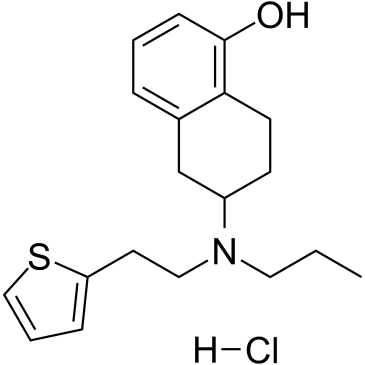
rac-Rotigotine Hydrochloride is the racemic mixture of Rotigotine (N-0437; N-0923), which is a potent, non-selective and dopamine receptor full agonist, used in the treatment of Parkinson's disease and restless legs syndrome. Rotigotine s an agonist of the dopamine D2 and D3 receptors, with corresponding Ki values of 13 and 0.71 nM for D2 and D3. Rotagotine also shows a high affinity for 5-HT1A and adrenergic α2B receptors.
Physicochemical Properties
| Molecular Formula | C19H26CLNOS |
| Molecular Weight | 351.93 |
| Exact Mass | 351.142 |
| CAS # | 102120-99-0 |
| Related CAS # | (Rac)-Rotigotine-d3 hydrochloride; 1215846-20-0; (Rac)-Rotigotine; 92206-54-7; (Rac)-Rotigotine-d7 hydrochloride |
| PubChem CID | 6917969 |
| Appearance | Solid powder |
| LogP | 5.067 |
| Hydrogen Bond Donor Count | 2 |
| Hydrogen Bond Acceptor Count | 3 |
| Rotatable Bond Count | 6 |
| Heavy Atom Count | 23 |
| Complexity | 337 |
| Defined Atom Stereocenter Count | 0 |
| InChi Key | CEXBONHIOKGWNU-UHFFFAOYSA-N |
| InChi Code | InChI=1S/C19H25NOS.ClH/c1-2-11-20(12-10-17-6-4-13-22-17)16-8-9-18-15(14-16)5-3-7-19(18)21;/h3-7,13,16,21H,2,8-12,14H2,1H3;1H |
| Chemical Name | 6-[propyl(2-thiophen-2-ylethyl)amino]-5,6,7,8-tetrahydronaphthalen-1-ol;hydrochloride |
| Synonyms | N 0923; N-0923; N-0924 Rotigotine Hydrochloride; Rotigotine HCl Neupro |
| HS Tariff Code | 2934.99.9001 |
| Storage |
Powder-20°C 3 years 4°C 2 years In solvent -80°C 6 months -20°C 1 month Note: Please store this product in a sealed and protected environment, avoid exposure to moisture. |
| Shipping Condition | Room temperature (This product is stable at ambient temperature for a few days during ordinary shipping and time spent in Customs) |
Biological Activity
| Targets | D3 Receptor ( Ki = 0.71 nM ); D2 Receptor ( Ki = 13.5 nM ); D4 Receptor ( Ki = 3.9-15 nM ); D5 Receptor ( Ki = 5.4 nM ); D1 Receptor ( Ki = 83 nM nM ); 5-HT1A Receptor ( Ki = 30 nM ); 5-HT2B Receptor ( Ki = 27 nM ); Alpha-2B adrenergic receptor | ||
| ln Vitro |
|
||
| ln Vivo |
|
||
| Enzyme Assay | In 96-well polypropylene tubes, binding assays are carried out with a final volume of 2 mL for D1 and D4 membranes and 1 mL for D2, D3, and D5 membranes. These tubes contain the following materials: 50 μL radioligand, 10 μL drug/buffer/non-specific binding, buffer (final concentration 50 mM Tris-HCl pH 7.4, MgCl2 2 mM), and membranes (5 μg protein for D2 and D3 and 25 μg protein for D1 and D5). Rapid vacuum filtration through A/C glass fiber filters presoaked in 0.1% polyethylenimine is used to determine bound radioligand after 120 minutes of incubation at 25°C. Liquid scintillation counting is used to determine the retained radioactivity after the filters are four times cleaned with 2 mL of ice-cold ishing buffer (Tris-HCl 50 mM, pH 7.4 at 4°C). | ||
| Animal Protocol |
|
||
| References |
[1]. Rotigotine is a potent agonist at dopamine D1 receptors as well as at dopamine D2 and D3 receptors. Br J Pharmacol. 2015 Feb;172(4):1124-35. [2]. The in vitro receptor profile of rotigotine: a new agent for the treatment of Parkinson's disease. Naunyn Schmiedebergs Arch Pharmacol. 2009 Jan;379(1):73-86. [3]. In vivo dopamine agonist properties of rotigotine: Role of D1 and D2 receptors. Eur J Pharmacol. 2016 Oct 5;788:183-91. [4]. Neuroprotective effect of rotigotine against complex I inhibitors, MPP+ and rotenone, in primary mesencephalic cell culture. Folia Neuropathol. 2014;52(2):179-86. |
Solubility Data
| Solubility (In Vitro) |
DMSO: ≥ 50 mg/mL (~142.1 mM) H2O: < 0.1 mg/mL |
| Solubility (In Vivo) |
Solubility in Formulation 1: ≥ 2.5 mg/mL (7.10 mM) (saturation unknown) in 10% DMSO + 40% PEG300 + 5% Tween80 + 45% Saline (add these co-solvents sequentially from left to right, and one by one), clear solution. For example, if 1 mL of working solution is to be prepared, you can add 100 μL of 25.0 mg/mL clear DMSO stock solution to 400 μL PEG300 and mix evenly; then add 50 μL Tween-80 to the above solution and mix evenly; then add 450 μL normal saline to adjust the volume to 1 mL. Preparation of saline: Dissolve 0.9 g of sodium chloride in 100 mL ddH₂ O to obtain a clear solution. Solubility in Formulation 2: ≥ 2.5 mg/mL (7.10 mM) (saturation unknown) in 10% DMSO + 90% (20% SBE-β-CD in Saline) (add these co-solvents sequentially from left to right, and one by one), clear solution. For example, if 1 mL of working solution is to be prepared, you can add 100 μL of 25.0 mg/mL clear DMSO stock solution to 900 μL of 20% SBE-β-CD physiological saline solution and mix evenly. Preparation of 20% SBE-β-CD in Saline (4°C,1 week): Dissolve 2 g SBE-β-CD in 10 mL saline to obtain a clear solution. Solubility in Formulation 3: ≥ 2.5 mg/mL (7.10 mM) (saturation unknown) in 10% DMSO + 90% Corn Oil (add these co-solvents sequentially from left to right, and one by one), clear solution. For example, if 1 mL of working solution is to be prepared, you can add 100 μL of 25.0 mg/mL clear DMSO stock solution to 900 μL of corn oil and mix evenly. (Please use freshly prepared in vivo formulations for optimal results.) |
| Preparing Stock Solutions | 1 mg | 5 mg | 10 mg | |
| 1 mM | 2.8415 mL | 14.2074 mL | 28.4147 mL | |
| 5 mM | 0.5683 mL | 2.8415 mL | 5.6829 mL | |
| 10 mM | 0.2841 mL | 1.4207 mL | 2.8415 mL |