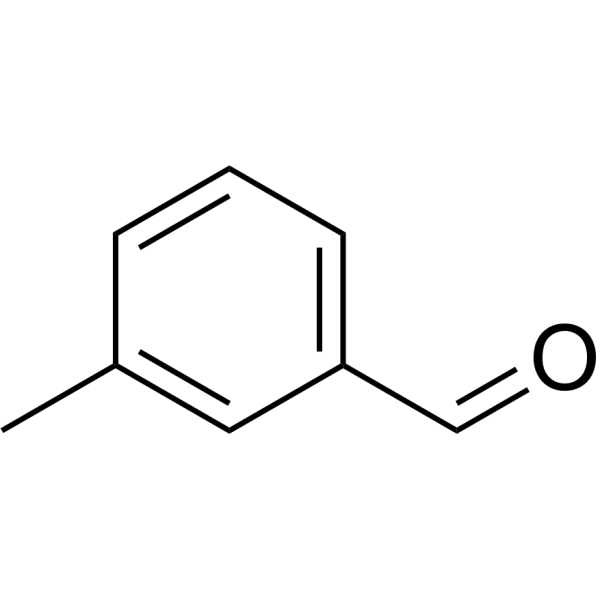
Physicochemical Properties
| Molecular Formula | C₈H₈O |
| Molecular Weight | 120.15 |
| Exact Mass | 120.057 |
| CAS # | 620-23-5 |
| PubChem CID | 12105 |
| Appearance | Colorless to light yellow liquid |
| Density | 1.0±0.1 g/cm3 |
| Boiling Point | 199.0±0.0 °C at 760 mmHg |
| Melting Point | < 25 °C |
| Flash Point | 78.3±0.0 °C |
| Vapour Pressure | 0.3±0.3 mmHg at 25°C |
| Index of Refraction | 1.558 |
| LogP | 2.1 |
| Hydrogen Bond Donor Count | 0 |
| Hydrogen Bond Acceptor Count | 1 |
| Rotatable Bond Count | 1 |
| Heavy Atom Count | 9 |
| Complexity | 98.7 |
| Defined Atom Stereocenter Count | 0 |
| SMILES | O=C([H])C1=C([H])C([H])=C([H])C(C([H])([H])[H])=C1[H] |
| InChi Key | OVWYEQOVUDKZNU-UHFFFAOYSA-N |
| InChi Code | InChI=1S/C8H8O/c1-7-3-2-4-8(5-7)6-9/h2-6H,1H3 |
| Chemical Name | 3-methylbenzaldehyde |
| Synonyms | mTolualdehyde; m Tolualdehyde |
| HS Tariff Code | 2934.99.9001 |
| Storage |
Powder-20°C 3 years 4°C 2 years In solvent -80°C 6 months -20°C 1 month Note: Please store this product in a sealed and protected environment (e.g. under nitrogen), avoid exposure to moisture. |
| Shipping Condition | Room temperature (This product is stable at ambient temperature for a few days during ordinary shipping and time spent in Customs) |
Biological Activity
| ADME/Pharmacokinetics |
Metabolism / Metabolites ... m-Xylene (m-XYL) has been shown to alter cytochrome P-450 (CYP) activity in an organ- and isozyme-specific manner. The purpose of this work was to determine if the metabolism of m-XYL to the inhibitory metabolite m-tolualdehyde (m-ALD) is the cause of inhibition of CYP isozymes following in vivo inhalation exposure to m-XYL (100, 300 ppm), 3-methylbenzyl alcohol (3-MBA) (50, 100 ppm), or m-ALD (50, 100 ppm). A single 6-hr inhalation exposure of rats to m-XYL inhibited pulmonary CYPs 2B1, 2E1, and 4B1 in a dose-dependent manner. Inhalation of 3-MBA inhibited pulmonary CYPs 2B1 and 4B1 in a dose-dependent manner. m-ALD inhibited pulmonary CYPs 2B1 and 2E1 in a dose-dependent manner, while 4B1 activity was increased dose dependently. Nasal mucosa CYP 2B1 and 2E1 activity was inhibited following exposure to m-XYL dose dependently, 3-MBA inhibited nasal mucosa CYPs 2E1 and 4B1 dose dependently. CYPs 2B1, 2E1, and 4B1 were inhibited in a dose-dependent fashion following inhalation of m-ALD. Following high-performance liquid chromatography (HPLC) analysis, m-ALD was detected after in vivo exposure to m-XYL, m-ALD, and 3-MBA in a dose-dependent manner, with highest m-ALD levels in the nasal mucosa and lung. Alteration of cytochrome P-450 activity by m-XYL could result in increased or decreased toxicity, changing the metabolic profiles of xenobiotics in coexposure scenarios in an organ-specific manner. p-Tolualdehyde was oxidized to p-toluic acid by resting cells of pseudomonas aeruginosa. Perillaldehyde dehydrogenase, isolated from soil pseudomonad, catalyzed the oxidn of m- & p-tolualdehyde but not o-tolualdehyde. Aldehydes are readily oxidized to organic acids. Oxidation of aldehydes is catalyzed by aldehyde dehydrogenase, which has been found in the brain, erythrocytes, liver, kidney, heart, and placenta. /Aldehydes/ |
| References |
[1]. Production method and varietal source influence the volatile profiles of spirits prepared from fig fruits (Ficus carica L.). European Food Research and Technology volume 244, pages2213–2229(2018). [2]. Food Protective Effects of 3-Methylbenzaldehyde Derived from Myosotis arvensis and Its Analogues against Tyrophagus putrescentiae. Sci Rep. 2017 Jul 26;7(1):6608. |
| Additional Infomation |
M-tolualdehyde is a tolualdehyde compound with the methyl substituent at the 3-position. It has a role as a plant metabolite. 3-Methylbenzaldehyde has been reported in Aloe africana, Cichorium endivia, and other organisms with data available. |
Solubility Data
| Solubility (In Vitro) | DMSO : ~100 mg/mL (~832.29 mM) |
| Solubility (In Vivo) |
Solubility in Formulation 1: ≥ 2.5 mg/mL (20.81 mM) (saturation unknown) in 10% DMSO + 40% PEG300 + 5% Tween80 + 45% Saline (add these co-solvents sequentially from left to right, and one by one), clear solution. For example, if 1 mL of working solution is to be prepared, you can add 100 μL of 25.0 mg/mL clear DMSO stock solution to 400 μL PEG300 and mix evenly; then add 50 μL Tween-80 to the above solution and mix evenly; then add 450 μL normal saline to adjust the volume to 1 mL. Preparation of saline: Dissolve 0.9 g of sodium chloride in 100 mL ddH₂ O to obtain a clear solution. Solubility in Formulation 2: ≥ 2.5 mg/mL (20.81 mM) (saturation unknown) in 10% DMSO + 90% (20% SBE-β-CD in Saline) (add these co-solvents sequentially from left to right, and one by one), clear solution. For example, if 1 mL of working solution is to be prepared, you can add 100 μL of 25.0 mg/mL clear DMSO stock solution to 900 μL of 20% SBE-β-CD physiological saline solution and mix evenly. Preparation of 20% SBE-β-CD in Saline (4°C,1 week): Dissolve 2 g SBE-β-CD in 10 mL saline to obtain a clear solution. Solubility in Formulation 3: ≥ 2.5 mg/mL (20.81 mM) (saturation unknown) in 10% DMSO + 90% Corn Oil (add these co-solvents sequentially from left to right, and one by one), clear solution. For example, if 1 mL of working solution is to be prepared, you can add 100 μL of 25.0 mg/mL clear DMSO stock solution to 900 μL of corn oil and mix evenly. (Please use freshly prepared in vivo formulations for optimal results.) |
| Preparing Stock Solutions | 1 mg | 5 mg | 10 mg | |
| 1 mM | 8.3229 mL | 41.6146 mL | 83.2293 mL | |
| 5 mM | 1.6646 mL | 8.3229 mL | 16.6459 mL | |
| 10 mM | 0.8323 mL | 4.1615 mL | 8.3229 mL |