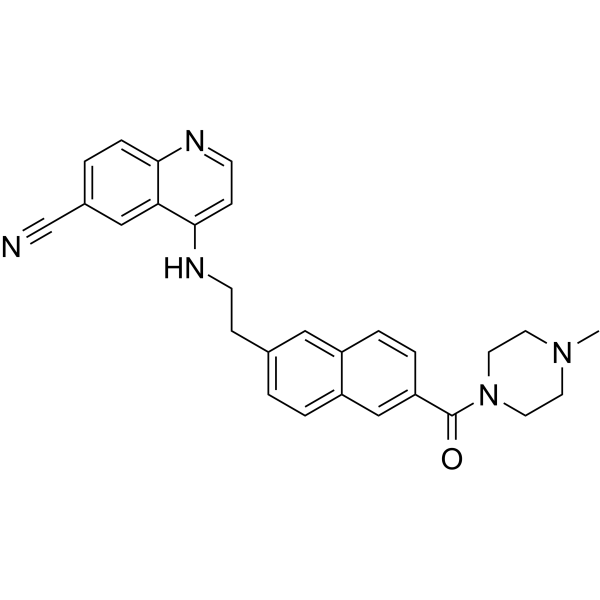
Physicochemical Properties
| Molecular Formula | C28H27N5O |
| Molecular Weight | 449.546885728836 |
| Exact Mass | 449.221 |
| CAS # | 2375554-02-0 |
| PubChem CID | 146403432 |
| Appearance | Off-white to light yellow solid powder |
| LogP | 4.4 |
| Hydrogen Bond Donor Count | 1 |
| Hydrogen Bond Acceptor Count | 5 |
| Rotatable Bond Count | 5 |
| Heavy Atom Count | 34 |
| Complexity | 740 |
| Defined Atom Stereocenter Count | 0 |
| SMILES | N(C1=CC=NC2C=CC(C#N)=CC1=2)CCC1C=CC2C=C(C(N3CCN(C)CC3)=O)C=CC=2C=1 |
| InChi Key | AFUHWZUYZJGVKM-UHFFFAOYSA-N |
| InChi Code | InChI=1S/C28H27N5O/c1-32-12-14-33(15-13-32)28(34)24-6-5-22-16-20(2-4-23(22)18-24)8-10-30-27-9-11-31-26-7-3-21(19-29)17-25(26)27/h2-7,9,11,16-18H,8,10,12-15H2,1H3,(H,30,31) |
| Chemical Name | 4-[2-[6-(4-methylpiperazine-1-carbonyl)naphthalen-2-yl]ethylamino]quinoline-6-carbonitrile |
| HS Tariff Code | 2934.99.9001 |
| Storage |
Powder-20°C 3 years 4°C 2 years In solvent -80°C 6 months -20°C 1 month |
| Shipping Condition | Room temperature (This product is stable at ambient temperature for a few days during ordinary shipping and time spent in Customs) |
Biological Activity
| ln Vitro | Senexin C (compound 20a) has strong and highly specific CDK8/19 inhibitory action (IC50 of 108 nM for MV4-11-Luc cells and 56 nM for 293-NFκB-Luc cells, respectively) [1]. In various kinase tests, sensexin C (2 µM) demonstrates potency (IC50 = 3.6 nM for CD8/CycC, Kd = 1.4 nM for CD8/CycC, Kd = 2.9 nM for CDK19/CycC) [1]. Senexin C (1 µM, 3 hours) inhibits the expression of cellular genes that are dependent on CDK8/19 [1]. |
| ln Vivo | Senexin C exhibits good oral bioavailability at doses of 100 mg/kg orally and 2.5 mg/kg intravenously [1]. Senexin C (40 mg/kg; oral; twice daily for 4 weeks) is well-tolerated and inhibits the growth of MV4-11 AML in the systemic form [1]. Senexin C pharmacokinetic parameters in female Balb/c mice aged eight weeks [1]. Parameter IV (2.5 mg/kg) po (100 mg/kg) Plasma Tumor Plasma Tumor C0 (μg/mL) 503 Kel (h-1) 0.93 0.06 0.2 0.1 T1/2 (h) 0.75 12.1 3.53 7.27 Tmax (h) 0.58 12 12 Cmax (ng/mL or ng/g) 488 144 5728 AUC0-24 h (ng xh/ml or ng xh/g) 331 6408 2182 88,600 F% 16.5% 34.6% Eight-week-old female Balb/c mice (CT26 tumor model); 2.5 mg/kg intravenously (10 mg/mL Senexin C solution in 5% glucose); 100 mg/kg orally (10 mg/mL Senexin C solution in 30% propylene glycol/ 70% PEG-400 carrier) [1]. |
| Cell Assay |
RT-PCR[1] Cell Types: 293 cells Tested Concentrations: 1 µM Incubation Duration: 3 hrs (hours) Experimental Results: Shows inhibition of CDK8/19-dependent cellular gene expression. |
| Animal Protocol |
Animal/Disease Models: Eightweeks old female balb/c (Bagg ALBino) mouse (CT26 tumor model) [1] Doses: 2.5 mg/kg (10 mL/kg 2.5 mg/mL Senexin C solution in 5% glucose), 100 mg/kg ( 10 mL/kg 10 mg/mL Senexin C solution in 30% propylene glycol/70% PEG-400 vehicle) Dosing: 2.5 mg/kg IV; 100 mg/kg PO Experimental Results: Demonstrated good oral biologic Utilization. Animal/Disease Models: 8weeks old female NSG mice (AML model) [1] Doses: 40 mg/kg Route of Administration: po; twice a day for 4 weeks Experimental Results: Inhibited the systemic growth of MV4-11 AML, with good tolerance. |
| References |
[1]. A Selective and Orally Bioavailable Quinoline-6-Carbonitrile-Based Inhibitor of CDK8/19 Mediator Kinase with Tumor-Enriched Pharmacokinetics. J Med Chem. 2022; 65(4):3420-3433. |
Solubility Data
| Solubility (In Vitro) | May dissolve in DMSO (in most cases), if not, try other solvents such as H2O, Ethanol, or DMF with a minute amount of products to avoid loss of samples |
| Solubility (In Vivo) |
Note: Listed below are some common formulations that may be used to formulate products with low water solubility (e.g. < 1 mg/mL), you may test these formulations using a minute amount of products to avoid loss of samples. Injection Formulations (e.g. IP/IV/IM/SC) Injection Formulation 1: DMSO : Tween 80: Saline = 10 : 5 : 85 (i.e. 100 μL DMSO stock solution → 50 μL Tween 80 → 850 μL Saline) *Preparation of saline: Dissolve 0.9 g of sodium chloride in 100 mL ddH ₂ O to obtain a clear solution. Injection Formulation 2: DMSO : PEG300 :Tween 80 : Saline = 10 : 40 : 5 : 45 (i.e. 100 μL DMSO → 400 μLPEG300 → 50 μL Tween 80 → 450 μL Saline) Injection Formulation 3: DMSO : Corn oil = 10 : 90 (i.e. 100 μL DMSO → 900 μL Corn oil) Example: Take the Injection Formulation 3 (DMSO : Corn oil = 10 : 90) as an example, if 1 mL of 2.5 mg/mL working solution is to be prepared, you can take 100 μL 25 mg/mL DMSO stock solution and add to 900 μL corn oil, mix well to obtain a clear or suspension solution (2.5 mg/mL, ready for use in animals). Injection Formulation 4: DMSO : 20% SBE-β-CD in saline = 10 : 90 [i.e. 100 μL DMSO → 900 μL (20% SBE-β-CD in saline)] *Preparation of 20% SBE-β-CD in Saline (4°C,1 week): Dissolve 2 g SBE-β-CD in 10 mL saline to obtain a clear solution. Injection Formulation 5: 2-Hydroxypropyl-β-cyclodextrin : Saline = 50 : 50 (i.e. 500 μL 2-Hydroxypropyl-β-cyclodextrin → 500 μL Saline) Injection Formulation 6: DMSO : PEG300 : castor oil : Saline = 5 : 10 : 20 : 65 (i.e. 50 μL DMSO → 100 μLPEG300 → 200 μL castor oil → 650 μL Saline) Injection Formulation 7: Ethanol : Cremophor : Saline = 10: 10 : 80 (i.e. 100 μL Ethanol → 100 μL Cremophor → 800 μL Saline) Injection Formulation 8: Dissolve in Cremophor/Ethanol (50 : 50), then diluted by Saline Injection Formulation 9: EtOH : Corn oil = 10 : 90 (i.e. 100 μL EtOH → 900 μL Corn oil) Injection Formulation 10: EtOH : PEG300:Tween 80 : Saline = 10 : 40 : 5 : 45 (i.e. 100 μL EtOH → 400 μLPEG300 → 50 μL Tween 80 → 450 μL Saline) Oral Formulations Oral Formulation 1: Suspend in 0.5% CMC Na (carboxymethylcellulose sodium) Oral Formulation 2: Suspend in 0.5% Carboxymethyl cellulose Example: Take the Oral Formulation 1 (Suspend in 0.5% CMC Na) as an example, if 100 mL of 2.5 mg/mL working solution is to be prepared, you can first prepare 0.5% CMC Na solution by measuring 0.5 g CMC Na and dissolve it in 100 mL ddH2O to obtain a clear solution; then add 250 mg of the product to 100 mL 0.5% CMC Na solution, to make the suspension solution (2.5 mg/mL, ready for use in animals). Oral Formulation 3: Dissolved in PEG400 Oral Formulation 4: Suspend in 0.2% Carboxymethyl cellulose Oral Formulation 5: Dissolve in 0.25% Tween 80 and 0.5% Carboxymethyl cellulose Oral Formulation 6: Mixing with food powders Note: Please be aware that the above formulations are for reference only. InvivoChem strongly recommends customers to read literature methods/protocols carefully before determining which formulation you should use for in vivo studies, as different compounds have different solubility properties and have to be formulated differently. (Please use freshly prepared in vivo formulations for optimal results.) |
| Preparing Stock Solutions | 1 mg | 5 mg | 10 mg | |
| 1 mM | 2.2244 mL | 11.1222 mL | 22.2445 mL | |
| 5 mM | 0.4449 mL | 2.2244 mL | 4.4489 mL | |
| 10 mM | 0.2224 mL | 1.1122 mL | 2.2244 mL |