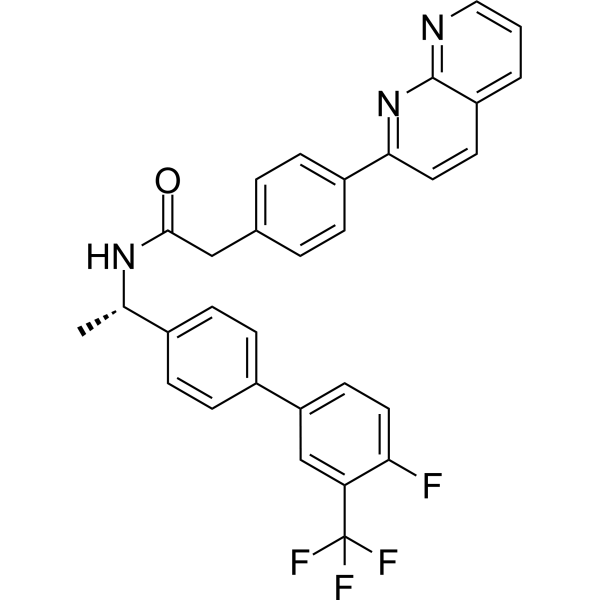
Physicochemical Properties
| Molecular Formula | C31H23F4N3O |
| Molecular Weight | 529.527441263199 |
| Exact Mass | 529.177 |
| CAS # | 1314796-00-3 |
| PubChem CID | 53358775 |
| Appearance | White to off-white solid powder |
| LogP | 6.8 |
| Hydrogen Bond Donor Count | 1 |
| Hydrogen Bond Acceptor Count | 7 |
| Rotatable Bond Count | 6 |
| Heavy Atom Count | 39 |
| Complexity | 793 |
| Defined Atom Stereocenter Count | 1 |
| SMILES | FC1C=CC(=CC=1C(F)(F)F)C1C=CC(=CC=1)[C@H](C)NC(CC1C=CC(C2C=CC3=CC=CN=C3N=2)=CC=1)=O |
| InChi Key | SSQLYMLUWZAJTK-IBGZPJMESA-N |
| InChi Code | InChI=1S/C31H23F4N3O/c1-19(21-8-10-22(11-9-21)25-12-14-27(32)26(18-25)31(33,34)35)37-29(39)17-20-4-6-23(7-5-20)28-15-13-24-3-2-16-36-30(24)38-28/h2-16,18-19H,17H2,1H3,(H,37,39)/t19-/m0/s1 |
| Chemical Name | N-[(1S)-1-[4-[4-fluoro-3-(trifluoromethyl)phenyl]phenyl]ethyl]-2-[4-(1,8-naphthyridin-2-yl)phenyl]acetamide |
| HS Tariff Code | 2934.99.9001 |
| Storage |
Powder-20°C 3 years 4°C 2 years In solvent -80°C 6 months -20°C 1 month |
| Shipping Condition | Room temperature (This product is stable at ambient temperature for a few days during ordinary shipping and time spent in Customs) |
Biological Activity
| Targets |
hGPR91 antagonist 1 is an antagonist of the human G protein-coupled receptor 91 (hGPR91) with an IC50 of 0.8 µM (measured in a CHO-K1 stable cell line overexpressing hGPR91, monitoring succinate-induced intracellular Ca²⁺ increase). It also shows activity against the Bradykinin B1 Receptor (BK1R) with an IC50 of 2.5 µM. [1] |
| ln Vitro |
In a high-throughput screening (HTS) assay using a hGPR91 overexpressed CHO-K1 stable cell line, hGPR91 antagonist 1 completely inhibited the succinate-induced increase in intracellular Ca²⁺ pool with an IC50 of 0.8 µM. [1] |
| ln Vivo | Compound 4c, the HGPR91 antagonist 1, demonstrated 99% rat plasma protein binding and produced ΔMAP inhibition of 59% and 76% at 2 and 4 hours. In vivo, HGPR91 antagonist 1 attaches itself to the target. HGPR91 antagonist 1 has an RLM clearance (CL) of 0.2 nmol/min/mg [1]. |
| Cell Assay | The antagonist activity of hGPR91 antagonist 1 was identified from a high-throughput screen of an internal compound collection. The screening assay utilized a CHO-K1 cell line stably overexpressing human GPR91 (hGPR91). Cells were presumably loaded with a calcium-sensitive fluorescent dye. The assay measured the inhibition of intracellular calcium ([Ca²⁺]i) increase induced by the endogenous ligand, succinate. [1] |
| Animal Protocol |
Animal/Disease Models: Wistar rat[1] Doses: 100 mg/kg Route of Administration: intraperitoneal (ip) injection; 2 hrs (hrs (hours)) and 4 hrs (hrs (hours)) Experimental Results: ΔMAP inhibition was caused by 59% and 76% at 2 hrs (hrs (hours)) and 4 hrs (hrs (hours)). |
| References |
[1]. Discovery of a potent and selective small molecule hGPR91 antagonist. Bioorg Med Chem Lett. 2011 Jun 15;21(12):3596-602. |
| Additional Infomation |
hGPR91 antagonist 1 (structure shown in Fig. 1 of the paper) served as the high-throughput screening (HTS) hit for the discovery program aimed at identifying potent and selective hGPR91 antagonists. [1] It was originally synthesized and evaluated as a Bradykinin B1 Receptor (BK1R) inhibitor within Merck. [1] Systematic structure-activity relationship (SAR) studies starting from this hit led to the discovery of significantly more potent and selective hGPR91 antagonists (e.g., compounds 2c, 4c, 5g, 7e). [1] GPR91 is a Gq/Gi-coupled receptor activated by succinate, a Krebs cycle intermediate. Antagonists of GPR91 are postulated to have potential therapeutic utility in conditions such as renal hypertension, diabetic nephropathy, autoimmune diseases, and retinal angiogenesis. [1] |
Solubility Data
| Solubility (In Vitro) | DMSO : ≥ 125 mg/mL (~236.06 mM) |
| Solubility (In Vivo) |
Note: Listed below are some common formulations that may be used to formulate products with low water solubility (e.g. < 1 mg/mL), you may test these formulations using a minute amount of products to avoid loss of samples. Injection Formulations (e.g. IP/IV/IM/SC) Injection Formulation 1: DMSO : Tween 80: Saline = 10 : 5 : 85 (i.e. 100 μL DMSO stock solution → 50 μL Tween 80 → 850 μL Saline) *Preparation of saline: Dissolve 0.9 g of sodium chloride in 100 mL ddH ₂ O to obtain a clear solution. Injection Formulation 2: DMSO : PEG300 :Tween 80 : Saline = 10 : 40 : 5 : 45 (i.e. 100 μL DMSO → 400 μLPEG300 → 50 μL Tween 80 → 450 μL Saline) Injection Formulation 3: DMSO : Corn oil = 10 : 90 (i.e. 100 μL DMSO → 900 μL Corn oil) Example: Take the Injection Formulation 3 (DMSO : Corn oil = 10 : 90) as an example, if 1 mL of 2.5 mg/mL working solution is to be prepared, you can take 100 μL 25 mg/mL DMSO stock solution and add to 900 μL corn oil, mix well to obtain a clear or suspension solution (2.5 mg/mL, ready for use in animals). Injection Formulation 4: DMSO : 20% SBE-β-CD in saline = 10 : 90 [i.e. 100 μL DMSO → 900 μL (20% SBE-β-CD in saline)] *Preparation of 20% SBE-β-CD in Saline (4°C,1 week): Dissolve 2 g SBE-β-CD in 10 mL saline to obtain a clear solution. Injection Formulation 5: 2-Hydroxypropyl-β-cyclodextrin : Saline = 50 : 50 (i.e. 500 μL 2-Hydroxypropyl-β-cyclodextrin → 500 μL Saline) Injection Formulation 6: DMSO : PEG300 : castor oil : Saline = 5 : 10 : 20 : 65 (i.e. 50 μL DMSO → 100 μLPEG300 → 200 μL castor oil → 650 μL Saline) Injection Formulation 7: Ethanol : Cremophor : Saline = 10: 10 : 80 (i.e. 100 μL Ethanol → 100 μL Cremophor → 800 μL Saline) Injection Formulation 8: Dissolve in Cremophor/Ethanol (50 : 50), then diluted by Saline Injection Formulation 9: EtOH : Corn oil = 10 : 90 (i.e. 100 μL EtOH → 900 μL Corn oil) Injection Formulation 10: EtOH : PEG300:Tween 80 : Saline = 10 : 40 : 5 : 45 (i.e. 100 μL EtOH → 400 μLPEG300 → 50 μL Tween 80 → 450 μL Saline) Oral Formulations Oral Formulation 1: Suspend in 0.5% CMC Na (carboxymethylcellulose sodium) Oral Formulation 2: Suspend in 0.5% Carboxymethyl cellulose Example: Take the Oral Formulation 1 (Suspend in 0.5% CMC Na) as an example, if 100 mL of 2.5 mg/mL working solution is to be prepared, you can first prepare 0.5% CMC Na solution by measuring 0.5 g CMC Na and dissolve it in 100 mL ddH2O to obtain a clear solution; then add 250 mg of the product to 100 mL 0.5% CMC Na solution, to make the suspension solution (2.5 mg/mL, ready for use in animals). Oral Formulation 3: Dissolved in PEG400 Oral Formulation 4: Suspend in 0.2% Carboxymethyl cellulose Oral Formulation 5: Dissolve in 0.25% Tween 80 and 0.5% Carboxymethyl cellulose Oral Formulation 6: Mixing with food powders Note: Please be aware that the above formulations are for reference only. InvivoChem strongly recommends customers to read literature methods/protocols carefully before determining which formulation you should use for in vivo studies, as different compounds have different solubility properties and have to be formulated differently. (Please use freshly prepared in vivo formulations for optimal results.) |
| Preparing Stock Solutions | 1 mg | 5 mg | 10 mg | |
| 1 mM | 1.8885 mL | 9.4423 mL | 18.8847 mL | |
| 5 mM | 0.3777 mL | 1.8885 mL | 3.7769 mL | |
| 10 mM | 0.1888 mL | 0.9442 mL | 1.8885 mL |