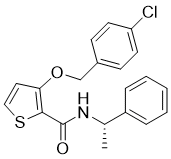
Physicochemical Properties
| Molecular Formula | C20H18CLNO2S |
| Molecular Weight | 371.879 |
| Exact Mass | 371.075 |
| CAS # | 1203680-76-5 |
| PubChem CID | 44473434 |
| Appearance | White to off-white solid powder |
| LogP | 6.046 |
| Hydrogen Bond Donor Count | 1 |
| Hydrogen Bond Acceptor Count | 3 |
| Rotatable Bond Count | 6 |
| Heavy Atom Count | 25 |
| Complexity | 422 |
| Defined Atom Stereocenter Count | 1 |
| SMILES | C[C@@H](C1=CC=CC=C1)NC(=O)C2=C(C=CS2)OCC3=CC=C(C=C3)Cl |
| InChi Key | RFZPGNRLOKVZJY-AWEZNQCLSA-N |
| InChi Code | InChI=1S/C20H18ClNO2S/c1-14(16-5-3-2-4-6-16)22-20(23)19-18(11-12-25-19)24-13-15-7-9-17(21)10-8-15/h2-12,14H,13H2,1H3,(H,22,23)/t14-/m0/s1 |
| Chemical Name | 3-[(4-chlorophenyl)methoxy]-N-[(1S)-1-phenylethyl]thiophene-2-carboxamide |
| Synonyms | AS1949490 AS 1949490 AS-1949490 |
| HS Tariff Code | 2934.99.9001 |
| Storage |
Powder-20°C 3 years 4°C 2 years In solvent -80°C 6 months -20°C 1 month |
| Shipping Condition | Room temperature (This product is stable at ambient temperature for a few days during ordinary shipping and time spent in Customs) |
Biological Activity
| ln Vitro | Insulin-induced Akt phosphorylation in L6 myotubes is increased by AS1949490 (0-16 μM; 15 minutes) [1]. In L6 myotubes, AS1949490 (0-10 μM; 48) induces stress and promotes trophic activity [1]. AS1949490 (0-0.10 μM; 24-hour; L6 myotubes) inhibits the gluconeogenic process triggered by insulin [1]. In L6 myotubes, AS1949490 (10 μM; 48 hours) upregulates the GLUT1 gene to initiate oxygen switching [2]. |
| ln Vivo | The intracellular insulin signaling pathway is activated and the risk of diabetes in the diabetic retina is decreased by AS1949490 (300 mg/kg; Pathway; twice daily for 7 or 10 days) [1]. AS1949490 (300 mg/kg; 8-hour single dose). |
| Cell Assay |
Western Blot Analysis [1] Cell Types: L6 Myotubes Tested Concentrations: 0, 4, 8 and 16 μM; ]. 1 nM (insulin) Incubation Duration: 15 minutes Experimental Results: Insulin-induced Akt phosphorylation increases in a dose-dependent manner. Western Blot Analysis[2] Cell Types: L6 myotubes Tested Concentrations: 10 µM Incubation Duration: 48 hrs (hours) Experimental Results: GLUT1 mRNA expression was increased in L6 myotubes, but GLUT4 mRNA expression was not. |
| Animal Protocol |
Animal/Disease Models: Male C57BL/KsJ Jcl-dbm mice and db/+db mice [1]. Doses: 300 mg/kg. Route of Administration: oral; ; formulated ICR s) Inhibit gluconeogenesis and the expression of related genes [1]. twice (two times) daily for 7 or 10 days Experimental Results: Decrease in plasma glucose (23% relative to vehicle). Reduction in fasting blood glucose (37% relative to vehicle) and area under the blood glucose concentration-time curve (AUC). Increases GSK3β phosphorylation in the liver without changing overall GSK3β protein levels. Animal/Disease Models: Male ICR mice (6 weeks old) [1] Doses: 300 mg/kg Route of Administration: po (po (oral gavage)) once for 8 hrs (hrs (hours)). Experimental Results: PEPCK and G6Pase mRNA levels were diminished by approximately 50%. |
| References |
[1]. Discovery and functional characterization of a novel small molecule inhibitor of the intracellular phosphatase, SHIP2. Br J Pharmacol. 2009 Oct;158(3):879-87. [2]. Glucose metabolism activation by SHIP2 inhibitors via up-regulation of GLUT1 gene in L6 myotubes. Eur J Pharmacol. 2010 Sep 10;642(1-3):177-82. |
Solubility Data
| Solubility (In Vitro) | DMSO : ~50 mg/mL (~134.45 mM) |
| Solubility (In Vivo) |
Solubility in Formulation 1: ≥ 2.08 mg/mL (5.59 mM) (saturation unknown) in 10% DMSO + 40% PEG300 +5% Tween-80 + 45% Saline (add these co-solvents sequentially from left to right, and one by one), clear solution. For example, if 1 mL of working solution is to be prepared, you can add 100 μL of 20.8 mg/mL clear DMSO stock solution to 400 μL PEG300 and mix evenly; then add 50 μL Tween-80 + to the above solution and mix evenly; then add 450 μL normal saline to adjust the volume to 1 mL. Preparation of saline: Dissolve 0.9 g of sodium chloride in 100 mL ddH₂ O to obtain a clear solution. (Please use freshly prepared in vivo formulations for optimal results.) |
| Preparing Stock Solutions | 1 mg | 5 mg | 10 mg | |
| 1 mM | 2.6890 mL | 13.4452 mL | 26.8904 mL | |
| 5 mM | 0.5378 mL | 2.6890 mL | 5.3781 mL | |
| 10 mM | 0.2689 mL | 1.3445 mL | 2.6890 mL |