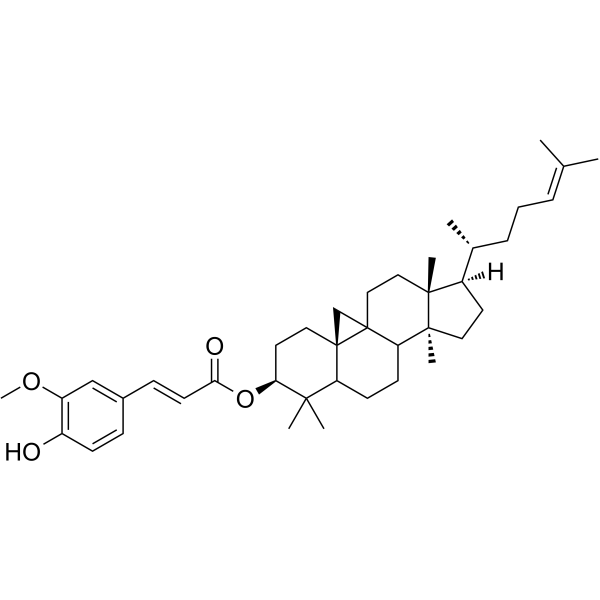
Physicochemical Properties
| Molecular Formula | C40H58O4 |
| Molecular Weight | 602.8861 |
| Exact Mass | 602.433 |
| CAS # | 11042-64-1 |
| PubChem CID | 5282164 |
| Appearance | White to off-white solid powder |
| Density | 1.1±0.1 g/cm3 |
| Boiling Point | 663.2±40.0 °C at 760 mmHg |
| Melting Point | 135-137°C |
| Flash Point | 193.8±20.8 °C |
| Vapour Pressure | 0.0±2.1 mmHg at 25°C |
| Index of Refraction | 1.570 |
| LogP | 12.85 |
| Hydrogen Bond Donor Count | 1 |
| Hydrogen Bond Acceptor Count | 4 |
| Rotatable Bond Count | 9 |
| Heavy Atom Count | 44 |
| Complexity | 1150 |
| Defined Atom Stereocenter Count | 9 |
| SMILES | C[C@H](CCC=C(C)C)[C@H]1CC[C@@]2([C@@]1(CC[C@]34[C@H]2CC[C@@H]5[C@]3(C4)CC[C@@H](C5(C)C)OC(=O)/C=C/C6=CC(=C(C=C6)O)OC)C)C |
| InChi Key | FODTZLFLDFKIQH-FSVGXZBPSA-N |
| InChi Code | InChI=1S/C40H58O4/c1-26(2)10-9-11-27(3)29-18-20-38(7)33-16-15-32-36(4,5)34(19-21-39(32)25-40(33,39)23-22-37(29,38)6)44-35(42)17-13-28-12-14-30(41)31(24-28)43-8/h10,12-14,17,24,27,29,32-34,41H,9,11,15-16,18-23,25H2,1-8H3/b17-13+/t27-,29-,32+,33+,34+,37-,38+,39-,40+/m1/s1 |
| Chemical Name | [(1S,3R,6S,8R,11S,12S,15R,16R)-7,7,12,16-tetramethyl-15-[(2R)-6-methylhept-5-en-2-yl]-6-pentacyclo[9.7.0.01,3.03,8.012,16]octadecanyl] (E)-3-(4-hydroxy-3-methoxyphenyl)prop-2-enoate |
| HS Tariff Code | 2934.99.9001 |
| Storage |
Powder-20°C 3 years 4°C 2 years In solvent -80°C 6 months -20°C 1 month |
| Shipping Condition | Room temperature (This product is stable at ambient temperature for a few days during ordinary shipping and time spent in Customs) |
Biological Activity
| ln Vitro | γ-Oryzanol suppresses DNMT1 (IC50=3.2 μM), DNMT 3a (IC50=22.3 μM), and DNMT 3b (highest inhibition rate: 57%). Conversely, ferulic acid, γ-oryzanol's metabolite, has substantially less inhibitory activity than γ-oryzanol. Moreover, ERRγ primarily functions as a positive regulator of DNMT1 synthesis, which lowers the activity of DNMT1, and γ-Oryzanol can function as a partial antagonist of ERRγ [1]. |
| ln Vivo | By lowering hypothalamic endoplasmic reticulum (ER) stress, brown rice's special bioactive ingredient, γ-oryzanol—a blend of ferulate and several phytosterols—attenuates demand for dietary fat. γ-oryzanol has the ability to ameliorate HFD-induced DNA hypermethylation in the mouse striatum's D2R promoter region. A striatal-specific regulation of DNMT levels may be attributed to γ-oryzanol. ERRγ activity is partially reduced by γ-oryzanol (around 40% reduction in inherent value). Gamma-oryzanol given orally by gavage to male mice considerably reduced their liking for HFD (93% of the value in mice treated with a vehicle), which in turn led to a significantly reduced rate of weight gain [1]. |
| References |
[1]. Impact of brown rice-specific γ-oryzanol on epigenetic modulation of dopamine D2 receptors in brain striatum in high-fat-diet-induced obesity in mice. Diabetologia. 2017 Aug;60(8):1502-1511. |
| Additional Infomation |
Gamma-Oryzanol (TN) is a triterpenoid. gamma-Oryzanol has been reported in Oryza sativa, Ophiocordyceps sinensis, and other organisms with data available. |
Solubility Data
| Solubility (In Vitro) | DMSO : ~62.5 mg/mL (~103.67 mM) |
| Solubility (In Vivo) |
Solubility in Formulation 1: ≥ 2.08 mg/mL (3.45 mM) (saturation unknown) in 10% DMSO + 40% PEG300 + 5% Tween80 + 45% Saline (add these co-solvents sequentially from left to right, and one by one), clear solution. For example, if 1 mL of working solution is to be prepared, you can add 100 μL of 20.8 mg/mL clear DMSO stock solution to 400 μL PEG300 and mix evenly; then add 50 μL Tween-80 to the above solution and mix evenly; then add 450 μL normal saline to adjust the volume to 1 mL. Preparation of saline: Dissolve 0.9 g of sodium chloride in 100 mL ddH₂ O to obtain a clear solution. Solubility in Formulation 2: 2.08 mg/mL (3.45 mM) in 10% DMSO + 90% (20% SBE-β-CD in Saline) (add these co-solvents sequentially from left to right, and one by one), suspension solution; with heating and sonication. For example, if 1 mL of working solution is to be prepared, you can add 100 μL of 20.8 mg/mL clear DMSO stock solution to 900 μL of 20% SBE-β-CD physiological saline solution and mix evenly. Preparation of 20% SBE-β-CD in Saline (4°C,1 week): Dissolve 2 g SBE-β-CD in 10 mL saline to obtain a clear solution. Solubility in Formulation 3: ≥ 2.08 mg/mL (3.45 mM) (saturation unknown) in 10% DMSO + 90% Corn Oil (add these co-solvents sequentially from left to right, and one by one), clear solution. For example, if 1 mL of working solution is to be prepared, you can add 100 μL of 20.8 mg/mL clear DMSO stock solution to 900 μL of corn oil and mix evenly. Solubility in Formulation 4: 2.5 mg/mL (4.15 mM) in 50% PEG300 50% Saline (add these co-solvents sequentially from left to right, and one by one), suspension solution; with ultrasonication. Preparation of saline: Dissolve 0.9 g of sodium chloride in 100 mL ddH₂ O to obtain a clear solution. Solubility in Formulation 5: 10 mg/mL (16.59 mM) in 10% PEG400 10% Tween80 80%saline (add these co-solvents sequentially from left to right, and one by one), suspension solution; with ultrasonication. Preparation of saline: Dissolve 0.9 g of sodium chloride in 100 mL ddH₂ O to obtain a clear solution. (Please use freshly prepared in vivo formulations for optimal results.) |
| Preparing Stock Solutions | 1 mg | 5 mg | 10 mg | |
| 1 mM | 1.6587 mL | 8.2934 mL | 16.5868 mL | |
| 5 mM | 0.3317 mL | 1.6587 mL | 3.3174 mL | |
| 10 mM | 0.1659 mL | 0.8293 mL | 1.6587 mL |