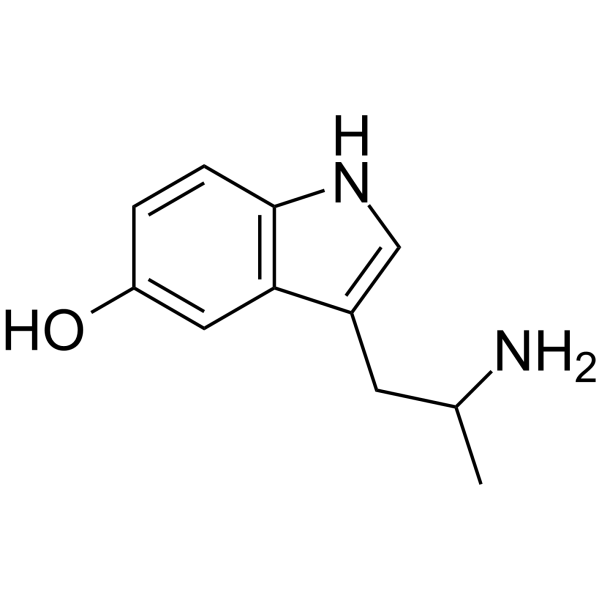
Physicochemical Properties
| Molecular Formula | C11H14N2O |
| Molecular Weight | 190.24 |
| Exact Mass | 306.122 |
| CAS # | 304-52-9 |
| PubChem CID | 2107 |
| Appearance | Typically exists as solid at room temperature |
| Boiling Point | 411.7ºC at 760 mmHg |
| Flash Point | 202.8ºC |
| LogP | 2.175 |
| Hydrogen Bond Donor Count | 3 |
| Hydrogen Bond Acceptor Count | 2 |
| Rotatable Bond Count | 2 |
| Heavy Atom Count | 14 |
| Complexity | 198 |
| Defined Atom Stereocenter Count | 0 |
| SMILES | NC(C)CC1C2C(=CC=C(O)C=2)NC=1 |
| InChi Key | LYPCGXKCQDYTFV-UHFFFAOYSA-N |
| InChi Code | InChI=1S/C11H14N2O/c1-7(12)4-8-6-13-11-3-2-9(14)5-10(8)11/h2-3,5-7,13-14H,4,12H2,1H3 |
| Chemical Name | 3-(2-aminopropyl)-1H-indol-5-ol |
| HS Tariff Code | 2934.99.9001 |
| Storage |
Powder-20°C 3 years 4°C 2 years In solvent -80°C 6 months -20°C 1 month |
| Shipping Condition | Room temperature (This product is stable at ambient temperature for a few days during ordinary shipping and time spent in Customs) |
Biological Activity
| References |
[1]. Dobbins DE. Receptor mechanisms of serotonin-induced prenodal lymphatic constriction in the canine forelimb. Am J Physiol. 1998 Feb;274(2):H650-4. [2]. Brumley MR, et al. The serotonergic agonists quipazine, CGS-12066A, and alpha-methylserotonin alter motor activity and induce hindlimb stepping in the intact and spinal rat fetus. Behav Neurosci. 2005 Jun;119(3):821-33. [3]. Edwards E, et al. (+/-)-1-(2,5-Dimethoxy-4-iodophenyl)-2-aminopropane(DOI) and alpha-methyl-5-HT: 5-HT2 receptor agonistic action on phosphatidylinositol metabolism in the rat fronto-cingulate and entorhinal cortex. Neuropharmacology. 1992 Jul;31(7):615-2 |
| Additional Infomation | Alpha-methylserotonin is a member of tryptamines. It has a role as a serotonergic agonist. |
Solubility Data
| Solubility (In Vitro) |
Methanol: 62.5 mg/mL (328.53 mM) DMSO: 50 mg/mL (262.83 mM) |
| Solubility (In Vivo) |
Solubility in Formulation 1: ≥ 2.5 mg/mL (13.14 mM) (saturation unknown) in 10% DMSO + 40% PEG300 + 5% Tween80 + 45% Saline (add these co-solvents sequentially from left to right, and one by one), clear solution. For example, if 1 mL of working solution is to be prepared, you can add 100 μL of 25.0 mg/mL clear DMSO stock solution to 400 μL PEG300 and mix evenly; then add 50 μL Tween-80 to the above solution and mix evenly; then add 450 μL normal saline to adjust the volume to 1 mL. Preparation of saline: Dissolve 0.9 g of sodium chloride in 100 mL ddH₂ O to obtain a clear solution. Solubility in Formulation 2: ≥ 2.5 mg/mL (13.14 mM) (saturation unknown) in 10% DMSO + 90% (20% SBE-β-CD in Saline) (add these co-solvents sequentially from left to right, and one by one), clear solution. For example, if 1 mL of working solution is to be prepared, you can add 100 μL of 25.0 mg/mL clear DMSO stock solution to 900 μL of 20% SBE-β-CD physiological saline solution and mix evenly. Preparation of 20% SBE-β-CD in Saline (4°C,1 week): Dissolve 2 g SBE-β-CD in 10 mL saline to obtain a clear solution. (Please use freshly prepared in vivo formulations for optimal results.) |
| Preparing Stock Solutions | 1 mg | 5 mg | 10 mg | |
| 1 mM | 5.2565 mL | 26.2826 mL | 52.5652 mL | |
| 5 mM | 1.0513 mL | 5.2565 mL | 10.5130 mL | |
| 10 mM | 0.5257 mL | 2.6283 mL | 5.2565 mL |