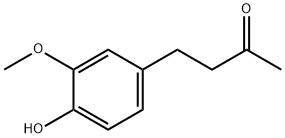
Physicochemical Properties
| Molecular Formula | C11H14O3 |
| Molecular Weight | 194.23 |
| Exact Mass | 194.094 |
| Elemental Analysis | C, 68.02; H, 7.27; O, 24.71 |
| CAS # | 122-48-5 |
| Related CAS # | 122-48-5 |
| PubChem CID | 31211 |
| Appearance | Off-white to light yellow solid powder |
| Density | 1.1±0.1 g/cm3 |
| Boiling Point | 323.0±27.0 °C at 760 mmHg |
| Melting Point | 40-41 °C(lit.) |
| Flash Point | 123.7±17.2 °C |
| Vapour Pressure | 0.0±0.7 mmHg at 25°C |
| Index of Refraction | 1.526 |
| LogP | 0.64 |
| Hydrogen Bond Donor Count | 1 |
| Hydrogen Bond Acceptor Count | 3 |
| Rotatable Bond Count | 4 |
| Heavy Atom Count | 14 |
| Complexity | 191 |
| Defined Atom Stereocenter Count | 0 |
| SMILES | O(C([H])([H])[H])C1=C(C([H])=C([H])C(=C1[H])C([H])([H])C([H])([H])C(C([H])([H])[H])=O)O[H] |
| InChi Key | OJYLAHXKWMRDGS-UHFFFAOYSA-N |
| InChi Code | InChI=1S/C11H14O3/c1-8(12)3-4-9-5-6-10(13)11(7-9)14-2/h5-7,13H,3-4H2,1-2H3 |
| Chemical Name | 4-(4-hydroxy-3-methoxyphenyl)butan-2-one |
| Synonyms | Gingerone; Zingerone; AI331837; AI3 31837; AI3-31837 |
| HS Tariff Code | 2934.99.9001 |
| Storage |
Powder-20°C 3 years 4°C 2 years In solvent -80°C 6 months -20°C 1 month Note: Please store this product in a sealed and protected environment, avoid exposure to moisture. |
| Shipping Condition | Room temperature (This product is stable at ambient temperature for a few days during ordinary shipping and time spent in Customs) |
Biological Activity
| Targets | NF-κB |
| ln Vitro |
Zingerone is a non-toxic methoxyphenol that has powerful anti-inflammatory, anti-diabetic, anti-lipolytic, anti-diarrheic, and antispasmodic properties[1]. Zingerone (0–2 mM) reduces neoblastoma cell survival[3]. Zingerone (0–2 mM) decreases cyclin D1 expression and increases caspase-3 and PARP-1 cleavage in BE(2)-M17 cells[3]. |
| ln Vivo |
Zingerone (50, 100 mg/kg, p.o. daily for 21 days) protects against alloxan-induced diabetes in rats by reducing oxidative stress and inflammation[2]. Zingerone (10 mg/kg, i.p.) slows the growth of tumors by stopping the mitotic cycle, preventing cell division, and inducing apoptosis[3]. |
| ADME/Pharmacokinetics |
Metabolism / Metabolites ORAL OR IP ADMIN OF 100 MG/KG /TO RATS/ RESULTED IN URINARY EXCRETION...MAINLY AS GLUCURONIDE AND/OR SULFATE CONJUGATES. WHILST UNCHANGED ZINGERONE ACCOUNTED FOR 50-55% OF DOSE, REDN TO CARBINOL (11-13%) ALSO OCCURRED. /AFTER ORAL OR IP ADMIN OF 100 MG/KG ZINGERONE TO RATS/ SIDE CHAIN OXIDN TOOK PLACE AT THE 3 FEASIBLE SITES, AND OXIDN IN 3-POSITION PREDOMINATED TO YIELD C-6--C-2 METABOLITES. IDENTIFIED METABOLITES ACCOUNTED FOR 95-97% OF DOSE. BILIARY STUDIES AND INVESTIGATIONS WITH CECAL MICRO-ORGANISMS IN VITRO /IN RATS/ INDICATED THAT SEVERAL OF THE URINARY O-DEMETHYLATED METABOLITES /OF ZINGERONE/ WERE OF BACTERIAL ORIGIN. |
| References |
[1]. A Review on Pharmacological Properties of Zingerone (4-(4-Hydroxy-3-methoxyphenyl)-2-butanone). ScientificWorldJournal. 2015;2015:816364. [2]. Zingerone (4-(4-hydroxy-3-methylphenyl) butan-2-one) protects against alloxan-induced diabetes via alleviation of oxidative stress and inflammation: Probable role of NF-kB activation. Saudi Pharm J. 2018 Dec;26(8):1137-1145. [3]. Zingerone Suppresses Tumor Development through Decreasing Cyclin D1 Expression and Inducing Mitotic Arrest. Int J Mol Sci. 2018 Sep 19;19(9). |
| Additional Infomation |
Zingerone is a methyl ketone that is 4-phenylbutan-2-one in which the phenyl ring is substituted at positions 3 and 4 by methoxy and hydroxy groups respectively. The major pungent component in ginger. It has a role as an antioxidant, an anti-inflammatory agent, a radiation protective agent, an antiemetic, a flavouring agent, a fragrance and a plant metabolite. It is a member of phenols, a monomethoxybenzene and a methyl ketone. Zingerone is a pungent component of ginger. Zingerone has been reported in Alpinia officinarum, Aframomum melegueta, and other organisms with data available. Zingerone is a metabolite found in or produced by Saccharomyces cerevisiae. |
Solubility Data
| Solubility (In Vitro) |
DMSO: 38~100 mg/mL (195.6~514.9 mM) Water: ~10 mg/mL (~51.5 mM) Ethanol: ~38 mg/mL (~195.6 mM) |
| Solubility (In Vivo) |
Solubility in Formulation 1: ≥ 2.5 mg/mL (12.87 mM) (saturation unknown) in 10% DMSO + 40% PEG300 + 5% Tween80 + 45% Saline (add these co-solvents sequentially from left to right, and one by one), clear solution. For example, if 1 mL of working solution is to be prepared, you can add 100 μL of 25.0 mg/mL clear DMSO stock solution to 400 μL PEG300 and mix evenly; then add 50 μL Tween-80 to the above solution and mix evenly; then add 450 μL normal saline to adjust the volume to 1 mL. Preparation of saline: Dissolve 0.9 g of sodium chloride in 100 mL ddH₂ O to obtain a clear solution. Solubility in Formulation 2: ≥ 2.5 mg/mL (12.87 mM) (saturation unknown) in 10% DMSO + 90% (20% SBE-β-CD in Saline) (add these co-solvents sequentially from left to right, and one by one), clear solution. For example, if 1 mL of working solution is to be prepared, you can add 100 μL of 25.0 mg/mL clear DMSO stock solution to 900 μL of 20% SBE-β-CD physiological saline solution and mix evenly. Preparation of 20% SBE-β-CD in Saline (4°C,1 week): Dissolve 2 g SBE-β-CD in 10 mL saline to obtain a clear solution. Solubility in Formulation 3: ≥ 2.5 mg/mL (12.87 mM) (saturation unknown) in 10% DMSO + 90% Corn Oil (add these co-solvents sequentially from left to right, and one by one), clear solution. For example, if 1 mL of working solution is to be prepared, you can add 100 μL of 25.0 mg/mL clear DMSO stock solution to 900 μL of corn oil and mix evenly. (Please use freshly prepared in vivo formulations for optimal results.) |
| Preparing Stock Solutions | 1 mg | 5 mg | 10 mg | |
| 1 mM | 5.1485 mL | 25.7427 mL | 51.4854 mL | |
| 5 mM | 1.0297 mL | 5.1485 mL | 10.2971 mL | |
| 10 mM | 0.5149 mL | 2.5743 mL | 5.1485 mL |