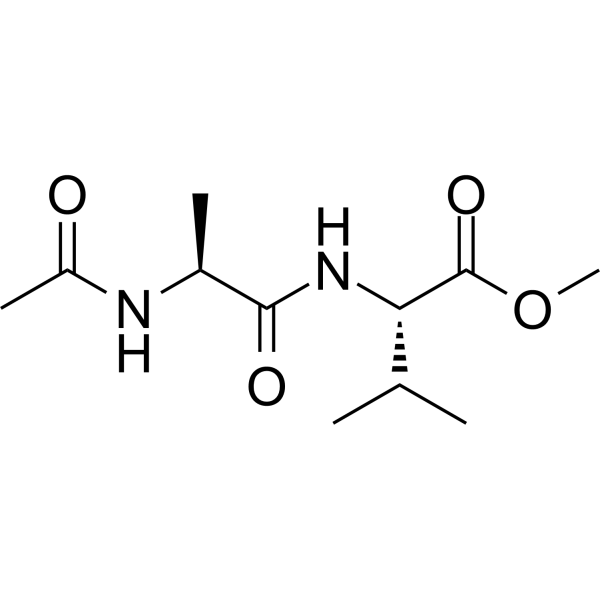
Physicochemical Properties
| Molecular Formula | C11H20N2O4 |
| Molecular Weight | 244.29 |
| Exact Mass | 244.142 |
| Elemental Analysis | C, 54.08; H, 8.25; N, 11.47; O, 26.20 |
| CAS # | 99141-91-0 |
| PubChem CID | 166176924 |
| Appearance | White to off-white oil |
| LogP | -0.2 |
| Hydrogen Bond Donor Count | 2 |
| Hydrogen Bond Acceptor Count | 4 |
| Rotatable Bond Count | 6 |
| Heavy Atom Count | 17 |
| Complexity | 302 |
| Defined Atom Stereocenter Count | 2 |
| SMILES | C[C@@H](C(=O)N[C@@H](C(C)C)C(=O)OC)NC(=O)C |
| InChi Key | RHDUVXUSBMPQOK-CBAPKCEASA-N |
| InChi Code | InChI=1S/C11H20N2O4/c1-6(2)9(11(16)17-5)13-10(15)7(3)12-8(4)14/h6-7,9H,1-5H3,(H,12,14)(H,13,15)/t7-,9-/m0/s1 |
| Chemical Name | methyl (2S)-2-[[(2S)-2-acetamidopropanoyl]amino]-3-methylbutanoate |
| Synonyms | ZZL-7; ZZL7; ZZL 7 |
| HS Tariff Code | 2934.99.9001 |
| Storage |
Powder-20°C 3 years 4°C 2 years In solvent -80°C 6 months -20°C 1 month Note: This product requires protection from light (avoid light exposure) during transportation and storage. |
| Shipping Condition | Room temperature (This product is stable at ambient temperature for a few days during ordinary shipping and time spent in Customs) |
Biological Activity
| Targets | Serotonin transporter (SERT) and neuronal nitric oxide synthase (nNOS) interaction |
| ln Vitro | The quantity of SERT-nNOS complex is considerably reduced when grown 293T cells transfected with nNOS and SERT are incubated with ZZL-7 (1.0 μM) for two hours[1]. |
| ln Vivo | Two hours after treatment, in vivo electrophysiology in SERT-Cre mice shows a substantial increase in the firing frequency of serotonergic neurons caused by ZZL-7 (10 mg/kg, intraperitoneally). ZZL-7 shortens the duration of immobility in wild-type mice[1]. Two hours after treatment, intragastric injection of ZZL-7 (10, 20, and 40 mg/kg; once) causes dose-dependent antidepressant-like behaviors[1]. Two hours after treatment, chronic unpredictable moderate stress (CMS)-induced depression behaviors are reversed by ZZL-7 (10 mg/kg; intraperitoneal administration)[1]. |
| Enzyme Assay | Major depressive disorder (MDD) is one of the most common mental disorders. We designed a fast-onset antidepressant that works by disrupting the interaction between the serotonin transporter (SERT) and neuronal nitric oxide synthase (nNOS) in the dorsal raphe nucleus (DRN). Chronic unpredictable mild stress (CMS) selectively increased the SERT-nNOS complex in the DRN in mice. Augmentation of SERT-nNOS interactions in the DRN caused a depression-like phenotype and accounted for the CMS-induced depressive behaviors. Disrupting the SERT-nNOS interaction produced a fast-onset antidepressant effect by enhancing serotonin signaling in forebrain circuits. We discovered a small-molecule compound, ZZL-7, that elicited an antidepressant effect 2 hours after treatment without undesirable side effects. This compound, or analogous reagents, may serve as a new, rapidly acting treatment for MDD [1]. |
| Animal Protocol |
Animal/Disease Models: SERT-Cre mice[1] Doses: 10 mg/kg Route of Administration: ip; once Experimental Results: Dramatically increased firing frequency of serotonergic neurons 2 hrs (hours) after treatment in vivo electrophysiology in SERT-Cre mice. |
| References |
[1]. Design of fast-onset antidepressant by dissociating SERT from nNOS in the DRN. Science. 2022 Oct 28;378(6618):390-398. |
Solubility Data
| Solubility (In Vitro) | DMSO: 250 mg/mL (1023.37 mM) |
| Solubility (In Vivo) |
Solubility in Formulation 1: ≥ 2.08 mg/mL (8.51 mM) (saturation unknown) in 10% DMSO + 40% PEG300 + 5% Tween80 + 45% Saline (add these co-solvents sequentially from left to right, and one by one), clear solution. For example, if 1 mL of working solution is to be prepared, you can add 100 μL of 20.8 mg/mL clear DMSO stock solution to 400 μL PEG300 and mix evenly; then add 50 μL Tween-80 to the above solution and mix evenly; then add 450 μL normal saline to adjust the volume to 1 mL. Preparation of saline: Dissolve 0.9 g of sodium chloride in 100 mL ddH₂ O to obtain a clear solution. Solubility in Formulation 2: ≥ 2.08 mg/mL (8.51 mM) (saturation unknown) in 10% DMSO + 90% (20% SBE-β-CD in Saline) (add these co-solvents sequentially from left to right, and one by one), clear solution. For example, if 1 mL of working solution is to be prepared, you can add 100 μL of 20.8 mg/mL clear DMSO stock solution to 900 μL of 20% SBE-β-CD physiological saline solution and mix evenly. Preparation of 20% SBE-β-CD in Saline (4°C,1 week): Dissolve 2 g SBE-β-CD in 10 mL saline to obtain a clear solution. Solubility in Formulation 3: ≥ 2.08 mg/mL (8.51 mM) (saturation unknown) in 10% DMSO + 90% Corn Oil (add these co-solvents sequentially from left to right, and one by one), clear solution. For example, if 1 mL of working solution is to be prepared, you can add 100 μL of 20.8 mg/mL clear DMSO stock solution to 900 μL of corn oil and mix evenly. (Please use freshly prepared in vivo formulations for optimal results.) |
| Preparing Stock Solutions | 1 mg | 5 mg | 10 mg | |
| 1 mM | 4.0935 mL | 20.4675 mL | 40.9350 mL | |
| 5 mM | 0.8187 mL | 4.0935 mL | 8.1870 mL | |
| 10 mM | 0.4093 mL | 2.0467 mL | 4.0935 mL |