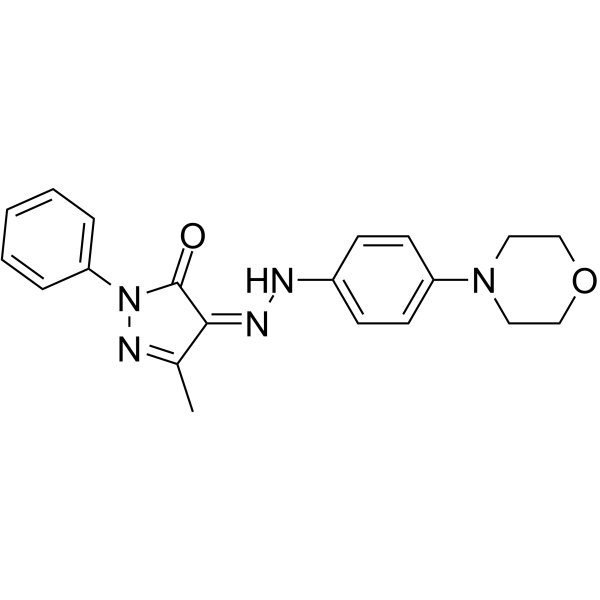
Physicochemical Properties
| Molecular Formula | C20H21N5O2 |
| Molecular Weight | 363.413043737412 |
| Exact Mass | 363.169 |
| CAS # | 117953-17-0 |
| PubChem CID | 3120439 |
| Appearance | Pink to red solid powder |
| LogP | 3.6 |
| Hydrogen Bond Donor Count | 1 |
| Hydrogen Bond Acceptor Count | 6 |
| Rotatable Bond Count | 4 |
| Heavy Atom Count | 27 |
| Complexity | 585 |
| Defined Atom Stereocenter Count | 0 |
| SMILES | O1CCN(C2C=CC(=CC=2)/N=N/C2C(N(C3C=CC=CC=3)NC=2C)=O)CC1 |
| InChi Key | BPLMVWHZMFTKIE-UHFFFAOYSA-N |
| InChi Code | InChI=1S/C20H21N5O2/c1-15-19(20(26)25(23-15)18-5-3-2-4-6-18)22-21-16-7-9-17(10-8-16)24-11-13-27-14-12-24/h2-10,23H,11-14H2,1H3 |
| Chemical Name | 5-methyl-4-[(4-morpholin-4-ylphenyl)diazenyl]-2-phenyl-1H-pyrazol-3-one |
| HS Tariff Code | 2934.99.9001 |
| Storage |
Powder-20°C 3 years 4°C 2 years In solvent -80°C 6 months -20°C 1 month Note: Please store this product in a sealed and protected environment (e.g. under nitrogen), avoid exposure to moisture. |
| Shipping Condition | Room temperature (This product is stable at ambient temperature for a few days during ordinary shipping and time spent in Customs) |
Biological Activity
| Targets | The protein-protein interaction between hypoxia-inducible factor 1α (HIF-1α) and von Hippel-Lindau protein (pVHL) (inhibitor, IC50 = 2.0 ± 0.14 µM) [1] |
| ln Vitro |
In a fluorescence polarization-based binding assay, ZINC13466751 (compound 9) inhibited the interaction between HIF-1α peptide and pVHL protein with an IC50 value of 2.0 ± 0.14 µM. This activity was comparable to the positive control, the native ligand from the 4W9H crystal structure (IC50 = 1.1 ± 0.03 µM). [1] Molecular docking simulations predicted that ZINC13466751 binds to the pVHL protein (PDB id: 4W9H) and forms key interactions: one hydrogen bond with His110, another hydrogen bond with a structural water molecule near Pro99, two strong π-π interactions with Trp88, and one weak π-π interaction with Tyr112, along with multiple hydrophobic interactions. [1] |
| Cell Assay | Fluorescence Polarization Binding Assay: A competitive binding assay was performed to measure the ability of ZINC13466751 to disrupt the HIF-1α/pVHL interaction. The assay used a fluorescently labeled HIF-1α peptide (FAM-DEALA-Hyp-YIPD, 278 nM) and the pVHL protein (V1-213CB, 450 nM). Test compounds were dissolved in DMSO. Serial dilutions of the compound were prepared and mixed with the protein and labeled peptide in black 96-well plates. After incubation, fluorescence polarization was measured on a plate reader using 485 nm excitation and 535 nm emission filters. The fluorescence intensities parallel and perpendicular to the excitation plane were measured. Wells containing protein, DMSO, and labeled peptide represented maximum polarization (minimum displacement), while wells with buffer instead of protein represented minimum polarization (maximum displacement). Inhibition percentages were calculated by normalizing to the maximum and minimum polarization values. Dose-response curves were plotted, and IC50 values were determined using appropriate software, with each compound tested in multiple replicates (n=9). [1] |
| References |
[1]. Discovery of novel inhibitors disrupting HIF-1α/von Hippel-Lindau interaction through shape-based screening and cascade docking. PeerJ. 2016 Dec 15;4:e2757. |
| Additional Infomation |
ZINC13466751 (Compound 9) was identified as a hit compound from a virtual screening campaign combining shape-based modeling and cascade docking. It is a pyrazolone derivative with a molecular weight of 363.2 g/mol. [1] It represents a novel chemical scaffold distinct from previously reported inhibitors of the HIF-1α/pVHL interaction. [1] The study suggests that due to its relatively low molecular weight and simple structure, ZINC13466751 has the potential for further structural optimization to develop more potent inhibitors with high ligand efficiency. [1] |
Solubility Data
| Solubility (In Vitro) | DMSO : ~50 mg/mL (~137.59 mM) |
| Solubility (In Vivo) |
Note: Listed below are some common formulations that may be used to formulate products with low water solubility (e.g. < 1 mg/mL), you may test these formulations using a minute amount of products to avoid loss of samples. Injection Formulations (e.g. IP/IV/IM/SC) Injection Formulation 1: DMSO : Tween 80: Saline = 10 : 5 : 85 (i.e. 100 μL DMSO stock solution → 50 μL Tween 80 → 850 μL Saline) *Preparation of saline: Dissolve 0.9 g of sodium chloride in 100 mL ddH ₂ O to obtain a clear solution. Injection Formulation 2: DMSO : PEG300 :Tween 80 : Saline = 10 : 40 : 5 : 45 (i.e. 100 μL DMSO → 400 μLPEG300 → 50 μL Tween 80 → 450 μL Saline) Injection Formulation 3: DMSO : Corn oil = 10 : 90 (i.e. 100 μL DMSO → 900 μL Corn oil) Example: Take the Injection Formulation 3 (DMSO : Corn oil = 10 : 90) as an example, if 1 mL of 2.5 mg/mL working solution is to be prepared, you can take 100 μL 25 mg/mL DMSO stock solution and add to 900 μL corn oil, mix well to obtain a clear or suspension solution (2.5 mg/mL, ready for use in animals). Injection Formulation 4: DMSO : 20% SBE-β-CD in saline = 10 : 90 [i.e. 100 μL DMSO → 900 μL (20% SBE-β-CD in saline)] *Preparation of 20% SBE-β-CD in Saline (4°C,1 week): Dissolve 2 g SBE-β-CD in 10 mL saline to obtain a clear solution. Injection Formulation 5: 2-Hydroxypropyl-β-cyclodextrin : Saline = 50 : 50 (i.e. 500 μL 2-Hydroxypropyl-β-cyclodextrin → 500 μL Saline) Injection Formulation 6: DMSO : PEG300 : castor oil : Saline = 5 : 10 : 20 : 65 (i.e. 50 μL DMSO → 100 μLPEG300 → 200 μL castor oil → 650 μL Saline) Injection Formulation 7: Ethanol : Cremophor : Saline = 10: 10 : 80 (i.e. 100 μL Ethanol → 100 μL Cremophor → 800 μL Saline) Injection Formulation 8: Dissolve in Cremophor/Ethanol (50 : 50), then diluted by Saline Injection Formulation 9: EtOH : Corn oil = 10 : 90 (i.e. 100 μL EtOH → 900 μL Corn oil) Injection Formulation 10: EtOH : PEG300:Tween 80 : Saline = 10 : 40 : 5 : 45 (i.e. 100 μL EtOH → 400 μLPEG300 → 50 μL Tween 80 → 450 μL Saline) Oral Formulations Oral Formulation 1: Suspend in 0.5% CMC Na (carboxymethylcellulose sodium) Oral Formulation 2: Suspend in 0.5% Carboxymethyl cellulose Example: Take the Oral Formulation 1 (Suspend in 0.5% CMC Na) as an example, if 100 mL of 2.5 mg/mL working solution is to be prepared, you can first prepare 0.5% CMC Na solution by measuring 0.5 g CMC Na and dissolve it in 100 mL ddH2O to obtain a clear solution; then add 250 mg of the product to 100 mL 0.5% CMC Na solution, to make the suspension solution (2.5 mg/mL, ready for use in animals). Oral Formulation 3: Dissolved in PEG400 Oral Formulation 4: Suspend in 0.2% Carboxymethyl cellulose Oral Formulation 5: Dissolve in 0.25% Tween 80 and 0.5% Carboxymethyl cellulose Oral Formulation 6: Mixing with food powders Note: Please be aware that the above formulations are for reference only. InvivoChem strongly recommends customers to read literature methods/protocols carefully before determining which formulation you should use for in vivo studies, as different compounds have different solubility properties and have to be formulated differently. (Please use freshly prepared in vivo formulations for optimal results.) |
| Preparing Stock Solutions | 1 mg | 5 mg | 10 mg | |
| 1 mM | 2.7517 mL | 13.7586 mL | 27.5171 mL | |
| 5 mM | 0.5503 mL | 2.7517 mL | 5.5034 mL | |
| 10 mM | 0.2752 mL | 1.3759 mL | 2.7517 mL |