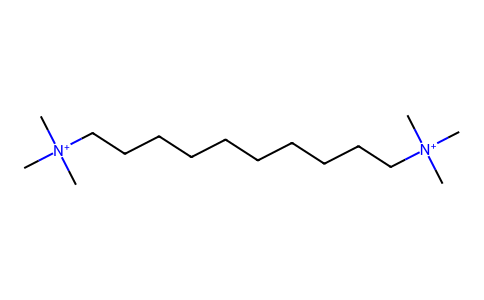
Physicochemical Properties
| Molecular Formula | C16H38N22+ |
| Molecular Weight | 258.49 |
| Exact Mass | 258.303 |
| CAS # | 156-74-1 |
| Related CAS # | 1420-40-2 (diiodide);3198-38-7 (dichloride);541-22-0 (dibromide) |
| PubChem CID | 2968 |
| Appearance | Typically exists as solid at room temperature |
| Melting Point |
268-270 °C MP: 188-189 °C /Bromide/ 268 - 270 °C |
| LogP | 3.519 |
| Hydrogen Bond Donor Count | 0 |
| Hydrogen Bond Acceptor Count | 0 |
| Rotatable Bond Count | 11 |
| Heavy Atom Count | 18 |
| Complexity | 164 |
| Defined Atom Stereocenter Count | 0 |
| SMILES | C(CCC[N+](C)(C)C)CCCCCC[N+](C)(C)C |
| InChi Key | MTCUAOILFDZKCO-UHFFFAOYSA-N |
| InChi Code | InChI=1S/C16H38N2/c1-17(2,3)15-13-11-9-7-8-10-12-14-16-18(4,5)6/h7-16H2,1-6H3/q+2 |
| Chemical Name | trimethyl-[10-(trimethylazaniumyl)decyl]azanium |
| Synonyms | Ammonium, decamethylenebis(trimethyl-; Decamethonium; Decamethonium |
| HS Tariff Code | 2934.99.9001 |
| Storage |
Powder-20°C 3 years 4°C 2 years In solvent -80°C 6 months -20°C 1 month |
| Shipping Condition | Room temperature (This product is stable at ambient temperature for a few days during ordinary shipping and time spent in Customs) |
Biological Activity
| ADME/Pharmacokinetics |
Absorption, Distribution and Excretion Rapidly absorbed. QUATERNARY AMMONIUM NEUROMUSCULAR BLOCKING AGENTS ARE VERY POORLY & IRREGULARLY ABSORBED FROM THE GI TRACT. /NEUROMUSCULAR BLOCKING AGENTS/ ONSET OF PARALYSIS IS ABOUT 2 MIN, & DURATION OF ACTION IS USUALLY ABOUT 15 MIN; PLASMA T/2 IS APPROX 0.5-1 HR. ELIMINATION IS MAINLY BY COMBINATION OF GLOMERULAR FILTRATION & TUBULAR SECRETION... DISTRIBUTION OF (14)C AFTER IP ADMIN OF [(14)C]DECAMETHONIUM...IN MICE WERE COMPARED BY WHOLE BODY AUTORADIOGRAM. RATE & EXTENT OF HEPATIC UPTAKE OF (14)C WERE INVERSELY PROPORTIONAL TO RATE OF URINARY EXCRETION. ...(14)C WAS RAPIDLY ACCUM IN CARTILAGE...ALSO TAKEN UP IN MUSCULAR TISSUES AFTER DOSING... NO EVIDENCE WAS FOUND FOR DECAMETHONIUM BIOTRANSFORMATION IN SMALL ANIMALS. IN RABBITS, 80% OF IV INJECTION WAS EXCRETED RAPIDLY IN 24 HR URINE AS UNCHANGED DRUG, & BILIARY & PULMONARY ELIMINATIVE ROUTES WERE NOT UTILIZED. BLOOD-BRAIN BARRIER & PLACENTA PROTECT AGAINST TRANSFER...INTO BRAIN & FETUS. Metabolism / Metabolites ... IS NOT HYDROLYZED BY PLASMA CHOLINESTERASE BUT IS EXCRETED UNCHANGED BY KIDNEYS. NO EVIDENCE WAS FOUND FOR DECAMETHONIUM BIOTRANSFORMATION IN SMALL ANIMALS. ... Biological Half-Life ... PLASMA T1/2 IS APPROX 0.5-1 HR. ... |
| Toxicity/Toxicokinetics |
Interactions ... IN MAN ... DECAMETHONIUM ... PRODUCE & MAINTAIN NEUROMUSCULAR BLOCKADE THAT HAS ALL CHARACTERISTICS OF DEPOLARIZING BLOCKADE ... THIS APPLIES IN PARTICULAR TO ITS INTENSIFICATION BY EDROpHONIUM, NEOSTIGMINE, & OTHER ANTI-CHOLINESTERASE AGENTS THAT ANTAGONIZE COMPETITIVE BLOCK. DEPOLARIZING MUSCLE RELAXANTS DECAMETHONIUM...HAVE BEEN SHOWN TO INTERACT WITH PROPRANOLOL... IN PRESENCE OF DIGITALIS, ESP...IF K LOSS, CARDIAC ARRHYTHMIAS, & EVEN CARDIAC ARREST, MAY OCCUR. DEPOLARIZING MUSCLE RELAXANTS DECAMETHONIUM...HAVE BEEN SHOWN TO INTERACT WITH QUINIDINE IN ANIMALS. For more Interactions (Complete) data for DECAMETHONIUM (8 total), please visit the HSDB record page. |
| Additional Infomation |
Decamethonium is a quaternary ammonium ion that is a depolarising muscle relaxant whose structure comprises a decane-1,10-diamine core in which each amino group carries three methyl substituents. It has a role as a muscle relaxant and a nicotinic acetylcholine receptor agonist. It derives from a hydride of a decane. Decamethonium is used in anesthesia to cause paralysis. It is a short acting depolarizing muscle relaxant. It is similar to acetylcholine and acts as a partial agonist of the nicotinic acetylcholine receptor. Drug Indication For use as a skeletal muscle relaxant Mechanism of Action Binds to the nicotinic acetycholine receptors (by virtue of its similarity to acetylcholine) in the motor endplate and blocks access to the receptors. In the process of binding, the receptor is actually activated - causing a process known as depolarization. Since it is not degraded in the neuromuscular junction, the depolarized membrance remains depolarized and unresponsive to any other impulse, causing muscle paralysis. ... DECAMETHONIUM ... COMBINES CERTAIN FEATURES OF BOTH THE DEPOLARIZING & THE COMPETITIVE AGENTS ... TERMED "DUAL" MECHANISM ... /IN CASES OF DUAL MECHANISM/ ... DEPOLARIZING AGENTS PRODUCE INITIALLY THE CHARACTERISTIC FASCICULATIONS & POTENTIATION OF THE MAXIMAL TWITCH, FOLLOWED BY THE RAPID ONSET OF NEUROMUSCULAR BLOCK ... THERE IS A POORLY SUSTAINED RESPONSE TO TETANIC STIMULATION OF THE MOTOR NERVE, INTENSIFICATION OF THE BLOCK BY TUBOCURARINE, & USUAL REVERSAL BY ANTI-CHOLINESTERASE AGENTS. THEIR INITIAL EFFECT IS TO DEPOLARIZE THE MEMBRANE BY OPENING CHANNELS IN THE SAME MANNER AS ACETYLCHOLINE. HOWEVER, SINCE THEY PERSIST FOR LONGER DURATIONS AT THE NEUROMUSCULAR JUNCTION, PRIMARILY BECAUSE OF THEIR RESISTANCE TO ACETYLCHOLINESTERASE, THE DEPOLARIZATION IS LONGER LASTING, RESULTING IN A BRIEF PERIOD OF REPETITIVE EXCITATION THAT MAY ELICIT TRANSIENT MUSCLE FASCICULATIONS. THE INITIAL PHASE IS FOLLOWED BY BLOCK OF NEUROMUSCULAR TRANSMISSION AND FLACCID PARALYSIS. /DEPOLARIZING AGENTS/ DURING DEPOLARIZED STATE, K IS RAPIDLY LOST FROM MUSCLE... DESPITE CONTINUING PRESENCE OF DECAMETHONIUM, SOME MOTOR END-PLATE MEMBRANES...REPOLARIZE, BUT... ARE INCAPABLE OF...NERVE STIMULATION; IN THIS STAGE, BLOCK CAN BE ANTAGONIZED BY ANTICHOLINESTERASES & AUGMENTED BY STABILIZING BLOCKING DRUGS & OTHER DRUGS... Therapeutic Uses Neuromuscular Depolarizing Agents NEUROMUSCULAR BLOCKING AGENTS ARE ADMIN PARENTERALLY & NEARLY ALWAYS IV. /NEUROMUSCULAR BLOCKING AGENTS/ THE MAIN CLINICAL USE OF THE NEUROMUSCULAR BLOCKING AGENTS IS AS AN ADJUVANT IN SURGICAL ANESTHESIA ... MUSCLE RELAXATION IS ALSO OF VALUE IN VARIOUS ORTHOPEDIC PROCEDURES ... /THEY/ HAVE BEEN USED TO FACILITATE LARYNGOSCOPY, BRONCHOSCOPY, & ESOPHAGOSCOPY ... USED TO PREVENT TRAUMA DURING ELECTROSHOCK THERAPY. /NEUROMUSCULAR BLOCKING AGENTS/ USUALLY, RESP MUSCLES ARE MOST RESISTANT TO DECAMETHONIUM, SO THAT IT IS POSSIBLE TO ACHIEVE SURGICAL RELAXATION WITHOUT LOSS OF RESP FUNCTION; NEVERTHELESS, DECAMETHONIUM SHOULD NOT BE USED WITHOUT TRACHEAL INTUBATION, IN CASE RESP REQUIRES ASSISTANCE. For more Therapeutic Uses (Complete) data for DECAMETHONIUM (7 total), please visit the HSDB record page. Drug Warnings THE NEUROMUSCULAR BLOCKING AGENTS ARE POTENTIALLY HAZARDOUS DRUGS. CONSEQUENTLY, THEY SHOULD BE ADMINISTERED TO PATIENTS ONLY BY ANESTHESIOLOGISTS & OTHER CLINICIANS WHO HAVE HAD EXTENSIVE TRAINING IN THEIR USE & IN A SETTING WHERe FACILITIES FOR RESPIRATORY & CARDIOVASCULAR RESUSCITATION ARE IMMEDIATELY AT HAND. /NEUROMUSCULAR BLOCKING AGENTS/ GREAT CARE SHOULD BE TAKEN WHEN ADMIN MUSCLE RELAXANTS TO DEHYDRATED OR SEVERELY ILL PATIENTS. /NEUROMUSCULAR BLOCKING AGENTS/ MUSCULAR PARALYSIS IS INCR BY HYPOTHERMIA, HYPOKALEMIA, HYPERMAGNESEMIA, POLYMYXIN B, & COLISTIN. DECAMETHONIUM SHOULD BE AVOIDED, IF POSSIBLE, IN PT WITH BONE FRACTURES OR MUSCLE SPASM BECAUSE OF FASCICULATIONS DURING ONSET OF ACTION. IT IS CONTRAINDICATED WHEN RESP IS ALREADY DEPRESSED UNLESS FACILITIES FOR PROLONGED ASSISTED RESP ARE @ HAND. CAUTION MUST BE EXERCISED IN YOUNG CHILDREN & AGED PERSONS & WHEN LITHOTOMY OR TRENDELENBURG POSITIONS ARE TO BE USED. For more Drug Warnings (Complete) data for DECAMETHONIUM (15 total), please visit the HSDB record page. Pharmacodynamics Decamethonium acts as a depolarizing muscle relaxant or neuromuscular blocking agent. It acts as an agonist of nicotinic acetycholine receptors in the motor endplate and causes depolarization. This class of drugs has its effect at the neuromuscular junction by preventing the effects of acetylcholine. Normally, when a nerve stimulus acts to contract a muscle, it releases acetylcholine. The binding of this acetylcholine to receptors causes the muscle to contract. Muscle relaxants play an important role in anesthesia even though they don't provide any pain relief or produce unconsciousness. |
Solubility Data
| Solubility (In Vitro) | May dissolve in DMSO (in most cases), if not, try other solvents such as H2O, Ethanol, or DMF with a minute amount of products to avoid loss of samples |
| Solubility (In Vivo) |
Note: Listed below are some common formulations that may be used to formulate products with low water solubility (e.g. < 1 mg/mL), you may test these formulations using a minute amount of products to avoid loss of samples. Injection Formulations (e.g. IP/IV/IM/SC) Injection Formulation 1: DMSO : Tween 80: Saline = 10 : 5 : 85 (i.e. 100 μL DMSO stock solution → 50 μL Tween 80 → 850 μL Saline) *Preparation of saline: Dissolve 0.9 g of sodium chloride in 100 mL ddH ₂ O to obtain a clear solution. Injection Formulation 2: DMSO : PEG300 :Tween 80 : Saline = 10 : 40 : 5 : 45 (i.e. 100 μL DMSO → 400 μLPEG300 → 50 μL Tween 80 → 450 μL Saline) Injection Formulation 3: DMSO : Corn oil = 10 : 90 (i.e. 100 μL DMSO → 900 μL Corn oil) Example: Take the Injection Formulation 3 (DMSO : Corn oil = 10 : 90) as an example, if 1 mL of 2.5 mg/mL working solution is to be prepared, you can take 100 μL 25 mg/mL DMSO stock solution and add to 900 μL corn oil, mix well to obtain a clear or suspension solution (2.5 mg/mL, ready for use in animals). Injection Formulation 4: DMSO : 20% SBE-β-CD in saline = 10 : 90 [i.e. 100 μL DMSO → 900 μL (20% SBE-β-CD in saline)] *Preparation of 20% SBE-β-CD in Saline (4°C,1 week): Dissolve 2 g SBE-β-CD in 10 mL saline to obtain a clear solution. Injection Formulation 5: 2-Hydroxypropyl-β-cyclodextrin : Saline = 50 : 50 (i.e. 500 μL 2-Hydroxypropyl-β-cyclodextrin → 500 μL Saline) Injection Formulation 6: DMSO : PEG300 : castor oil : Saline = 5 : 10 : 20 : 65 (i.e. 50 μL DMSO → 100 μLPEG300 → 200 μL castor oil → 650 μL Saline) Injection Formulation 7: Ethanol : Cremophor : Saline = 10: 10 : 80 (i.e. 100 μL Ethanol → 100 μL Cremophor → 800 μL Saline) Injection Formulation 8: Dissolve in Cremophor/Ethanol (50 : 50), then diluted by Saline Injection Formulation 9: EtOH : Corn oil = 10 : 90 (i.e. 100 μL EtOH → 900 μL Corn oil) Injection Formulation 10: EtOH : PEG300:Tween 80 : Saline = 10 : 40 : 5 : 45 (i.e. 100 μL EtOH → 400 μLPEG300 → 50 μL Tween 80 → 450 μL Saline) Oral Formulations Oral Formulation 1: Suspend in 0.5% CMC Na (carboxymethylcellulose sodium) Oral Formulation 2: Suspend in 0.5% Carboxymethyl cellulose Example: Take the Oral Formulation 1 (Suspend in 0.5% CMC Na) as an example, if 100 mL of 2.5 mg/mL working solution is to be prepared, you can first prepare 0.5% CMC Na solution by measuring 0.5 g CMC Na and dissolve it in 100 mL ddH2O to obtain a clear solution; then add 250 mg of the product to 100 mL 0.5% CMC Na solution, to make the suspension solution (2.5 mg/mL, ready for use in animals). Oral Formulation 3: Dissolved in PEG400 Oral Formulation 4: Suspend in 0.2% Carboxymethyl cellulose Oral Formulation 5: Dissolve in 0.25% Tween 80 and 0.5% Carboxymethyl cellulose Oral Formulation 6: Mixing with food powders Note: Please be aware that the above formulations are for reference only. InvivoChem strongly recommends customers to read literature methods/protocols carefully before determining which formulation you should use for in vivo studies, as different compounds have different solubility properties and have to be formulated differently. (Please use freshly prepared in vivo formulations for optimal results.) |
| Preparing Stock Solutions | 1 mg | 5 mg | 10 mg | |
| 1 mM | 3.8686 mL | 19.3431 mL | 38.6862 mL | |
| 5 mM | 0.7737 mL | 3.8686 mL | 7.7372 mL | |
| 10 mM | 0.3869 mL | 1.9343 mL | 3.8686 mL |