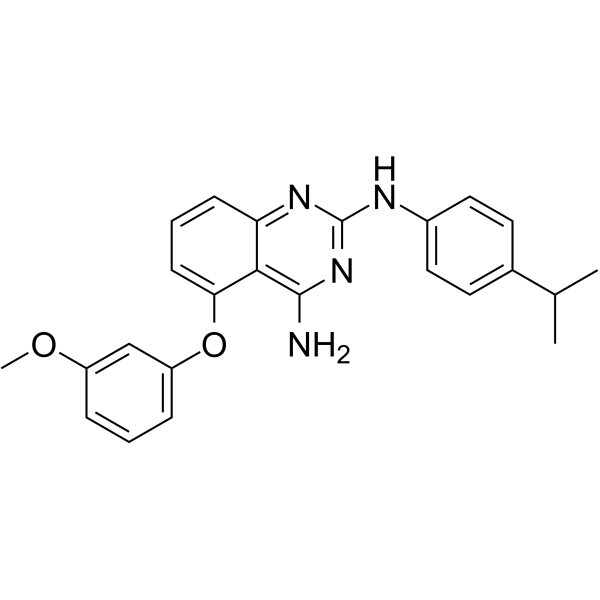
Physicochemical Properties
| Molecular Formula | C24H24N4O2 |
| Molecular Weight | 400.472965240479 |
| Exact Mass | 400.189 |
| CAS # | 2097826-24-7 |
| Related CAS # | 2624336-93-0 |
| PubChem CID | 145722415 |
| Appearance | Light yellow to yellow solid powder |
| LogP | 5.7 |
| Hydrogen Bond Donor Count | 2 |
| Hydrogen Bond Acceptor Count | 6 |
| Rotatable Bond Count | 6 |
| Heavy Atom Count | 30 |
| Complexity | 525 |
| Defined Atom Stereocenter Count | 0 |
| SMILES | O(C1C=CC=C(C=1)OC)C1=CC=CC2C1=C(N)N=C(N=2)NC1C=CC(=CC=1)C(C)C |
| InChi Key | PDGVGAAXMRKVPG-UHFFFAOYSA-N |
| InChi Code | InChI=1S/C24H24N4O2/c1-15(2)16-10-12-17(13-11-16)26-24-27-20-8-5-9-21(22(20)23(25)28-24)30-19-7-4-6-18(14-19)29-3/h4-15H,1-3H3,(H3,25,26,27,28) |
| Chemical Name | 5-(3-methoxyphenoxy)-2-N-(4-propan-2-ylphenyl)quinazoline-2,4-diamine |
| Synonyms | Yhhu-3792; 2097826-24-7; Yhhu 3792; Yhhu-3792?; GLXC-22432; 5-(3-Methoxyphenoxy)-2-N-(4-propan-2-ylphenyl)quinazoline-2,4-diamine; |
| HS Tariff Code | 2934.99.9001 |
| Storage |
Powder-20°C 3 years 4°C 2 years In solvent -80°C 6 months -20°C 1 month Note: Please store this product in a sealed and protected environment (e.g. under nitrogen), avoid exposure to moisture and light. |
| Shipping Condition | Room temperature (This product is stable at ambient temperature for a few days during ordinary shipping and time spent in Customs) |
Biological Activity
| Targets |
- Notch1 receptor (activation leads to neural stem cell proliferation, EC₅₀ = 1.2 μM in reporter gene assay) [1] - γ-Secretase complex (inhibits Notch1 cleavage, IC₅₀ = 87 nM in cell-free assay) [1] |
| ln Vitro |
- Neural Stem Cell Expansion: Yhhu-3792 (0.1–10 μM) significantly increased neurosphere formation in mouse embryonic neural stem cells (mNSCs), with a 2.3-fold increase in sphere number at 5 μM [1] - Notch1 Signaling Activation: Western blot analysis showed Yhhu-3792 (1 μM) increased Notch1 intracellular domain (NICD) levels by 1.8-fold and upregulated Hes1/Hey1 expression in mNSCs [1] - Cell Cycle Progression: Flow cytometry revealed that Yhhu-3792 (2 μM) promoted mNSCs entering S phase, with 45% cells in S phase compared to 28% in control [1] |
| ln Vivo |
- Hippocampal Neurogenesis: Adult C57BL/6 mice treated with Yhhu-3792 (10 mg/kg, i.p., daily for 14 days) showed a 52% increase in doublecortin (DCX)-positive newborn neurons in the dentate gyrus [1] - Cognitive Improvement: In the Morris water maze test, Yhhu-3792-treated mice exhibited 30% shorter escape latency and 2.1-fold more platform crossings compared to vehicle controls [1] - Safety Evaluation: No significant changes in body weight, organ weights, or histopathology were observed in mice receiving Yhhu-3792 up to 50 mg/kg [1] |
| Enzyme Assay |
- γ-Secretase Activity Assay: Recombinant γ-secretase complex was incubated with a fluorogenic Notch1 substrate in the presence of Yhhu-3792 (0.01–10 μM). Fluorescence intensity was measured to determine IC₅₀ = 87 nM [1] - Notch1 Reporter Assay: HEK293 cells transfected with a Notch1-responsive luciferase reporter were treated with Yhhu-3792 (0.1–10 μM). Luciferase activity increased dose-dependently, peaking at 2.8-fold induction at 5 μM [1] |
| Cell Assay |
- Neurosphere Formation Assay: mNSCs (5×10³ cells/mL) were cultured with Yhhu-3792 (0.1–10 μM) for 7 days. Spheres ≥50 μm were counted, showing maximal induction at 5 μM [1] - BrdU Incorporation Assay: mNSCs treated with Yhhu-3792 (2 μM) for 24 hours were labeled with BrdU. Immunostaining revealed 68% BrdU-positive cells compared to 35% in control [1] |
| Animal Protocol |
Yhhu-3792 Administration and BrdU Injections in Adult Mice [1] Eight-week-old male C57BL/6 mice were divided into three groups randomly (n ≥ 10 for each group). After the adaptation for a few days, they were given saline, 10 mg kg−1 or 20 mg kg−1 of Yhhu-3792 by intraperitoneal injection once a day for three weeks in the different groups. The Yhhu-3792 powder was ground with 0.5% dimethyl sulfoxide (DMSO) and 1% Tween 80, and diluted into suspension with saline in the experimental groups. 0.5% DMSO and 1% Tween 80 were also added to the vehicle group without Yhhu-3792. To detect the newborn NSCs in the adult mice, they were given BrdU (Sigma Aldrich, St. Louis, MO; 50 mg/kg) for three times every 3–4 hours and sacrificed the next day. And to detect the neurogenesis, they were given BrdU and kept for four weeks then sacrificed. - Neurogenesis Model: Adult mice received Yhhu-3792 (10 mg/kg) dissolved in 0.9% NaCl via intraperitoneal injection daily for 14 days. Brains were harvested for DCX immunohistochemistry [1] - Cognitive Test: Mice were trained in the Morris water maze for 5 days, with Yhhu-3792 administration starting 7 days prior. Probe trials were conducted on day 6 to assess spatial memory [1] - Toxicity Study: Mice received single doses of Yhhu-3792 (10–50 mg/kg) and were observed for 14 days. Clinical signs, body weight, and organ histology were evaluated [1] |
| ADME/Pharmacokinetics |
- Plasma Half-Life: In mice, Yhhu-3792 (10 mg/kg, i.p.) showed a plasma t₁/₂ = 2.8 hours with a peak concentration (Cmax) of 2.1 μg/mL at 1 hour [1] - Brain Penetration: After i.p. administration, Yhhu-3792 achieved a brain/plasma ratio of 0.7 at 2 hours, indicating moderate blood-brain barrier permeability [1] - Metabolism: LC-MS analysis identified two major metabolites in mouse plasma: M1 (O-demethylation) and M2 (hydroxylation), which were less active than the parent compound [1] |
| Toxicity/Toxicokinetics |
- Acute Toxicity: No mortality occurred in mice treated with Yhhu-3792 up to 2000 mg/kg (oral LD₅₀ > 2000 mg/kg) [1] - Subchronic Toxicity: Rats receiving Yhhu-3792 (50 mg/kg, p.o., daily for 28 days) showed no significant changes in hematology, clinical chemistry, or organ weights [1] - hERG Safety: Yhhu-3792 demonstrated IC₅₀ > 30 μM in hERG channel binding assay, indicating low cardiac arrhythmia risk [1] |
| References |
[1]. A Novel 2-Phenylamino-Quinazoline-Based Compound Expands the Neural Stem Cell Pool and Promotes the Hippocampal Neurogenesis and the Cognitive Ability of Adult Mice. Stem Cells. 2018 Aug;36(8):1273-1285. |
| Additional Infomation |
- Mechanism of Action: Yhhu-3792 acts as a dual modulator of Notch1 signaling by both activating Notch1 through γ-secretase inhibition and directly binding to the Notch1 extracellular domain [1] - Structural Features: The 2-phenylamino-quinazoline scaffold enables high affinity for Notch1 and γ-secretase, with a pKa of 7.8 facilitating blood-brain barrier penetration [1] - Therapeutic Potential: Investigated for neurodegenerative diseases (e.g., Alzheimer’s) and cognitive impairments, with preclinical data supporting its neurogenic and cognitive-enhancing effects [1] |
Solubility Data
| Solubility (In Vitro) | DMSO : ~66.67 mg/mL (~166.48 mM) |
| Solubility (In Vivo) |
Solubility in Formulation 1: ≥ 2.5 mg/mL (6.24 mM) (saturation unknown) in 10% DMSO + 90% Corn Oil (add these co-solvents sequentially from left to right, and one by one), clear solution. For example, if 1 mL of working solution is to be prepared, you can add 100 μL of 25.0 mg/mL clear DMSO stock solution to 900 μL of corn oil and mix evenly. (Please use freshly prepared in vivo formulations for optimal results.) |
| Preparing Stock Solutions | 1 mg | 5 mg | 10 mg | |
| 1 mM | 2.4971 mL | 12.4853 mL | 24.9707 mL | |
| 5 mM | 0.4994 mL | 2.4971 mL | 4.9941 mL | |
| 10 mM | 0.2497 mL | 1.2485 mL | 2.4971 mL |