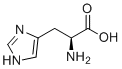
Physicochemical Properties
| Molecular Formula | C6H9N3O2 |
| Molecular Weight | 155.15 |
| Exact Mass | 155.069 |
| CAS # | 71-00-1 |
| Related CAS # | L-Histidine-15N3;1217456-12-6;L-Histidine-13C6,15N3 hydrochloride;L-Histidine dihydrochloride;6027-02-7 |
| PubChem CID | 6274 |
| Appearance |
Needles or plates COLORLESS |
| Density | 1.4±0.1 g/cm3 |
| Boiling Point | 458.9±35.0 °C at 760 mmHg |
| Melting Point | 282 °C (dec.)(lit.) |
| Flash Point | 231.3±25.9 °C |
| Vapour Pressure | 0.0±1.2 mmHg at 25°C |
| Index of Refraction | 1.615 |
| LogP | -1.26 |
| Hydrogen Bond Donor Count | 3 |
| Hydrogen Bond Acceptor Count | 4 |
| Rotatable Bond Count | 3 |
| Heavy Atom Count | 11 |
| Complexity | 151 |
| Defined Atom Stereocenter Count | 1 |
| SMILES | C1=C(NC=N1)C[C@@H](C(=O)O)N |
| InChi Key | HNDVDQJCIGZPNO-YFKPBYRVSA-N |
| InChi Code | InChI=1S/C6H9N3O2/c7-5(6(10)11)1-4-2-8-3-9-4/h2-3,5H,1,7H2,(H,8,9)(H,10,11)/t5-/m0/s1 |
| Chemical Name | (2S)-2-amino-3-(1H-imidazol-5-yl)propanoic acid |
| Synonyms | Histidine NSC137773 NSC 137773 NSC-137773L-Histidine |
| HS Tariff Code | 2934.99.9001 |
| Storage |
Powder-20°C 3 years 4°C 2 years In solvent -80°C 6 months -20°C 1 month |
| Shipping Condition | Room temperature (This product is stable at ambient temperature for a few days during ordinary shipping and time spent in Customs) |
Biological Activity
| ln Vitro | Growth was totally suppressed by L-histidine, and its impact on viability was inversely connected with the expression of FLO11. L-histidine had no effect on the S288c and Δflo11 strains' capacity to survive. Saccharomyces floresii's air-liquid biofilm formation and polysiloxane traces were greatly inhibited by L-histidine, while the altered levels of the FLO11 gene remained unaffected. Moreover, L-histidine can alter the amount of lipid and chitin in the flor yeast cell wall [1]. |
| ln Vivo | Brain edema treated with thioacetamide is completely inhibited by L-histidine (100 mg/kg) [2]. 60% of the cerebral edema in the L-histidine diet group was caused by the histamine release in the hypothalamus under strong K+ stimulation. The L-histidine diet, however, has no effect on other monoamines and does not change the substance's concentration. While the L-histidine diet group stopped in the light box during their entire stay in the light/dark box test performance, they stopped in the center zone during the open field test performance. This suggests that the L-histidine diet group may cause anxiety-like behavior [3]. |
| ADME/Pharmacokinetics |
Absorption, Distribution and Excretion Absorbed from the small intestine via an active transport mechanism requiring the presence of sodium. ESSENTIAL AMINO ACIDS ARE TRANSFERRED TO FETUS AGAINST A CONCN GRADIENT &, IN THE CASE OF HISTIDINE, NATURAL L-ISOMER HAS BEEN SHOWN TO CROSS SEVERAL TIMES AS FAST AS THE D-ISOMER. Metabolism / Metabolites PRODUCT OF OXIDATIVE DEAMINATION OR TRANSAMINATION OF L-HISTIDINE IS BETA-IMIDAZOLEPYRUVIC ACID; & PRODUCT OF DECARBOXYLATION IS HISTAMINE. HISTAMINE ENTERS OTHER PATHWAYS TO YIELD FURTHER METABOLIC PRODUCTS. /FROM TABLE/ |
| Toxicity/Toxicokinetics |
Toxicity Summary Since the actions of supplemental L-histidine are unclear, any postulated mechanism is entirely speculative. However, some facts are known about L-histidine and some of its metabolites, such as histamine and trans-urocanic acid, which suggest that supplemental L-histidine may one day be shown to have immunomodulatory and/or antioxidant activities. Low free histidine has been found in the serum of some rheumatoid arthritis patients. Serum concentrations of other amino acids have been found to be normal in these patients. L-histidine is an excellent chelating agent for such metals as copper, iron and zinc. Copper and iron participate in a reaction (Fenton reaction) that generates potent reactive oxygen species that could be destructive to tissues, including joints. L-histidine is the obligate precursor of histamine, which is produced via the decarboxylation of the amino acid. In experimental animals, tissue histamine levels increase as the amount of dietary L-histidine increases. It is likely that this would be the case in humans as well. Histamine is known to possess immunomodulatory and antioxidant activity. Suppressor T cells have H2 receptors, and histamine activates them. Promotion of suppressor T cell activity could be beneficial in rheumatoid arthritis. Further, histamine has been shown to down-regulate the production of reactive oxygen species in phagocytic cells, such as monocytes, by binding to the H2 receptors on these cells. Decreased reactive oxygen species production by phagocytes could play antioxidant, anti-inflammatory and immunomodulatory roles in such diseases as rheumatoid arthritis. This latter mechanism is the rationale for the use of histamine itself in several clinical trials studying histamine for the treatment of certain types of cancer and viral diseases. In these trials, down-regulation by histamine of reactive oxygen species formation appears to inhibit the suppression of natural killer (NK) cells and cytotoxic T lymphocytes, allowing these cells to be more effective in attacking cancer cells and virally infected cells. Toxicity Data ORL-RAT LD50 > 15000 mg/kg, IPR-RAT LD50 > 8000 mg/kg, ORL-MUS LD50 > 15000 mg/kg, IVN-MUS LD50 > 2000 mg/kg Interactions WARFARIN ALONE AT 5 MG/KG OF BAIT KILLED 37% OF ROOF RATS, BUT WHEN IN COMBINATION WITH L-HISTIDINE (40 MG/KG BAIT), ACTIVATED CLAY, CHARCOAL, & CARBON (10 G/KG BAIT) IT CAUSED, RESPECTIVELY, 100, 88, 75, & 63% MORTALITY OF RATS. |
| References |
[1]. Bou Zeidan M, et al. L-histidine inhibits biofilm formation and FLO11-associated phenotypes in Saccharomyces cerevisiae flor yeasts. PLoS One. 2014 Nov 4;9(11):e112141. [2]. Rama Rao KV, et al. Brain edema in acute liver failure: inhibition by L-histidine. Am J Pathol. 2010 Mar;176(3):1400-8. [3]. Yoshikawa T, et al. Insufficient intake of L-histidine reduces brain histamine and causes anxiety-like behaviors in male mice. J Nutr. 2014 Oct;144(10):1637-41 |
| Additional Infomation |
Pharmacodynamics Is found abundantly in hemoglobin; has been used in the treatment of rheumatoid arthritis, allergic diseases, ulcers and anemia. A deficiency can cause poor hearing. |
Solubility Data
| Solubility (In Vitro) |
H2O : ~20.83 mg/mL (~134.26 mM) DMSO : ~1 mg/mL (~6.45 mM) |
| Solubility (In Vivo) |
Solubility in Formulation 1: 25 mg/mL (161.13 mM) in PBS (add these co-solvents sequentially from left to right, and one by one), clear solution; with sonication. (Please use freshly prepared in vivo formulations for optimal results.) |
| Preparing Stock Solutions | 1 mg | 5 mg | 10 mg | |
| 1 mM | 6.4454 mL | 32.2269 mL | 64.4538 mL | |
| 5 mM | 1.2891 mL | 6.4454 mL | 12.8908 mL | |
| 10 mM | 0.6445 mL | 3.2227 mL | 6.4454 mL |