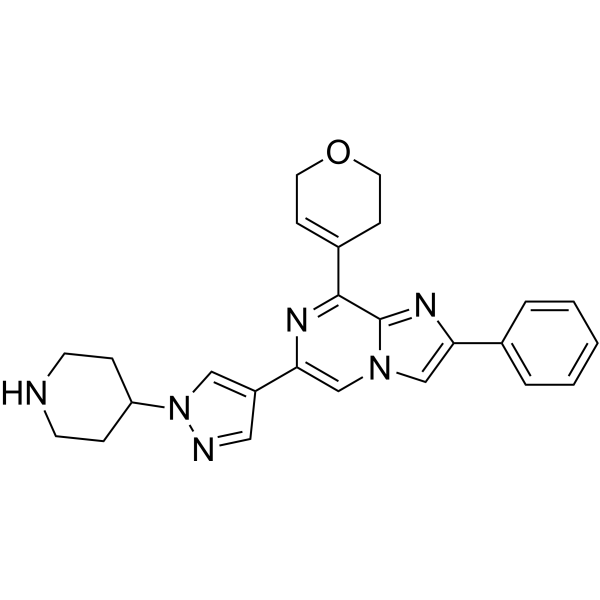
Physicochemical Properties
| Molecular Formula | C25H26N6O |
| Molecular Weight | 426.51 |
| CAS # | 3023925-68-7 |
| Appearance | Off-white to light yellow solid powder |
| HS Tariff Code | 2934.99.9001 |
| Storage |
Powder-20°C 3 years 4°C 2 years In solvent -80°C 6 months -20°C 1 month |
| Shipping Condition | Room temperature (This product is stable at ambient temperature for a few days during ordinary shipping and time spent in Customs) |
Biological Activity
| ln Vitro | YL-939 (0.01-10 μM) and HT-1080, Miapaca-2, Calu-1, HCT116, and SHSY5Y cells significantly protect cells against ferroptosis (IC50 values of 0.14 μM, 0.25 μM, 0.16 μM, 0.16 μM). 0.24 micrograms per milligram[1]. Reduces ROS levels in cytosol and membrane lipids with YL-939 (5 μM; 10 hours; ES-2 cells)[1]. PHB2 is a biological target of YL-939 (5 μM; 1-10 h; ES-2 cells) [1]. The concentration-dependent inhibition of ferritin autophagy is achieved by YL-939 (3 μM; 10 h; ES-2 cells) through its improvement of ferritin expression and its ability to block autophagosomes/lysosomes. |
| ln Vivo | In an acute liver injury model induced by acetaminophen (APAP), YL-939 (3 mg/kg; i.p.; single injection) ameliorates liver injury [1]. |
| Cell Assay |
Western Blot Analysis[1] Cell Types: ES-2 cells Tested Concentrations: 5 μM Incubation Duration: 1, 5, 7.5, and 10 hrs (hours) Experimental Results: Pulled down PHB2 protein by the probe. Western Blot Analysis[1] Cell Types: ES- 2 cells Tested Concentrations: 3 μM Incubation Duration: 10 hrs (hours) Experimental Results: Increased the expression of nuclear receptor coactivator 4(NCOA4) in a dose-dependent manner. |
| Animal Protocol |
Animal/Disease Models: Acetaminophen (APAP)-induced male C57BL /6J mouse[1] Doses: 3 mg/kg Route of Administration: intraperitoneal (ip)injection; single injection Experimental Results: Inhibited the cell death and inflammatory infiltration in the liver tissues of male C57BL/J6 mice that received APAP. |
| References |
[1]. Non-classical ferroptosis inhibition by a small molecule targeting PHB2. Nat Commun. 2022 Dec 3;13(1):7473. |
Solubility Data
| Solubility (In Vitro) | DMSO :~100 mg/mL (~234.46 mM) |
| Solubility (In Vivo) |
Solubility in Formulation 1: ≥ 2.5 mg/mL (5.86 mM) (saturation unknown) in 10% DMSO + 40% PEG300 +5% Tween-80 + 45% Saline (add these co-solvents sequentially from left to right, and one by one), clear solution. For example, if 1 mL of working solution is to be prepared, you can add 100 μL of 25.0 mg/mL clear DMSO stock solution to 400 μL PEG300 and mix evenly; then add 50 μL Tween-80 + to the above solution and mix evenly; then add 450 μL normal saline to adjust the volume to 1 mL. Preparation of saline: Dissolve 0.9 g of sodium chloride in 100 mL ddH₂ O to obtain a clear solution. (Please use freshly prepared in vivo formulations for optimal results.) |
| Preparing Stock Solutions | 1 mg | 5 mg | 10 mg | |
| 1 mM | 2.3446 mL | 11.7231 mL | 23.4461 mL | |
| 5 mM | 0.4689 mL | 2.3446 mL | 4.6892 mL | |
| 10 mM | 0.2345 mL | 1.1723 mL | 2.3446 mL |