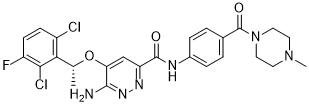
X-376 (an analog of Ensartinib or X-396) is a novel, potent and highly selective ALK inhibitor with IC50 of 0.61 nM and the potential to be used for treating non-small cell lung cancer.
Physicochemical Properties
| Molecular Formula | C25H25CL2FN6O3 |
| Molecular Weight | 547.4088 |
| Exact Mass | 546.134 |
| CAS # | 1365267-27-1 |
| Related CAS # | 1370651-20-9 (X396);1365267-27-1 (X376); |
| PubChem CID | 56960447 |
| Appearance | White to off-white solid powder |
| Density | 1.4±0.1 g/cm3 |
| Boiling Point | 695.1±55.0 °C at 760 mmHg |
| Flash Point | 374.2±31.5 °C |
| Vapour Pressure | 0.0±2.2 mmHg at 25°C |
| Index of Refraction | 1.654 |
| LogP | 4.21 |
| Hydrogen Bond Donor Count | 2 |
| Hydrogen Bond Acceptor Count | 8 |
| Rotatable Bond Count | 6 |
| Heavy Atom Count | 37 |
| Complexity | 784 |
| Defined Atom Stereocenter Count | 1 |
| SMILES | C[C@H](C1=C(C=CC(=C1Cl)F)Cl)OC2=CC(=NN=C2N)C(=O)NC3=CC=C(C=C3)C(=O)N4CCN(CC4)C |
| InChi Key | ONPGOSVDVDPBCY-CQSZACIVSA-N |
| InChi Code | InChI=1S/C25H25Cl2FN6O3/c1-14(21-17(26)7-8-18(28)22(21)27)37-20-13-19(31-32-23(20)29)24(35)30-16-5-3-15(4-6-16)25(36)34-11-9-33(2)10-12-34/h3-8,13-14H,9-12H2,1-2H3,(H2,29,32)(H,30,35)/t14-/m1/s1 |
| Chemical Name | 6-Amino-5-[(1R)-1-(2,6-dichloro-3-fluorophenyl)ethoxy]-N-[4-[(4-methyl-1-piperazinyl)carbonyl]phenyl]-3-pyridazinecarboxamide |
| Synonyms | X-376 X 376 X376 Ensartinib-analog X 396-analog |
| HS Tariff Code | 2934.99.9001 |
| Storage |
Powder-20°C 3 years 4°C 2 years In solvent -80°C 6 months -20°C 1 month |
| Shipping Condition | Room temperature (This product is stable at ambient temperature for a few days during ordinary shipping and time spent in Customs) |
Biological Activity
| ln Vitro | The capacity of X-376 to inhibit the proliferation of several cancer cell lines carrying ALK fusions or point mutations was investigated. X-376 is effective against H3122 lung cancer cells harboring EML4-ALK E13;A20 (IC50: 77 nM). X-376 is similarly effective against H2228 lung cancer cells harboring EML4-ALK E6a/b; A20 (IC50: 57 nM). In addition, X-376 is effective against NPM-ALK-bearing SUDHL-1 lymphoma cells (IC50: 32 nM). X-376 also suppresses SY5Y neuroblastoma cells harboring ALK F1174L, MET-dependent MKN-45 gastric cancer cells, HepG2 cells, and PC-9 lung cancer cell lines containing EGFR exon 19 del, with IC50 of 142 nM, respectively. , 150 nM, 15.137 μM and 3.062 μM correspondingly [1]. |
| ln Vivo | X-376's in vivo effects on H3122 xenografts are being investigated. X-376 has a considerable in vivo half-life and a notable bioavailability, according to pharmacokinetic investigations. X-376 was given to naked mice containing H3122 xenografts at a dose of 50 mg/kg bid. When X-376 was used in place of the vehicle alone, tumor growth was markedly delayed. In vivo, X-376 was well tolerated in xenograft tests. Treatment with X-376 had no effect on mouse body weight. The mice receiving the medication looked well and did not exhibit any harm related to the compounds. Sprague Dawley (SD) rats were used in additional systemic toxicity and toxicokinetic experiments to assess the possible adverse effects of X-376. In SD rats, X-376 was repeatedly given orally at doses of 25, 50, and 100 mg/kg for ten days. All of the animals survived until the end of the trial. 50 mg/kg was found to be the non-significant toxicity (NST) limit for X-376. The AUC and Cmax of X-376 at the NST level are 41 μM×hr and 5.04 μM, respectively[1]. |
| References |
[1]. Insights into ALK-driven cancers revealed through development of novel ALK tyrosine kinaseinhibitors. Cancer Res. 2011 Jul 15;71(14):4920-31. |
| Additional Infomation |
X-396 has been used in trials studying the treatment of Advanced Solid Tumors and Non-small Cell Lung Cancer. See also: Ensartinib (annotation moved to). |
Solubility Data
| Solubility (In Vitro) | DMSO : ~100 mg/mL (~182.68 mM) |
| Solubility (In Vivo) |
Solubility in Formulation 1: ≥ 2.5 mg/mL (4.57 mM) (saturation unknown) in 10% DMSO + 40% PEG300 + 5% Tween80 + 45% Saline (add these co-solvents sequentially from left to right, and one by one), clear solution. For example, if 1 mL of working solution is to be prepared, you can add 100 μL of 25.0 mg/mL clear DMSO stock solution to 400 μL PEG300 and mix evenly; then add 50 μL Tween-80 to the above solution and mix evenly; then add 450 μL normal saline to adjust the volume to 1 mL. Preparation of saline: Dissolve 0.9 g of sodium chloride in 100 mL ddH₂ O to obtain a clear solution. Solubility in Formulation 2: ≥ 2.5 mg/mL (4.57 mM) (saturation unknown) in 10% DMSO + 90% (20% SBE-β-CD in Saline) (add these co-solvents sequentially from left to right, and one by one), clear solution. For example, if 1 mL of working solution is to be prepared, you can add 100 μL of 25.0 mg/mL clear DMSO stock solution to 900 μL of 20% SBE-β-CD physiological saline solution and mix evenly. Preparation of 20% SBE-β-CD in Saline (4°C,1 week): Dissolve 2 g SBE-β-CD in 10 mL saline to obtain a clear solution. Solubility in Formulation 3: ≥ 2.5 mg/mL (4.57 mM) (saturation unknown) in 10% DMSO + 90% Corn Oil (add these co-solvents sequentially from left to right, and one by one), clear solution. For example, if 1 mL of working solution is to be prepared, you can add 100 μL of 25.0 mg/mL clear DMSO stock solution to 900 μL of corn oil and mix evenly. (Please use freshly prepared in vivo formulations for optimal results.) |
| Preparing Stock Solutions | 1 mg | 5 mg | 10 mg | |
| 1 mM | 1.8268 mL | 9.1339 mL | 18.2678 mL | |
| 5 mM | 0.3654 mL | 1.8268 mL | 3.6536 mL | |
| 10 mM | 0.1827 mL | 0.9134 mL | 1.8268 mL |