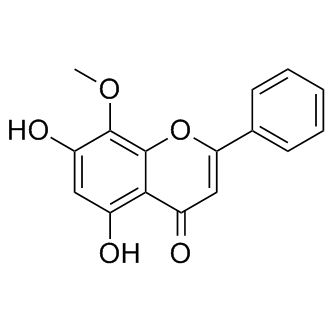
Wogonin (Vogonin), a naturally occurring and pharmacologically-active flavonoid found in plants, has been reported to exhibit anticancer effects against various cancer cell types such as osteosarcoma, leukemia, breast cancer and glioma. Wogonin induced a G1 phase cell cycle arrest in HCT116 cells in a concentration- and time-dependent manner. Meanwhile, the cell cycle-related proteins, such as cyclin A, E, D1, and CDK2, 4 were down-regulated in wogonin-induced G1 cell cycle arrest. Furthermore, we showed that the anti-proliferation and G1 arrest effect of wogonin on HCT116 cells was associated with deregulation of Wnt/β-catenin signaling pathway.
Physicochemical Properties
| Molecular Formula | C16H12O5 | |
| Molecular Weight | 284.26 | |
| Exact Mass | 284.068 | |
| Elemental Analysis | C, 67.60; H, 4.26; O, 28.14 | |
| CAS # | 632-85-9 | |
| Related CAS # | 51059-44-0 (Wogonoside) | |
| PubChem CID | 5281703 | |
| Appearance | Light yellow to yellow solid powder | |
| Density | 1.4±0.1 g/cm3 | |
| Boiling Point | 518.8±50.0 °C at 760 mmHg | |
| Melting Point | 203-206°C | |
| Flash Point | 198.4±23.6 °C | |
| Vapour Pressure | 0.0±1.4 mmHg at 25°C | |
| Index of Refraction | 1.669 | |
| LogP | 2.14 | |
| Hydrogen Bond Donor Count | 2 | |
| Hydrogen Bond Acceptor Count | 5 | |
| Rotatable Bond Count | 2 | |
| Heavy Atom Count | 21 | |
| Complexity | 426 | |
| Defined Atom Stereocenter Count | 0 | |
| InChi Key | XLTFNNCXVBYBSX-UHFFFAOYSA-N | |
| InChi Code | InChI=1S/C16H12O5/c1-20-15-12(19)7-10(17)14-11(18)8-13(21-16(14)15)9-5-3-2-4-6-9/h2-8,17,19H,1H3 | |
| Chemical Name | 4H-1-Benzopyran-4-one, 5,7-dihydroxy-8-methoxy-2-phenyl- | |
| Synonyms |
|
|
| HS Tariff Code | 2934.99.9001 | |
| Storage |
Powder-20°C 3 years 4°C 2 years In solvent -80°C 6 months -20°C 1 month Note: This product requires protection from light (avoid light exposure) during transportation and storage. |
|
| Shipping Condition | Room temperature (This product is stable at ambient temperature for a few days during ordinary shipping and time spent in Customs) |
Biological Activity
| Targets |
CDK8; Natural flavone; anti-inflammatory, anti-tumor, anti-oxidant, neuroprotective, anti-fungal activities; Wnt CDK8 (Cyclin-dependent kinase 8) [1] - Cdk4 (Cyclin-dependent kinase 4) and Cyclin D1 [2] - PPAR-γ (Peroxisome proliferator-activated receptor gamma) [3] - Wnt/β-catenin signaling pathway components (β-catenin, c-Myc) [1] |
| ln Vitro |
In caco-2, SW1116, and HCT116 cells, wogonin (0-200 μM) shows a dose- and time-dependent reduction in cell viability. In HCT-116 cells, wogonin (10–40 μM) causes G1 phase arrest. In HCT116 cells, wogonin also inhibits the Wnt signaling pathway. Wogonin interferes with the TCF/Lef family transcription factor's function. Furthermore, Wogonin suppresses CDK8 activity to prevent β-catenin-mediated transcription[1]. On HeLa cells, wogonin exhibits cytotoxic and antiproliferative properties. In HeLa cells, wogonin (90 µM) significantly reduces the levels of cyclin D1 and Cdk4, and causes cell cycle arrest at the G0-G1 phase[2]. In RAW264.7 cells, wogonin (1.25, 2.5, 5, 10, 20 μg/ml) inhibits the inflammatory response triggered by EtOH[3]. In human colorectal cancer cells, Wogonin (20 μM, 40 μM, 60 μM) induced concentration-dependent G1 phase cell cycle arrest, reduced cell proliferation by 32% (20 μM), 58% (40 μM), and 75% (60 μM) compared to control, and inactivated CDK8 protein expression. It also downregulated Wnt/β-catenin pathway-related proteins (β-catenin, c-Myc, Cyclin D1) and mRNA levels [1] - In human cervical carcinoma HeLa cells, Wogonin (10 μM, 20 μM, 30 μM) exerted concentration-dependent antiproliferative effects, with 48-hour IC50 value of ~25 μM. It induced G1 phase arrest by inhibiting Cdk4 and Cyclin D1 protein expression, while increasing p21Cip1 (cyclin-dependent kinase inhibitor) protein levels [2] - In in vitro alcoholic liver disease-related inflammation models, Wogonin (5 μM, 10 μM, 20 μM) activated PPAR-γ, reduced the expression of proinflammatory cytokines (TNF-α, IL-6, IL-1β) at mRNA and protein levels, and inhibited NF-κB (nuclear factor kappa B) pathway activation [3] |
| ln Vivo |
Wogonin (30, 60 mg/kg) inhibits HCT116 cell tumor growth in a xenograft model[1]. Wogonin (25, 50, and 100 mg/kg) shields mice's livers from damage and the pathological features of ALD. In mice with ALD and RAW264.7 cells induced by EtOH, wogonin stimulates the expression of PPAR-γ[3]. In a mouse model of alcoholic liver disease (induced by chronic alcohol feeding), oral administration of Wogonin (50 mg/kg, 100 mg/kg, once daily for 4 weeks) attenuated liver inflammation and injury. Liver tissue levels of TNF-α, IL-6, and IL-1β were reduced by 45% (50 mg/kg) and 68% (100 mg/kg) compared to the alcohol-fed control group [3] - Wogonin treatment upregulated PPAR-γ protein expression and downregulated NF-κB p65 phosphorylation in mouse liver tissues, alleviating alcoholic steatosis and hepatocellular necrosis [3] |
| Enzyme Assay |
Wogonin, a naturally occurring flavonoid, has been shown to have tumor therapeutic potential both in vitro and in vivo. To better understand its anticancer mechanism, we examined the effect of wogonin on human cervical carcinoma HeLa cells. In this study, we observed that G1 phase arrest was involved in wogonin-induced growth inhibition in HeLa cells. Over a 24 h exposure of HeLa cells to 90 micromol x L(-1) wogonin, the promoters of G1-S transition, including cyclin D1/Cdk4 and pRb, decreased within 12 h and E2F-1 depleted in the nucleus at the same time. As the G1 phase arrest developed, p53 and the Cdk inhibitor p21Cip1 elevated both at protein and mRNA levels. Furthermore, the up-regulation of p21Cip1 induced by wogonin was dramatically inhibited by siRNA-mediated p53 gene silencing. Collectively, our data suggested that wogonin induced G1 phase arrest in HeLa cells by modulating several key G1 regulatory proteins, such as Cdk4 and cyclin D1, as well as up-regulation of a p53-mediated p21Cip1 expression. This mechanism of wogonin may play an important role in the killing of cancerous cells and offer a potential mechanism for its anticancer action in vivo[2]. CDK8 kinase activity assay: Purified CDK8-Cyclin C complex was incubated with Wogonin at serial concentrations in reaction buffer containing ATP and a specific CDK8 substrate peptide. The reaction was incubated at 37°C for 60 minutes, and the phosphorylated substrate was detected via a colorimetric assay. The inhibition rate of CDK8 kinase activity was calculated by comparing the absorbance of drug-treated groups with the control group [1] - PPAR-γ activation assay: PPAR-γ reporter gene-transfected cells were treated with Wogonin (5 μM, 10 μM, 20 μM) for 24 hours. After cell lysis, the luciferase activity was measured using a luminometer to evaluate PPAR-γ transcriptional activation. A PPAR-γ agonist was used as a positive control [3] |
| Cell Assay |
Wogonin, a naturally occurring mono-flavonoid, has been reported to have tumor therapeutic potential and good selectivity both in vitro and in vivo. Herein, we investigated the anti-proliferation effects and associated mechanisms of wogonin in human colorectal cancer in vitro. The flow-cytometric analysis showed that wogonin induced a G1 phase cell cycle arrest in HCT116 cells in a concentration- and time-dependent manner. Meanwhile, the cell cycle-related proteins, such as cyclin A, E, D1, and CDK2, 4 were down-regulated in wogonin-induced G1 cell cycle arrest. Furthermore, we showed that the anti-proliferation and G1 arrest effect of wogonin on HCT116 cells was associated with deregulation of Wnt/β-catenin signaling pathway. Wogonin-treated cells showed decreased intracellular levels of Wnt proteins, and activated degradation complex to phosphorylated and targeted β-catenin for proteasomal degradation. Wogonin inhibited β-catenin-mediated transcription by interfering in the transcriptional activity of TCF/Lef, and repressing the kinase activity of CDK8 which has been considered as an oncogene involving in the development of colorectal cancers. Moreover, CDK8 siRNA-transfected HCT116 cells showed similar results to wogonin treated cells. Thus, our data suggested that wogonin induced anti-proliferation and G1 arrest via Wnt/β-catenin signaling pathway and it can be developed as a therapeutic agent against human colorectal cancer[1]. HCT116 cells were planted on a 96-well plate (1 × 10⁵ cells per well). Different concentrations of wogonin were added and incubated for 24 h. Subsequently, 20 μL of MTT solution (5 mg/mL) is transferred to each well and the plates were incubated for 4 h at 37°C and 5% CO2. The supernatant was aspirated off and 100 μL DMSO was added to dissolve the formazan crystal. The mixture was shaken and measured at 570 nm using a universal microplate reader.[1] Human colorectal cancer cell assay: Cells were seeded in 96-well plates and treated with Wogonin (20 μM, 40 μM, 60 μM) for 48 hours. Cell proliferation was assessed by MTT assay. For cell cycle analysis, cells were stained with propidium iodide and analyzed by flow cytometry. Western blot and RT-PCR were performed to detect the expression of CDK8, β-catenin, c-Myc, and Cyclin D1 [1] - HeLa cell assay: HeLa cells were cultured in 6-well plates and treated with Wogonin (10 μM, 20 μM, 30 μM) for 24 hours. Cell viability was measured by MTT assay to determine IC50. Cell cycle distribution was analyzed by flow cytometry after propidium iodide staining. Western blot was used to detect Cdk4, Cyclin D1, and p21Cip1 protein levels [2] - Inflammatory cell model assay: Hepatocytes or macrophages were treated with lipopolysaccharide (LPS) to induce inflammation, followed by Wogonin (5 μM, 10 μM, 20 μM) treatment for 18 hours. RT-PCR and Western blot were performed to measure the mRNA and protein levels of TNF-α, IL-6, IL-1β, PPAR-γ, and NF-κB p65 [3] |
| Animal Protocol |
In this study, researchers found that wogonin significantly attenuated inflammatory response in EtOH-fed mice, and reduced the expression of inflammatory cytokines such as TNF-α and IL-6 in EtOH-induced RAW264.7 cells. Furthermore, our findings showed that wogonin remarkably induced the expression of PPAR-γ in vivo and in vitro. Compared with the wogonin-treated group, blockade of PPAR-γ with inhibitor (T0070907) or PPAR-γ small interfering (si)-RNA were applied in RAW264.7 cells to evaluate the involvement of wogonin in alleviating EtOH-induced inflammation. Moreover, forced expression of PPAR-γ further suppressed the expression of TNF-α and IL-6 when treated with wogonin on EtOH-induced RAW264.7 cells. In addition, it was demonstrated that wogonin remarkably suppressed PPAR-γ-meditated phosphorylation and activation of NF-κB-P65. In conclusion, the above results indicated that wogonin may serve as an effective modulator of PPAR-γ by down-regulating NF-κB pathway, thereby attenuated inflammatory response in ALD.[3] C57BL/6 mice, male, 6-8 weeks old, weighing 18-22 g mice were housed at comfortable environment and are acclimatized for 3 days before the experiment. A total of 48 mice were randomLy divided into six groups of 8 animals, respectively control diet (CD)-fed mice, EtOH-fed mice, wogonin-treated mice at the dose of 25, 50, 100 mg/kg/day and the positive (dexamethasone, 1 mg/kg/day)-treated mice. Modeling process has a total of 16 days including a liquid diet adaptation period for 3 days and modeling for 13 days. The EtOH-fed mice are fed containing 5% v/v ethanol liquid diets adding certain vitamin and choline for 16 days, and mice are gavaged with a single binge ethanol administration (5 g/kg, body weight, 20% ethanol) at last day. At the same time, the wogonin-treated mice and the positive-treated mice are not only plus the ethanol administration, but also plus the medicines by gavage daily, whereas the CD-fed mice are fed with control liquid diets and gavaged with isocaloric maltose-dextrin at last day. All diets are prepared fresh daily. 9 h after the last gavage alcohol, mice are sacrificed under anaesthesia, the liver tissues and blood are collected for further analysis.[3] Mouse alcoholic liver disease model: Male mice were randomly divided into control, alcohol-fed, and Wogonin-treated groups. The alcohol-fed group received a Lieber-DeCarli liquid diet containing 5% ethanol for 4 weeks to induce alcoholic liver disease. Wogonin was dissolved in corn oil and administered via oral gavage at doses of 50 mg/kg and 100 mg/kg once daily during the 4-week alcohol feeding period. Control mice received a control liquid diet and corn oil. At the end of the experiment, mice were sacrificed, and liver tissues were collected for histological, biochemical, and molecular biological analyses [3] |
| ADME/Pharmacokinetics |
Metabolism / Metabolites Wogonin has known human metabolites that include (2S,3S,4S,5R)-3,4,5-trihydroxy-6-(5-hydroxy-8-methoxy-4-oxo-2-phenylchromen-7-yl)oxyoxane-2-carboxylic acid. |
| References |
[1]. Wogonin induced G1 cell cycle arrest by regulating Wnt/β-catenin signaling pathway and inactivating CDK8 in human colorectal cancer carcinoma cells. Toxicology. 2013 Oct 4;312:36-47. [2]. Wogonin induces G1 phase arrest through inhibiting Cdk4 and cyclin D1 concomitant with an elevation in p21Cip1 in human cervical carcinoma HeLa cells. Biochem Cell Biol. 2009 Dec;87(6):933-42. [3]. Wogonin attenuates inflammation by activating PPAR-γ in alcoholic liver disease. Int Immunopharmacol. 2017 Sep;50:95-106. |
| Additional Infomation |
Wogonin is a dihydroxy- and monomethoxy-flavone in which the hydroxy groups are positioned at C-5 and C-7 and the methoxy group is at C-8. It has a role as a cyclooxygenase 2 inhibitor, an antineoplastic agent, an angiogenesis inhibitor and a plant metabolite. It is a dihydroxyflavone and a monomethoxyflavone. It is a conjugate acid of a wogonin(1-). Wogonin has been reported in Trichoderma virens, Rhinacanthus nasutus, and other organisms with data available. Wogonin is a natural flavonoid compound isolated from the roots of Scutellaria baicalensis Georgi [1][2][3] - Its biological activities include antiproliferative effects on cancer cells (via cell cycle arrest) and anti-inflammatory effects (via PPAR-γ activation and NF-κB inhibition) [1][2][3] - The antiproliferative mechanism in cancer cells involves regulating Wnt/β-catenin signaling pathway (by inactivating CDK8) and modulating cell cycle regulators (Cdk4, Cyclin D1, p21Cip1) [1][2] - It has potential therapeutic applications in the treatment of colorectal cancer, cervical cancer, and alcoholic liver disease [1][2][3] |
Solubility Data
| Solubility (In Vitro) |
|
|||
| Solubility (In Vivo) |
Solubility in Formulation 1: 2.08 mg/mL (7.32 mM) in 10% DMSO + 40% PEG300 +5% Tween-80 + 45% Saline (add these co-solvents sequentially from left to right, and one by one), suspension solution; with sonication. For example, if 1 mL of working solution is to be prepared, you can add 100 μL of 20.8 mg/mL clear DMSO stock solution to 400 μL PEG300 and mix evenly; then add 50 μL Tween-80 + to the above solution and mix evenly; then add 450 μL normal saline to adjust the volume to 1 mL. Preparation of saline: Dissolve 0.9 g of sodium chloride in 100 mL ddH₂ O to obtain a clear solution. Solubility in Formulation 2: 24 mg/mL (84.43 mM) in 0.5% CMC-Na/saline water (add these co-solvents sequentially from left to right, and one by one), suspension solution; with ultrasonication. Preparation of saline: Dissolve 0.9 g of sodium chloride in 100 mL ddH₂ O to obtain a clear solution. (Please use freshly prepared in vivo formulations for optimal results.) |
| Preparing Stock Solutions | 1 mg | 5 mg | 10 mg | |
| 1 mM | 3.5179 mL | 17.5895 mL | 35.1791 mL | |
| 5 mM | 0.7036 mL | 3.5179 mL | 7.0358 mL | |
| 10 mM | 0.3518 mL | 1.7590 mL | 3.5179 mL |