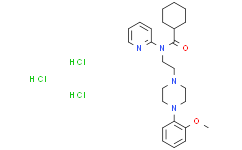
Physicochemical Properties
| Molecular Formula | C25H37CL3N4O2 |
| Molecular Weight | 531.9459 |
| Exact Mass | 422.268 |
| CAS # | 146714-97-8 |
| PubChem CID | 104911 |
| Appearance | Typically exists as solid at room temperature |
| Density | 1.2±0.1 g/cm3 |
| Boiling Point | 594.8±50.0 °C at 760 mmHg |
| Melting Point | 176-178°C |
| Flash Point | 313.5±30.1 °C |
| Vapour Pressure | 0.0±1.7 mmHg at 25°C |
| Index of Refraction | 1.590 |
| LogP | 2.66 |
| Hydrogen Bond Donor Count | 3 |
| Hydrogen Bond Acceptor Count | 5 |
| Rotatable Bond Count | 7 |
| Heavy Atom Count | 34 |
| Complexity | 546 |
| Defined Atom Stereocenter Count | 0 |
| SMILES | Cl[H].Cl[H].Cl[H].O=C(C1([H])C([H])([H])C([H])([H])C([H])([H])C([H])([H])C1([H])[H])N(C1=C([H])C([H])=C([H])C([H])=N1)C([H])([H])C([H])([H])N1C([H])([H])C([H])([H])N(C2=C([H])C([H])=C([H])C([H])=C2OC([H])([H])[H])C([H])([H])C1([H])[H] |
| InChi Key | QDUDBLVWOSYWID-UHFFFAOYSA-N |
| InChi Code | InChI=1S/C25H34N4O2.3ClH/c1-31-23-12-6-5-11-22(23)28-18-15-27(16-19-28)17-20-29(24-13-7-8-14-26-24)25(30)21-9-3-2-4-10-21;;;/h5-8,11-14,21H,2-4,9-10,15-20H2,1H3;3*1H |
| Chemical Name | N-[2-[4-(2-methoxyphenyl)piperazin-1-yl]ethyl]-N-pyridin-2-ylcyclohexanecarboxamide;trihydrochloride |
| Synonyms | WAY 100635 hydrochloride; WAY-100635 hydrochloride; Way 100635; WAY-100635 (hydrochloride); 8S48P899NE; N-[2-[4-(2-methoxyphenyl)piperazin-1-yl]ethyl]-N-pyridin-2-ylcyclohexanecarboxamide;trihydrochloride; Cyclohexanecarboxamide, N-(2-(4-(2-methoxyphenyl)-1-piperazinyl)ethyl)-N-2-pyridinyl-, trihydrochloride; |
| HS Tariff Code | 2934.99.9001 |
| Storage |
Powder-20°C 3 years 4°C 2 years In solvent -80°C 6 months -20°C 1 month |
| Shipping Condition | Room temperature (This product is stable at ambient temperature for a few days during ordinary shipping and time spent in Customs) |
Biological Activity
| Targets | D4 Receptor; 5-HT1A Receptor (pIC50 = 8.87); 5-HT1A Receptor (pA2 = 9.71) |
| ln Vitro | In HEK 293 cells that consistently express dopamine D2L or D4.4 receptors, the functional characteristics and binding affinities of WAY-100635 are assessed[1]. WAY-100635 exhibits binding affinities at D2L, D3, and D4. 2 receptors of 940, 370, and 16 nM, respectively. The Kd of [3H] WAY-100635 at D4.2 receptors is 2.4 nM, as shown by saturation analyses. WAY-100635 has an EC50 of 9.7 nM, making it a strong agonist in HEK-D4.4 cells. WAY-100635 has a strong 3.3 nM affinity for the D4.4 receptor [1]. |
| ln Vivo | Treatment with WAY-100635 (1 mg/kg; subcutaneous injection; male Sprague-Dawley rats) eliminates the reduction in abstinence signs severity brought on by administration of Rhodiola rosea in nicotine-dependent rats[2]. |
| Enzyme Assay | Screening assays[1] For the initial screens by the NIMH-PDSP at a large number of cloned receptors and transporters (for details, see Roth et al. (2002) and Shapiro et al. (2003)), 10 μM WAY-100635 was used. Where significant inhibition was measured (>50% inhibition with quadruplicate determinations), K i determinations were performed with 6–10 concentrations of unlabelled ligand, and data were analyzed with GraphPad Prism. |
| Cell Assay | Cyclic AMP accumulation assay[1] Cells were grown to confluent monolayers in 48-well clear tissue culture plates. Before assay, the growth medium was decanted, and the plates were placed on ice. Drug dilutions made in Earle’s balanced salt solution (EBSS) assay buffer (EBSS containing 2% bovine calf serum, 0.025% ascorbic acid, and 15 mM HEPES, pH 7.4) were added on ice. cAMP accumulation was stimulated by 5 μM forskolin, and each assay was performed in the presence of 500 μM isobutyl-methylxanthine. Incubations were performed for 15 min in a 37°C water bath. To terminate the stimulation, the assay medium was decanted, and cells were lysed by adding 100 μl of 3% trichloroacetic acid on ice. Plates were stored at 4°C for at least 1 h before quantification of cAMP.[1] |
| Animal Protocol |
Biodistribution Studies of [123I]6b and [123I]7b in Rat: General Procedure[3] Animal experiments were performed on male Wistar rats weighing approximately 230 g. Approval for the applied animal protocol used was obtained from the National Council on Animal Care and the in-house Ethics Committee according to the guidelines of the law on animal experiments of The Netherlands. The solution of the radiolabeled compounds was prepared 1 day prior to these studies. Rats were anesthetized with 2% isoflurane and received an intravenous injection of 200 μL of the radiolabeled compounds in the tail vein. After different time intervals, the rats were sacrificed, under anesthesia, by cervical dislocation, and blood was collected from the decapitated body. Tissues of interest were removed, weighed, and measured for radioactivity using a LKB Wallac 1282 CompuGamma CS. For calculation of the injected dose, five aliquots of the injected solution were weighed and counted for radioactivity. Results were decay corrected and expressed as percentage of injected dose per gram of tissue ± standard deviation (% ID/g ± SD).[3]br> [123I]6b[3] Two groups of four rats were used. The first group received 200 μL (7 MBq, <20 ng) of the radiolabeled compound intravenously and was sacrificed at 45 min after injection. In the second group, rats received an intravenous administration of nonlabeled compound 1 (2 mg/kg) 5 min prior to the intravenous administration of [123I]6b (7 MBq). Rats were also sacrificed and dissected at 45 min after injection.[3] [123I]7b[3] Three groups of four rats were used. Each rat received an intravenous injection of 200 μL (7 MBq, <20 ng) of the radiolabeled compound. They were sacrificed at 15, 45, and 120 min after injection and processed as above. |
| References |
[1]. Chemel BR, et al. WAY-100635 is a potent dopamine D4 receptor agonist. Psychopharmacology (Berl). 2006 Oct;188(2):244-51. [2]. Mannucci C, et al. Serotonin involvement in Rhodiola rosea attenuation of nicotine withdrawal signs in rats. Phytomedicine. 2012 Sep 15;19(12):1117-24. [3]. Al Hussainy R, et al. Design, synthesis, radiolabeling, and in vitro and in vivo evaluation of bridgehead iodinatedanalogues of N-{2-[4-(2-methoxyphenyl)piperazin-1-yl]ethyl}-N-(pyridin-2-yl)cyclohexanecarboxamide (WAY-100635) as potential SPECT ligands for the 5-HT1A receptor. J Med Chem. 2011 May 26;54(10):3480-91. |
Solubility Data
| Solubility (In Vitro) | May dissolve in DMSO (in most cases), if not, try other solvents such as H2O, Ethanol, or DMF with a minute amount of products to avoid loss of samples |
| Solubility (In Vivo) |
Note: Listed below are some common formulations that may be used to formulate products with low water solubility (e.g. < 1 mg/mL), you may test these formulations using a minute amount of products to avoid loss of samples. Injection Formulations (e.g. IP/IV/IM/SC) Injection Formulation 1: DMSO : Tween 80: Saline = 10 : 5 : 85 (i.e. 100 μL DMSO stock solution → 50 μL Tween 80 → 850 μL Saline) *Preparation of saline: Dissolve 0.9 g of sodium chloride in 100 mL ddH ₂ O to obtain a clear solution. Injection Formulation 2: DMSO : PEG300 :Tween 80 : Saline = 10 : 40 : 5 : 45 (i.e. 100 μL DMSO → 400 μLPEG300 → 50 μL Tween 80 → 450 μL Saline) Injection Formulation 3: DMSO : Corn oil = 10 : 90 (i.e. 100 μL DMSO → 900 μL Corn oil) Example: Take the Injection Formulation 3 (DMSO : Corn oil = 10 : 90) as an example, if 1 mL of 2.5 mg/mL working solution is to be prepared, you can take 100 μL 25 mg/mL DMSO stock solution and add to 900 μL corn oil, mix well to obtain a clear or suspension solution (2.5 mg/mL, ready for use in animals). Injection Formulation 4: DMSO : 20% SBE-β-CD in saline = 10 : 90 [i.e. 100 μL DMSO → 900 μL (20% SBE-β-CD in saline)] *Preparation of 20% SBE-β-CD in Saline (4°C,1 week): Dissolve 2 g SBE-β-CD in 10 mL saline to obtain a clear solution. Injection Formulation 5: 2-Hydroxypropyl-β-cyclodextrin : Saline = 50 : 50 (i.e. 500 μL 2-Hydroxypropyl-β-cyclodextrin → 500 μL Saline) Injection Formulation 6: DMSO : PEG300 : castor oil : Saline = 5 : 10 : 20 : 65 (i.e. 50 μL DMSO → 100 μLPEG300 → 200 μL castor oil → 650 μL Saline) Injection Formulation 7: Ethanol : Cremophor : Saline = 10: 10 : 80 (i.e. 100 μL Ethanol → 100 μL Cremophor → 800 μL Saline) Injection Formulation 8: Dissolve in Cremophor/Ethanol (50 : 50), then diluted by Saline Injection Formulation 9: EtOH : Corn oil = 10 : 90 (i.e. 100 μL EtOH → 900 μL Corn oil) Injection Formulation 10: EtOH : PEG300:Tween 80 : Saline = 10 : 40 : 5 : 45 (i.e. 100 μL EtOH → 400 μLPEG300 → 50 μL Tween 80 → 450 μL Saline) Oral Formulations Oral Formulation 1: Suspend in 0.5% CMC Na (carboxymethylcellulose sodium) Oral Formulation 2: Suspend in 0.5% Carboxymethyl cellulose Example: Take the Oral Formulation 1 (Suspend in 0.5% CMC Na) as an example, if 100 mL of 2.5 mg/mL working solution is to be prepared, you can first prepare 0.5% CMC Na solution by measuring 0.5 g CMC Na and dissolve it in 100 mL ddH2O to obtain a clear solution; then add 250 mg of the product to 100 mL 0.5% CMC Na solution, to make the suspension solution (2.5 mg/mL, ready for use in animals). Oral Formulation 3: Dissolved in PEG400 Oral Formulation 4: Suspend in 0.2% Carboxymethyl cellulose Oral Formulation 5: Dissolve in 0.25% Tween 80 and 0.5% Carboxymethyl cellulose Oral Formulation 6: Mixing with food powders Note: Please be aware that the above formulations are for reference only. InvivoChem strongly recommends customers to read literature methods/protocols carefully before determining which formulation you should use for in vivo studies, as different compounds have different solubility properties and have to be formulated differently. (Please use freshly prepared in vivo formulations for optimal results.) |
| Preparing Stock Solutions | 1 mg | 5 mg | 10 mg | |
| 1 mM | 1.8799 mL | 9.3994 mL | 18.7988 mL | |
| 5 mM | 0.3760 mL | 1.8799 mL | 3.7598 mL | |
| 10 mM | 0.1880 mL | 0.9399 mL | 1.8799 mL |