|
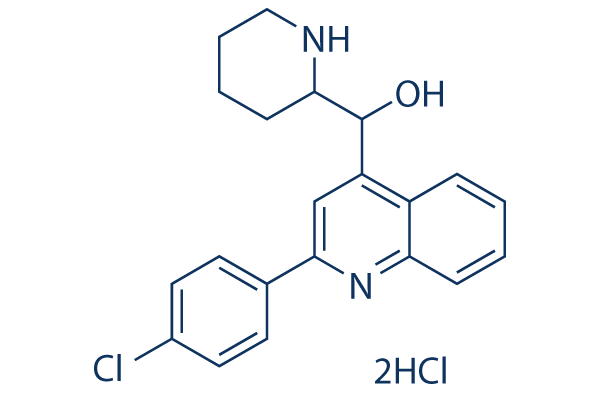
Vacquinol-1 dihydrochloride (also known as NSC-13316; NSC13316) is an MKK4 (mitogen-activated protein kinase kinase 4) activator with antitumor activity. It rapidly and selectively induces glioma cell death. Also inducing apoptosis in hepatocellular carcinoma (HCC)cell. Research showed that vacquinol-1 displayed high cytotoxicity against glioma cells, resulting in a complete loss of viability as measured by ATP depletion. Vacquinol-1 could selectively target GCs in mixed cocultures with human fibroblasts. Moreover, vacquinol-1 had no effect on caspase activity at any concentration or time point, which was unlike that of staurosporin. In addition, the fluorescence staining and western blot analyses of GCs for activating MKK4 phosphorylation revealed a rapid and pronounced activation by vacquinol-1 at 7.5 μM.
|
Physicochemical Properties
| Molecular Formula |
C21H23CL3N2O
|
| Molecular Weight |
425.779122591019
|
| CAS # |
2309312-85-2
|
| Related CAS # |
Vacquinol-1 dihydrochloride;2309312-85-2
|
| PubChem CID |
129896712
|
| Appearance |
White to off-white solid powder
|
| Hydrogen Bond Donor Count |
4
|
| Hydrogen Bond Acceptor Count |
3
|
| Rotatable Bond Count |
3
|
| Heavy Atom Count |
27
|
| Complexity |
426
|
| Defined Atom Stereocenter Count |
0
|
| SMILES |
ClC1C=CC(=CC=1)C1=CC(=C2C=CC=CC2=N1)C(C1CCCCN1)O.Cl.Cl
|
| Synonyms |
| NSC13316 hydrochloride;NSC 13316; NSC-13316; Vacquinol-1;Vacquinol 1;Vacquinol1hydrochloride |
|
| HS Tariff Code |
2934.99.9001
|
| Storage |
Powder-20°C 3 years
4°C 2 years
In solvent -80°C 6 months
-20°C 1 month Note: This product requires protection from light (avoid light exposure) during transportation and storage.
|
| Shipping Condition |
Room temperature (This product is stable at ambient temperature for a few days during ordinary shipping and time spent in Customs)
|
|
Biological Activity
| ln Vitro |
In vitro activity: Vacquinol-1 induces rapid and specific cell death of glioma cells with IC50 of 3.14 μM via membrane ruffling, cell rounding, massive macropinocytic vacuole accumulation, ATP depletion, and cytoplasmic membrane rupture.
Kinase Assay: Vacquinol-1 (also known as NSC-13316; NSC13316) is an MKK4 (mitogen-activated protein kinase kinase 4) activator with antitumor activity.
Cell Assay: Cell viability is measured using CellTiter-Glo Luminescent Cell Viability Assay according to the manufacturer’s instructions. |
|
| ln Vivo |
| The ability of vacquinol-1 to attenuate tumor progression was previously tested in a mouse model for human GBM. Vacquinol-1 or vehicle (DMSO) were intracranially administered into the site of original cell deposit 6 weeks after engraftment. Results showed that tumors were invariantly smaller, and the area of necrosis and hGFAP and hNestin immunoreactivity was significantly reduced. Moreove, only tumor cells in vacquinol-1-treated mice showed a massive LAMP1 staining. |
|
| Animal Protocol |
| Dissolved in DMSO; 15 μM or 20 mg/kg; Intracranial injection, i.p., p.o. | | Mice bearing U3013MG tumors | |
|
| References |
Cell.2014 Apr 10;157(2):313-28.
|
|
Solubility Data
| Solubility (In Vitro) |
| DMSO:70 mg/mL (164.4 mM) | | Water:<1 mg/mL | | Ethanol:<1 mg/mL |
|
| Solubility (In Vivo) |
Solubility in Formulation 1: 10 mg/mL (23.49 mM) in 50% PEG300 +50% Saline (add these co-solvents sequentially from left to right, and one by one), clear solution.
Preparation of saline: Dissolve 0.9 g of sodium chloride in 100 mL ddH₂ O to obtain a clear solution.
(Please use freshly prepared in vivo formulations for optimal results.)
|
| Preparing Stock Solutions |
|
1 mg |
5 mg |
10 mg |
| 1 mM |
2.3486 mL |
11.7432 mL |
23.4863 mL |
| 5 mM |
0.4697 mL |
2.3486 mL |
4.6973 mL |
| 10 mM |
0.2349 mL |
1.1743 mL |
2.3486 mL |
*Note: Please select an appropriate solvent for the preparation of stock solution based on your experiment needs. For most products, DMSO can be used for preparing stock solutions (e.g. 5 mM, 10 mM, or 20 mM concentration); some products with high aqueous solubility may be dissolved in water directly. Solubility information is available at the above Solubility Data section. Once the stock solution is prepared, aliquot it to routine usage volumes and store at -20°C or -80°C. Avoid repeated freeze and thaw cycles. |