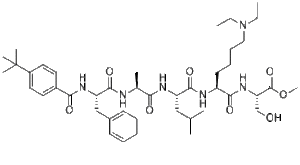
UNC3866 is a novel and potent antagonist of the methyllysine (Kme) reading function of the Polycomb CBX and CDY families of chromodomains with Kd of 100 nM as determined by AlphaScreen. UNC3866 binds the chromodomains of CBX4 and CBX7 most potently, with a Kd) of ∼100 nM for each, and is 6- to 18-fold selective as compared to seven other CBX and CDY chromodomains. Affinity of UNC3866 for CBX2, CBX4, CBX6 and CBX8 is surprisingly well associated with the percent sequence identity of each chromodomain relative to that of CBX7.
Physicochemical Properties
| Molecular Formula | C43H66N6O8 | |
| Molecular Weight | 795.0196 | |
| Exact Mass | 794.494 | |
| CAS # | 1872382-47-2 | |
| Related CAS # | 1872382-47-2;1872382-48-3 (TFA salt); | |
| PubChem CID | 101043861 | |
| Appearance | White to off-white solid powder | |
| LogP | 5.5 | |
| Hydrogen Bond Donor Count | 6 | |
| Hydrogen Bond Acceptor Count | 9 | |
| Rotatable Bond Count | 25 | |
| Heavy Atom Count | 57 | |
| Complexity | 1270 | |
| Defined Atom Stereocenter Count | 5 | |
| SMILES | O=C([C@]([H])(C([H])([H])C([H])(C([H])([H])[H])C([H])([H])[H])N([H])C([C@]([H])(C([H])([H])[H])N([H])C([C@]([H])(C([H])([H])C1C([H])=C([H])C([H])=C([H])C=1[H])N([H])C(C1C([H])=C([H])C(=C([H])C=1[H])C(C([H])([H])[H])(C([H])([H])[H])C([H])([H])[H])=O)=O)=O)N([H])[C@]([H])(C(N([H])[C@]([H])(C(=O)OC([H])([H])[H])C([H])([H])O[H])=O)C([H])([H])C([H])([H])C([H])([H])C([H])([H])N(C([H])([H])C([H])([H])[H])C([H])([H])C([H])([H])[H] |
|
| InChi Key | UMRRDXVUROEIKJ-JCXBGQGISA-N | |
| InChi Code | InChI=1S/C43H66N6O8/c1-10-49(11-2)24-16-15-19-33(39(53)48-36(27-50)42(56)57-9)45-41(55)34(25-28(3)4)46-37(51)29(5)44-40(54)35(26-30-17-13-12-14-18-30)47-38(52)31-20-22-32(23-21-31)43(6,7)8/h12-14,17-18,20-23,28-29,33-36,50H,10-11,15-16,19,24-27H2,1-9H3,(H,44,54)(H,45,55)(H,46,51)(H,47,52)(H,48,53)/t29-,33-,34-,35-,36-/m0/s1 | |
| Chemical Name | (3S,6S,9S,12S,15S)-methyl 3-benzyl-1-(4-(tert-butyl)phenyl)-12-(4-(diethylamino)butyl)-15-(hydroxymethyl)-9-isobutyl-6-methyl-1,4,7,10,13-pentaoxo-2,5,8,11,14-pentaazahexadecan-16-oate | |
| Synonyms |
|
|
| HS Tariff Code | 2934.99.9001 | |
| Storage |
Powder-20°C 3 years 4°C 2 years In solvent -80°C 6 months -20°C 1 month |
|
| Shipping Condition | Room temperature (This product is stable at ambient temperature for a few days during ordinary shipping and time spent in Customs) |
Biological Activity
| ln Vitro | UNC3866 is a strong antagonist of the Polycomb CBX and CDY families of chromodomains' ability to read methyl-lysine (Kme). With a Kd of 100 nM for each chromodomain, UNC3866 binds CBX4 and CBX7 chromodomains most potently. It also exhibits 6- to 18-fold selectivity against seven more CBX and CDY chromodomains and demonstrates good selectivity against over 250 other protein targets. A recognized CBX7 phenotype, PC3 cell growth, is inhibited by UNC3866, although few effects are observed with UNC4219, a methylated negative control molecule. A strong and physiologically relevant antagonist of PRC1 chromodomains is UNC3866. With a Kd of 97±2.4 nM, UNC3866 is the most powerful ligand for CBX7 that has been found. UNC3866 is 18-, 6-, and 12-fold selective for CBX4/7 over CBX2, -6 and -8, respectively, and equipotent for CBX4, which is most comparable to CBX7. Furthermore, CBX4/7 over CDY1 is 65-fold selective for UNC3866, while CBX4/7 over CDYL1b and CDYL2 is 9-fold selective[1]. | ||
| ln Vivo |
|
||
| Animal Protocol |
|
||
| References |
[1]. A cellular chemical probe targeting the chromodomains of Polycomb repressive complex 1. Nat Chem Biol. 2016 Mar;12(3):180-7. |
Solubility Data
| Solubility (In Vitro) |
|
|||
| Solubility (In Vivo) |
Solubility in Formulation 1: ≥ 2.5 mg/mL (3.14 mM) (saturation unknown) in 10% DMSO + 40% PEG300 + 5% Tween80 + 45% Saline (add these co-solvents sequentially from left to right, and one by one), clear solution. For example, if 1 mL of working solution is to be prepared, you can add 100 μL of 25.0 mg/mL clear DMSO stock solution to 400 μL PEG300 and mix evenly; then add 50 μL Tween-80 to the above solution and mix evenly; then add 450 μL normal saline to adjust the volume to 1 mL. Preparation of saline: Dissolve 0.9 g of sodium chloride in 100 mL ddH₂ O to obtain a clear solution. Solubility in Formulation 2: ≥ 2.5 mg/mL (3.14 mM) (saturation unknown) in 10% DMSO + 90% (20% SBE-β-CD in Saline) (add these co-solvents sequentially from left to right, and one by one), clear solution. For example, if 1 mL of working solution is to be prepared, you can add 100 μL of 25.0 mg/mL clear DMSO stock solution to 900 μL of 20% SBE-β-CD physiological saline solution and mix evenly. Preparation of 20% SBE-β-CD in Saline (4°C,1 week): Dissolve 2 g SBE-β-CD in 10 mL saline to obtain a clear solution. Solubility in Formulation 3: ≥ 2.5 mg/mL (3.14 mM) (saturation unknown) in 10% DMSO + 90% Corn Oil (add these co-solvents sequentially from left to right, and one by one), clear solution. For example, if 1 mL of working solution is to be prepared, you can add 100 μL of 25.0 mg/mL clear DMSO stock solution to 900 μL of corn oil and mix evenly. (Please use freshly prepared in vivo formulations for optimal results.) |
| Preparing Stock Solutions | 1 mg | 5 mg | 10 mg | |
| 1 mM | 1.2578 mL | 6.2891 mL | 12.5783 mL | |
| 5 mM | 0.2516 mL | 1.2578 mL | 2.5157 mL | |
| 10 mM | 0.1258 mL | 0.6289 mL | 1.2578 mL |