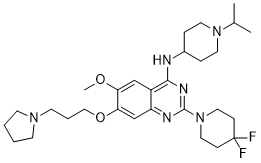
UNC0642 (UNC-0642) is a novel, potent, selective, dual inhibitor of G9a/GLP (histone methyltransferases) with antitumor activity. It inhibits G9a and GLP with IC50 values of < 2.5 nM. UNC0642 exhibits more than 300-fold selectivity for G9a and GLP over a broad range of kinases, GPCRs, transporters, and ion channels. UNC0642 has better pharmacokinetic properties than its early generations (lead compounds). As the first G9a and GLP in vivo chemical probe, UNC0642 not only maintains high in vitro and cellular potency, low cell toxicity, and excellent selectivity, but also displays improved in vivo PK properties, making it suitable for animal studies.
Physicochemical Properties
| Molecular Formula | C29H44F2N6O2 | |
| Molecular Weight | 546.7 | |
| Exact Mass | 546.349 | |
| Elemental Analysis | C, 63.71; H, 8.11; F, 6.95; N, 15.37; O, 5.85 | |
| CAS # | 1481677-78-4 | |
| Related CAS # |
|
|
| PubChem CID | 53315878 | |
| Appearance | White to off-white solid powder | |
| Density | 1.2±0.1 g/cm3 | |
| Boiling Point | 679.2±65.0 °C at 760 mmHg | |
| Flash Point | 364.6±34.3 °C | |
| Vapour Pressure | 0.0±2.1 mmHg at 25°C | |
| Index of Refraction | 1.592 | |
| LogP | 3.3 | |
| Hydrogen Bond Donor Count | 1 | |
| Hydrogen Bond Acceptor Count | 10 | |
| Rotatable Bond Count | 10 | |
| Heavy Atom Count | 39 | |
| Complexity | 739 | |
| Defined Atom Stereocenter Count | 0 | |
| SMILES | FC1(C([H])([H])C([H])([H])N(C2=NC3=C([H])C(=C(C([H])=C3C(=N2)N([H])C2([H])C([H])([H])C([H])([H])N(C([H])(C([H])([H])[H])C([H])([H])[H])C([H])([H])C2([H])[H])OC([H])([H])[H])OC([H])([H])C([H])([H])C([H])([H])N2C([H])([H])C([H])([H])C([H])([H])C2([H])[H])C([H])([H])C1([H])[H])F |
|
| InChi Key | RNAMYOYQYRYFQY-UHFFFAOYSA-N | |
| InChi Code | InChI=1S/C29H44F2N6O2/c1-21(2)36-14-7-22(8-15-36)32-27-23-19-25(38-3)26(39-18-6-13-35-11-4-5-12-35)20-24(23)33-28(34-27)37-16-9-29(30,31)10-17-37/h19-22H,4-18H2,1-3H3,(H,32,33,34) | |
| Chemical Name |
|
|
| Synonyms |
|
|
| HS Tariff Code | 2934.99.9001 | |
| Storage |
Powder-20°C 3 years 4°C 2 years In solvent -80°C 6 months -20°C 1 month |
|
| Shipping Condition | Room temperature (This product is stable at ambient temperature for a few days during ordinary shipping and time spent in Customs) |
Biological Activity
| ln Vitro | UNC0642 exhibits good selectivity, low cytotoxicity, and great in vitro and cellular potency. UNC0642 does not compete with the cofactor SAM; instead, it competes with the peptide substrate. It was found that UNC0642's Ki was 3.7±1 nM. Like G9a, UNC0642 has strong in vitro potency (IC50< 2.5 nM) against GLP. For G9a and GLP, UNC0642 exhibits > 300-fold selectivity across a wide variety of kinases, GPCRs, transporters, and ion channels. In several cell lines, UNC0642 shows strong separation of functional potency and cytotoxicity, minimal cytotoxicity, and great potency in lowering the H3K9me2 mark. It lessens the PANC-1 cell line's capacity to proliferate into pancreatic cancer [1]. | ||
| ln Vivo | AUC (area under the curve) *ng/mL of 1265 hours and a plasma Cmax (maximum concentration) of 947 ng/mL were obtained from a single intraperitoneal (IP) injection (5 mg/kg) of UNC0642 [1]. | ||
| Animal Protocol |
|
||
| References |
[1]. Discovery of an in vivo chemical probe of the lysine methyltransferases G9a and GLP. J Med Chem. 2013 Nov 14;56(21):8931-8942. [2]. Targeting EHMT2 reverses EGFR-TKI resistance in NSCLC by epigenetically regulating the PTEN/AKT signaling pathway. Cell Death Dis. 2018 Jan 26;9(2):129. |
Solubility Data
| Solubility (In Vitro) |
|
|||
| Solubility (In Vivo) |
Solubility in Formulation 1: ≥ 2.5 mg/mL (4.57 mM) (saturation unknown) in 10% DMSO + 40% PEG300 + 5% Tween80 + 45% Saline (add these co-solvents sequentially from left to right, and one by one), clear solution. For example, if 1 mL of working solution is to be prepared, you can add 100 μL of 25.0 mg/mL clear DMSO stock solution to 400 μL PEG300 and mix evenly; then add 50 μL Tween-80 to the above solution and mix evenly; then add 450 μL normal saline to adjust the volume to 1 mL. Preparation of saline: Dissolve 0.9 g of sodium chloride in 100 mL ddH₂ O to obtain a clear solution. Solubility in Formulation 2: ≥ 2.5 mg/mL (4.57 mM) (saturation unknown) in 10% DMSO + 90% (20% SBE-β-CD in Saline) (add these co-solvents sequentially from left to right, and one by one), clear solution. For example, if 1 mL of working solution is to be prepared, you can add 100 μL of 25.0 mg/mL clear DMSO stock solution to 900 μL of 20% SBE-β-CD physiological saline solution and mix evenly. Preparation of 20% SBE-β-CD in Saline (4°C,1 week): Dissolve 2 g SBE-β-CD in 10 mL saline to obtain a clear solution. Solubility in Formulation 3: ≥ 2.5 mg/mL (4.57 mM) (saturation unknown) in 10% DMSO + 90% Corn Oil (add these co-solvents sequentially from left to right, and one by one), clear solution. For example, if 1 mL of working solution is to be prepared, you can add 100 μL of 25.0 mg/mL clear DMSO stock solution to 900 μL of corn oil and mix evenly. (Please use freshly prepared in vivo formulations for optimal results.) |
| Preparing Stock Solutions | 1 mg | 5 mg | 10 mg | |
| 1 mM | 1.8292 mL | 9.1458 mL | 18.2916 mL | |
| 5 mM | 0.3658 mL | 1.8292 mL | 3.6583 mL | |
| 10 mM | 0.1829 mL | 0.9146 mL | 1.8292 mL |