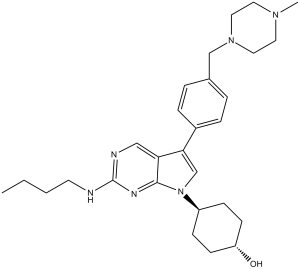
UNC-2025 is a novel, potent and orally bioavailable dual inhibitor of MER/FLT3 with IC50 of 0.74 nM and 0.8 nM, respectively, it displayed about 20-fold selectivity over Axl and Tyro3. Pharmacodynamic studies (PD) looking at phospho-Mer in leukemic blasts from mouse bone marrow show that UNC-2025 can inhibit Mer phosphorylation in vivo after oral dosing. UNC-2025 has similar subnanomolar activity against Flt3, an additional important target in acute myelogenous leukemia (AML), with pharmacologically useful selectivity compared to other kinases examined, according to kinome profiling versus more than 300 kinases in vitro and cellular selectivity assessments.
Physicochemical Properties
| Molecular Formula | C28H40N6O |
| Molecular Weight | 476.66 |
| Exact Mass | 476.326 |
| Elemental Analysis | C, 70.55; H, 8.46; N, 17.63; O, 3.36 |
| CAS # | 1429881-91-3 |
| Related CAS # | UNC2025 hydrochloride;2070015-17-5 |
| PubChem CID | 73425588 |
| Appearance | White to light yellow solid |
| Density | 1.2±0.1 g/cm3 |
| Boiling Point | 677.5±65.0 °C at 760 mmHg |
| Flash Point | 363.5±34.3 °C |
| Vapour Pressure | 0.0±2.2 mmHg at 25°C |
| Index of Refraction | 1.655 |
| LogP | 3.09 |
| Hydrogen Bond Donor Count | 2 |
| Hydrogen Bond Acceptor Count | 6 |
| Rotatable Bond Count | 8 |
| Heavy Atom Count | 35 |
| Complexity | 627 |
| Defined Atom Stereocenter Count | 0 |
| SMILES | O([H])C1([H])C([H])([H])C([H])([H])C([H])(C([H])([H])C1([H])[H])N1C([H])=C(C2C([H])=C([H])C(=C([H])C=2[H])C([H])([H])N2C([H])([H])C([H])([H])N(C([H])([H])[H])C([H])([H])C2([H])[H])C2=C([H])N=C(N([H])C([H])([H])C([H])([H])C([H])([H])C([H])([H])[H])N=C12 |
| InChi Key | MJSHVHLADKXCML-UHFFFAOYSA-N |
| InChi Code | InChI=1S/C28H40N6O/c1-3-4-13-29-28-30-18-25-26(20-34(27(25)31-28)23-9-11-24(35)12-10-23)22-7-5-21(6-8-22)19-33-16-14-32(2)15-17-33/h5-8,18,20,23-24,35H,3-4,9-17,19H2,1-2H3,(H,29,30,31) |
| Chemical Name | 4-[2-(butylamino)-5-[4-[(4-methylpiperazin-1-yl)methyl]phenyl]pyrrolo[2,3-d]pyrimidin-7-yl]cyclohexan-1-ol |
| Synonyms | UNC2025; UNC 2025; UNC-2025; mrx-6313; (1r,4r)-4-(2-(butylamino)-5-(4-((4-methylpiperazin-1-yl)methyl)phenyl)-7H-pyrrolo[2,3-d]pyrimidin-7-yl)cyclohexanol; trans-4-(2-(Butylamino)-5-(4-((4-methylpiperazin-1-yl)methyl)phenyl)-7H-pyrrolo[2,3-d]pyrimidin-7-yl)cyclohexanol; 4-[2-(butylamino)-5-[4-[(4-methylpiperazin-1-yl)methyl]phenyl]pyrrolo[2,3-d]pyrimidin-7-yl]cyclohexan-1-ol; CHEMBL3326006; UNC2025 |
| HS Tariff Code | 2934.99.9001 |
| Storage |
Powder-20°C 3 years 4°C 2 years In solvent -80°C 6 months -20°C 1 month |
| Shipping Condition | Room temperature (This product is stable at ambient temperature for a few days during ordinary shipping and time spent in Customs) |
Biological Activity
| Targets |
FLT3 (IC50 = 0.35 nM); Mer (IC50 = 0.46 nM); Axl (IC50 = 1.65 nM); TrkA (IC50 = 1.67 nM); TrkC (IC50 = 4.38 nM)
UNC-2025 targets MERTK (Ki = 0.15 nM) [1] UNC-2025 targets FLT3 (IC50 = 1.8 nM); exhibits selectivity over other kinases: c-KIT (IC50 = 45 nM), RET (IC50 = 62 nM), EGFR (IC50 > 1000 nM), VEGFR2 (IC50 > 1000 nM) [1] |
| ln Vitro |
UNC2025 has comparable subnanomolar activity against Flt3, an additional crucial target in acute myelogenous leukemia (AML), with pharmacologically useful selectivity versus other kinases investigated, according to kinome profiling versus more than 300 kinases in vitro and cellular selectivity assessments.[1] Recombinant kinase activity assay shows UNC-2025 potently inhibits MERTK and FLT3, with >300-fold selectivity over c-KIT and RET, and >500-fold over EGFR/VEGFR2 [1] - In FLT3-ITD-positive leukemia cell lines (MV4-11, MOLM-13), UNC-2025 (0.01–100 nM) dose-dependently inhibits cell proliferation (IC50 = 3.2 nM for MV4-11; IC50 = 4.5 nM for MOLM-13) and induces apoptosis (Annexin V-FITC/PI staining shows apoptotic rate ~55% at 10 nM for MV4-11) [2] - It blocks MERTK/FLT3 downstream signaling: reduces phosphorylation of MERTK (Tyr749), FLT3 (Tyr591), AKT (Ser473), ERK1/2 (Thr202/Tyr204), and STAT5 (Tyr694) in MV4-11 cells (Western blot), without affecting total protein levels [2] - In combination with CL14377 (BCL-2 inhibitor), UNC-2025 (1 nM) synergistically inhibits MV4-11 cell proliferation (combination index = 0.45) and increases apoptotic rate to ~75% (vs. 30% for single agents) [2] - In MERTK-overexpressing leukemia cells (K562-MERTK), UNC-2025 (0.1–10 nM) inhibits cell proliferation (IC50 = 2.8 nM) and reduces MERTK-mediated phagocytosis of apoptotic cells (reduced by ~60% at 5 nM) [2] |
| ln Vivo |
UNC2025 is a potent and highly oral bioavailable Mer inhibitor that, by pharmacodynamic (PD) studies looking at phospho-Mer in leukemic blasts from mouse bone marrow, is able to inhibit Mer phosphorylation in vivo after oral dosing.[1] UNC2025 had significant therapeutic effects in xenograft models, with dose-dependent decreases in tumor burden and consistent two-fold increases in median survival, irrespective of starting disease burden. In a patient-derived AML xenograft model, treatment with UNC2025 induced disease regression. In addition, UNC2025 increased sensitivity to methotrexate in vivo, suggesting that addition of MERTK-targeted therapy to current cytotoxic regimens may be particularly effective and/or allow for chemotherapy dose reduction.Conclusions: The broad-spectrum activity mediated by UNC2025 in leukemia patient samples and xenograft models, alone or in combination with cytotoxic chemotherapy, supports continued development of MERTK inhibitors for treatment of leukemia. [2] In MV4-11 (FLT3-ITD+) subcutaneous xenograft model (nude mice): Oral administration of UNC-2025 (25 mg/kg/day) for 21 days inhibits tumor growth by ~78% vs. vehicle. Tumor tissues show decreased p-MERTK, p-FLT3, p-STAT5, and Ki-67 expression, and increased cleaved caspase-3 levels (immunohistochemistry and Western blot) [2] - In MOLM-13 (FLT3-ITD+) intravenous leukemia model (NSG mice): Oral UNC-2025 (25 mg/kg/day) for 28 days prolongs median survival from 22 days (control) to 46 days. Bone marrow and spleen show reduced leukemia cell infiltration (flow cytometry: CD45+CD33+ cells reduced by ~65%) [2] - Combination therapy: In MV4-11 xenografts, oral UNC-2025 (15 mg/kg/day) + oral CL14377 (50 mg/kg/day) for 21 days inhibits tumor growth by ~90% and prolongs median survival to 72 days, with no increased toxicity [2] |
| Enzyme Assay |
Kinome Profiling Using ActivX ATP/ADP Probes[1] Briefly, 697 B-ALL cells were gently pelleted, washed twice with PBS, lysed using MPER supplemented with HALT protease/phosphatase inhibitor cocktail, and subjected to Zeba gel filtration spin columns to remove residual ATP and ADP. Following filtration, the final protein concentration was adjusted to 5.0 mg/mL using reaction buffer and supplemented with additional 1X HALT protease and phosphatase inhibitor cocktail. Lysate was aliquoted, snap frozen in liquid nitrogen, and stored at −80 °C until labeling. Prior to labeling, 2.5 mg of total lysate (final volume, 500 μL) was thawed to room temperature and treated with 10 μL of 1 M MnCl2 for 1 min. Then the lysate was treated with or without UNC2025 [0, 0.01, 0.1, 1.0, 10, 100, and 1000 nM] for 10 min. Following treatment, the ATP probe was added for 10 min at a final concentration of 5 μM. The labeling reaction was quenched with 500 μL of 10 M urea in MPER, 10 μL of 500 mM DTT, and heated to 65 °C for 30 min with shaking. Samples were cooled to room temperature and alkylated with 40 μL of a 1 M iodoacetamide solution for 30 min protected from light. The solution was then subjected to Zeba gel filtration and digested with 20 μg of trypsin at 37 °C for 2 h with shaking. 50 μL of a 50% high capacity streptavidin agarose slurry was added and allowed to incubate for 1 h at room temperature with constant mixing on a rotator. Agarose beads were then captured, washed, and eluted. Purified peptides were frozen, lyophilized, and stored at −80 °C. Immediately before mass spectrometric analysis, peptides were resuspended in 25 μL of 0.1% TFA. Details on mass spectrometry analysis and data analysis are provided in the Supporting Information. Cell-Based Assays for Kinase Inhibition[1] 697 B-ALL cells and Molm-14 AML cells were cultured in the presence of UNC2025 or vehicle-only for 1.0 h. Pervanadate solution was prepared fresh by combining 20 mM sodium orthovanadate in 0.9× PBS in a 1:1 ratio with 0.3% (w/w) hydrogen peroxide in PBS for 15–20 min at room temperature. Cultures were treated with 120 μM pervanadate for 3 min prior to collection, and cell lysates were prepared in 50 mM HEPES (pH 7.5), 150 mM NaCl, 10 mM EDTA, 10% glycerol, and 1% Triton X-100, supplemented with protease inhibitors. Mer and Flt3 proteins were immunoprecipitated with anti-Mer or anti-Flt3 antibody and Protein G agarose beads. Phospho-proteins were detected by Western blot using an antiphospho-Mer antibody raised against a peptide derived from the triphosphorylated activation loop of Mer8 or an antibody specific for phosphorylated Flt3. Nitrocellulose membranes were stripped and total proteins were detected using a second anti-Mer antibody or anti-Flt3 antibody. Relative phosphorylated and total protein levels were determined by densitometry using ImageJ, and IC50 values were calculated by nonlinear regression. UNC2025 hydrochloride has an IC50 of 0.8/0.74 nM for Mer/Flt3, making it a strong and orally bioavailable dual inhibitor of Mer/Flt3. Studies using pharmacodynamic (PD) methods to look at phospho-Mer in leukemic blasts from mouse bone marrow showed that UNC2025 could inhibit Mer phosphorylation in vivo after oral dosing. The results of kinome profiling against over 300 kinases in vitro and cellular selectivity assessments show that UNC2025 has pharmacologically useful selectivity compared to other kinases examined and has similar subnanomolar activity against Flt3, an additional important target in acute myelogenous leukemia (AML). MERTK kinase activity assay: Recombinant human MERTK (10 nM) was incubated with poly(Glu-Tyr) substrate, ATP, and reaction buffer (20 mM Tris-HCl pH 7.5, 10 mM MgCl2, 1 mM DTT) at 30°C for 60 minutes. UNC-2025 (0.001–10 nM) was added, and phosphorylated substrate was detected via radiometric assay using [γ-32P]ATP. Ki value was calculated by Lineweaver-Burk plot analysis [1] - FLT3 kinase activity assay: Recombinant human FLT3 (20 nM) was incubated with FLT3-derived peptide substrate, ATP, and reaction buffer at 30°C for 45 minutes. UNC-2025 (0.01–100 nM) was added, and phosphorylated peptide was detected via HTRF assay (excitation 340 nm, emission 665 nm). IC50 was determined by nonlinear regression of dose-response curves [1] - Kinase selectivity panel assay: UNC-2025 (100 nM) was incubated with 45 purified human kinases (including c-KIT, RET, EGFR, VEGFR2) and respective substrates/ATP. Kinase activity was measured via radiometric or fluorescence-based assays, and inhibition percentage was calculated to assess selectivity [1] |
| Cell Assay |
Soft Agar Colony Formation Assays[1] A549 or Molm-14 cells were cultured in 1.5 mL of 0.35% soft agar containing 1× RPMI medium and 10% FBS and overlaid with 2.0 mL of 1× RPMI medium containing 10% FBS and the indicated concentrations of UNC2025 or DMSO vehicle only. Medium and UNC2025 or vehicle were refreshed 3 times per week. Colonies were stained with nitrotetrazolium blue chloride and counted after 2 weeks. Immunoblot analysis[1] Leukemia cells (3x10⁶/mL) were cultured with UNC2025 or DMSO equivalent to 300nM UNC2025 for one hour. Cell lysates were prepared and signaling proteins were detected by immunoblot. Cells were treated with pervanadate and MERTK was immunoprecipitated to detect phosphorylated MERTK. Apoptosis, cell cycle, and colony formation assays[1] Cells were cultured (3x10~5/mL) for 6, 24, and/or 48 hours with UNC2025 or DMSO. Apoptotic and dead cells were detected by flow cytometry after staining with YO-PRO-1-iodide and propidium-iodide, cell cycle profiles were determined by assessment of propidium iodide staining in permeabilized cells using flow cytometry, and MTT reduction was determined as an indicator of viable cell number. Alternatively, ALL cell lines and patient samples were cultured in methylcellulose after treatment. AML cell lines were cultured in 0.35% Noble agar overlaid with medium containing UNC2025 or vehicle. Human mononuclear cells from normal bone marrow or umbilical cord blood were cultured in methylcellulose containing UNC2025 or DMSO. Colonies were counted after 7 (normal marrow) or 14 (umbilical cord blood, cell lines and patient samples) days. UNC-2025 has a 2.7 nM IC50 and can potently inhibit Mer phosphorylation in 697 B-ALL cells. UNC-2025, which is reliant on Flt3 and Mer8, significantly inhibits colony formation in A549 NSCLC and Molm-14 AML cell lines. UNC2025 blocks MERTK oncogenic signaling downstream in H2228 and H1299 cell lines, including basal and stimulated pAKT and pERK1/2. Additionally, UNC-2025 inhibits colony formation and triggers apoptotic cell death in four NSCLC cell lines. Leukemia cell proliferation and apoptosis assay: MV4-11/MOLM-13/K562-MERTK cells (5×10³ per well) were seeded in 96-well plates, treated with UNC-2025 (0.01–100 nM) for 72 hours. Cell viability was measured by CCK-8 assay to determine IC50. For apoptosis, cells were treated with the drug (1–10 nM) for 48 hours, stained with Annexin V-FITC/PI, and analyzed by flow cytometry [2] - Signaling pathway assay: MV4-11 cells (1×10⁶ per well) were seeded in 6-well plates, serum-starved for 16 hours, then treated with UNC-2025 (1–10 nM) for 24 hours. Cells were lysed, and Western blot detected p-MERTK, MERTK, p-FLT3, FLT3, p-AKT, AKT, p-ERK1/2, ERK1/2, p-STAT5, STAT5, and GAPDH [2] - Combination therapy assay: MV4-11 cells were treated with UNC-2025 (0.1–10 nM) + CL14377 (10–100 nM) for 72 hours. Cell viability was measured by CCK-8 assay, and combination index was calculated using Chou-Talalay method [2] - Phagocytosis assay: K562-MERTK cells were incubated with fluorescently labeled apoptotic Jurkat cells (MOI = 5) and UNC-2025 (0.1–10 nM) for 4 hours. Phagocytic rate was quantified by flow cytometry (K562-MERTK cells positive for apoptotic cell fluorescence) [2] |
| Animal Protocol |
NOD/SCID/gamma mice 3 mg/kg Oral gavage Pharmacodynamic Studies[1] NOD.Cg-PrkdcscidIl2rgtm1Wjl/SzJ (NSG) mice were transplanted with 2 × 10⁶ 697 B-ALL cells by intravenous injection into the tail vein, and leukemia was established for 14 days prior to treatment with a single dose of 3 mg/kg 11 (UNC2025) or an equivalent volume (10 mL/kg) of saline vehicle. Pervanadate solution was prepared fresh, as described above. Femurs were collected from mice 30 min after treatment, and bone marrow cells were flushed with 1 mL of room temperature RPMI medium + 20% FBS + 1 μM MgCl2 + 100 untis/ml DNase + 240 μM pervanadate and incubated at room temperature in the dark for 10 min. Bone marrow cells were collected by centrifugation at 4 °C, lysates were prepared, Mer protein was immunoprecipitated, and total and phospho-Mer proteins were detected and quantitated by Western blot, as described above. Leukemia xenograft models[2] 697 cells, monoclonal 697 cells expressing firefly luciferase (20), NOMO-1 cells, or mononuclear cells from an AML patient sample (2x10⁶/mouse) were injected into the tail vein in NOD.Cg-PrkdcscidIl2rgtm1Wjl/SzJ (NSG) or NOD.Cg-PrkdcscidIl2rgtm1WjlTg(CMV-IL3,CSF2,KITLG)1Eav/MloySzJ (NSGS) mice. Disease burden was monitored in 697-luciferase xenografts using bioluminescence imaging. Peripheral blood, spleen, and bone marrow were collected from patient-derived xenografts and red blood cells (RBCs) were lysed in 50% Dextran sulfate for 15 minutes. Human CD45+ cells were detected using flow cytometry. Mice were distributed to groups with statistically equal disease burden or randomized to groups if leukemia was undetectable. UNC2025 or saline was administered at 10ml/kg once daily by oral gavage. Methotrexate or saline was administered at 5ml/kg by intraperitoneal injection. Mice with advanced leukemia (>20% weight loss, tachypnea, hypothermia, hind-limb paralysis, minimal activity) were euthanized and survival was monitored. Pharmacodynamic studies were performed as previously described MV4-11 subcutaneous xenograft model: NSG mice (6-week-old, female) were subcutaneously injected with MV4-11 cells (5×10⁶ cells/mouse) into the right flank. When tumors reached ~100 mm³, mice were randomized into control (n = 6), UNC-2025 monotherapy (n = 6, 25 mg/kg/day, oral), and combination therapy (n = 6, UNC-2025 15 mg/kg/day + CL14377 50 mg/kg/day, oral) groups. Drugs were dissolved in 0.5% carboxymethylcellulose (CMC) + 0.1% Tween 80, administered once daily for 21 days. Tumor volume (length×width²/2) and body weight were measured every 3 days; tumors were excised for immunohistochemistry and Western blot [2] - MOLM-13 intravenous leukemia model: NSG mice (6-week-old, female) were intravenously injected with MOLM-13 cells (1×10⁶ cells/mouse). Seven days post-injection, mice were treated with UNC-2025 (25 mg/kg/day, oral) for 28 days. Survival time was recorded; bone marrow and spleen tissues were collected for flow cytometry analysis of leukemia cell infiltration [2] - Pharmacokinetic study: Male Sprague-Dawley rats (250–300 g) and beagle dogs (8–10 kg) were administered UNC-2025 via oral gavage (10 mg/kg) or intravenous injection (2 mg/kg). Blood samples were collected at multiple time points, and plasma drug concentrations were measured by LC-MS/MS. Pharmacokinetic parameters (Cmax, AUC, t1/2, F) were calculated using non-compartmental analysis [1] |
| ADME/Pharmacokinetics |
As a result, analogue 11 (UNC2025) was prepared and demonstrated excellent PK properties: low clearance (9.2 mL/min kg), longer half-life (3.8 h), and high oral exposure (100%) (Table 2). Furthermore, the HCl salt of 11 was highly soluble in normal saline (kinetic solubility: 38 μg/mL, pH = 7.4). Substitution of 11 with a cyclopropyl ethyl side-chain resulted in 12, which demonstrated a further modest decrease in clearance, consistent with some contribution of P450 metabolism of the C3 side-chain to metabolic stability but with very similar overall PK properties to 11. With excellent solubility and PK properties, as well as a much less expensive C3 substituent versus 12, analogue 11 was chosen for further studies, including kinome selectivity profiling, cell-based assays, and pharmacodynamic assays using a mouse model to determine the activity of the compound in leukemic blasts in vivo.[1] Oral bioavailability: 72% in rats, 68% in dogs [1] - Plasma half-life (t1/2): 4.1 hours in rats, 7.3 hours in dogs [1] - Plasma protein binding rate: 95% in human plasma, 93% in rat plasma, 94% in dog plasma (equilibrium dialysis assay) [1] - Tissue distribution: In rats, highest concentrations in liver (3.3-fold vs. plasma), spleen (2.9-fold vs. plasma), and bone marrow (2.5-fold vs. plasma); favorable penetration into hematopoietic tissues [1] - Metabolism: Primarily metabolized via hepatic CYP3A4-mediated oxidation; major metabolites are monohydroxylated derivatives (non-active) [1] - Excretion: In rats, 63% excreted in feces, 27% in urine within 72 hours post-administration [1] |
| Toxicity/Toxicokinetics |
In vitro toxicity: UNC-2025 at concentrations up to 100 nM shows no significant cytotoxicity to normal human bone marrow mononuclear cells (BMNCs) (cell viability >85% vs. control) [2] - Acute toxicity: LD50 > 2000 mg/kg in rats and mice (oral administration); no mortality or severe toxic symptoms (lethargy, convulsions) observed at doses up to 2000 mg/kg [1] - Repeat-dose toxicity: In a 28-day study in rats (oral doses of 10, 30, 60 mg/kg/day), the drug was well-tolerated. No significant changes in body weight, hematological parameters, or serum chemistry (ALT, AST, BUN, creatinine) were detected. Histological examination of liver, kidney, heart, and bone marrow revealed no abnormal lesions [1] - Combination therapy toxicity: Mice treated with UNC-2025 + CL14377 show no increased weight loss or organ toxicity compared to monotherapy groups [2] |
| References |
[1]. UNC2025, a Potent and Orally Bioavailable MER/FLT3 Dual Inhibitor. J Med Chem. 2014 Aug 28;57(16):7031-41. [2]. UNC2025, a MERTK Small-Molecule Inhibitor, Is Therapeutically Effective Alone and in Combination with CL14377 in Leukemia Models.Clin Cancer Res. 2017 Mar 15;23(6):1481-1492. |
| Additional Infomation |
We previously reported a potent small molecule Mer tyrosine kinase inhibitor UNC1062. However, its poor PK properties prevented further assessment in vivo. We report here the sequential modification of UNC1062 to address DMPK properties and yield a new potent and highly orally bioavailable Mer inhibitor, 11, capable of inhibiting Mer phosphorylation in vivo, following oral dosing as demonstrated by pharmaco-dynamic (PD) studies examining phospho-Mer in leukemic blasts from mouse bone marrow. Kinome profiling versus more than 300 kinases in vitro and cellular selectivity assessments demonstrate that 11 has similar subnanomolar activity against Flt3, an additional important target in acute myelogenous leukemia (AML), with pharmacologically useful selectivity versus other kinases examined.[1] Purpose: MERTK tyrosine kinase is ectopically expressed in 30% to 50% of acute lymphoblastic leukemias (ALL) and more than 80% of acute myeloid leukemias (AML) and is a potential therapeutic target. Here, we evaluated the utility of UNC2025, a MERTK tyrosine kinase inhibitor, for treatment of acute leukemia.Experimental Design: Preclinical in vitro and in vivo assays using cell lines and primary leukemia patient samples were used to evaluate antileukemic effects of UNC2025.Results: UNC2025 potently inhibited prosurvival signaling, induced apoptosis, and reduced proliferation and colony formation in MERTK-expressing ALL and AML cell lines and patient samples. Approximately 30% of primary leukemia patient samples (78 of 261 total) were sensitive to UNC2025. Sensitive samples were most prevalent in the AML, T-ALL, and minimally differentiated (M0) AML subsets. UNC2025 inhibited MERTK in bone marrow leukemia cells and had significant therapeutic effects in xenograft models, with dose-dependent decreases in tumor burden and consistent two-fold increases in median survival, irrespective of starting disease burden. In a patient-derived AML xenograft model, treatment with UNC2025 induced disease regression. In addition, UNC2025 increased sensitivity to methotrexate in vivo, suggesting that addition of MERTK-targeted therapy to current cytotoxic regimens may be particularly effective and/or allow for chemotherapy dose reduction.Conclusions: The broad-spectrum activity mediated by UNC2025 in leukemia patient samples and xenograft models, alone or in combination with cytotoxic chemotherapy, supports continued development of MERTK inhibitors for treatment of leukemia.[2] UNC-2025 is a potent, orally bioavailable dual MERTK/FLT3 inhibitor [1] - Its mechanism of action involves binding to the ATP-binding pockets of MERTK and FLT3, inhibiting their kinase activity and downstream PI3K-AKT-ERK/STAT5 signaling pathways, leading to leukemia cell proliferation arrest and apoptosis [1,2] - It exhibits preclinical efficacy in FLT3-ITD-positive and MERTK-overexpressing leukemia models, both as monotherapy and in combination with BCL-2 inhibitors [2] - Favorable oral bioavailability, tissue distribution (especially to hematopoietic tissues), and low toxicity support its clinical application for hematological malignancies [1,2] - It has been evaluated in preclinical studies for acute myeloid leukemia (AML) and other leukemias with MERTK/FLT3 dysregulation [2] |
Solubility Data
| Solubility (In Vitro) |
|
|||
| Solubility (In Vivo) |
Solubility in Formulation 1: ≥ 2.5 mg/mL (5.24 mM) (saturation unknown) in 10% DMSO + 40% PEG300 + 5% Tween80 + 45% Saline (add these co-solvents sequentially from left to right, and one by one), clear solution. For example, if 1 mL of working solution is to be prepared, you can add 100 μL of 25.0 mg/mL clear DMSO stock solution to 400 μL PEG300 and mix evenly; then add 50 μL Tween-80 to the above solution and mix evenly; then add 450 μL normal saline to adjust the volume to 1 mL. Preparation of saline: Dissolve 0.9 g of sodium chloride in 100 mL ddH₂ O to obtain a clear solution. Solubility in Formulation 2: ≥ 2.5 mg/mL (5.24 mM) (saturation unknown) in 10% DMSO + 90% Corn Oil (add these co-solvents sequentially from left to right, and one by one), clear solution. For example, if 1 mL of working solution is to be prepared, you can add 100 μL of 25.0 mg/mL clear DMSO stock solution to 900 μL of corn oil and mix evenly. (Please use freshly prepared in vivo formulations for optimal results.) |
| Preparing Stock Solutions | 1 mg | 5 mg | 10 mg | |
| 1 mM | 2.0979 mL | 10.4897 mL | 20.9793 mL | |
| 5 mM | 0.4196 mL | 2.0979 mL | 4.1959 mL | |
| 10 mM | 0.2098 mL | 1.0490 mL | 2.0979 mL |