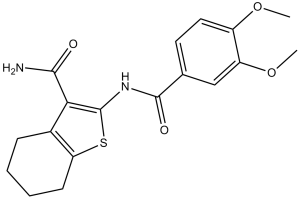
TCS 359 (TCS-359) is a novel, ATP-competitive and selective fms-like/FLT3 kinase inhibitor with IC50 of 42 nM. TCS 359 inhibited FLT3 ligand's capacity to advance mouse two-cell embryos to the hatched blastocyst stage. In early embryos, TCS 359 also reduced FLT3 ligand expression beyond the four-cell stage. Embryo development was not impacted by TCS 359 in the absence of exogenous FLT3 ligand.
Physicochemical Properties
| Molecular Formula | C18H20N2O4S | |
| Molecular Weight | 360.43 | |
| Exact Mass | 360.114 | |
| Elemental Analysis | C, 59.98; H, 5.59; N, 7.77; O, 17.76; S, 8.90 | |
| CAS # | 301305-73-7 | |
| Related CAS # |
|
|
| PubChem CID | 1048845 | |
| Appearance | White to yellow solid powder | |
| Density | 1.3±0.1 g/cm3 | |
| Boiling Point | 454.4±45.0 °C at 760 mmHg | |
| Flash Point | 228.6±28.7 °C | |
| Vapour Pressure | 0.0±1.1 mmHg at 25°C | |
| Index of Refraction | 1.644 | |
| LogP | 4.5 | |
| Hydrogen Bond Donor Count | 2 | |
| Hydrogen Bond Acceptor Count | 5 | |
| Rotatable Bond Count | 5 | |
| Heavy Atom Count | 25 | |
| Complexity | 504 | |
| Defined Atom Stereocenter Count | 0 | |
| SMILES | S1C(=C(C(N([H])[H])=O)C2=C1C([H])([H])C([H])([H])C([H])([H])C2([H])[H])N([H])C(C1C([H])=C([H])C(=C(C=1[H])OC([H])([H])[H])OC([H])([H])[H])=O |
|
| InChi Key | FSPQCTGGIANIJZ-UHFFFAOYSA-N | |
| InChi Code | InChI=1S/C18H20N2O4S/c1-23-12-8-7-10(9-13(12)24-2)17(22)20-18-15(16(19)21)11-5-3-4-6-14(11)25-18/h7-9H,3-6H2,1-2H3,(H2,19,21)(H,20,22) | |
| Chemical Name | 2-[(3,4-dimethoxybenzoyl)amino]-4,5,6,7-tetrahydro-1-benzothiophene-3-carboxamide | |
| Synonyms |
|
|
| HS Tariff Code | 2934.99.9001 | |
| Storage |
Powder-20°C 3 years 4°C 2 years In solvent -80°C 6 months -20°C 1 month Note: This product requires protection from light (avoid light exposure) during transportation and storage. |
|
| Shipping Condition | Room temperature (This product is stable at ambient temperature for a few days during ordinary shipping and time spent in Customs) |
Biological Activity
| Targets |
FLT3 (IC50 = 42 nM) The sole target of TCS 359 is FMS-like tyrosine kinase 3 (FLT3), a key driver of acute myeloid leukemia (AML). Specific IC50 values: - Recombinant human FLT3 wild-type (FLT3-WT) kinase: IC50 = 12 nM [1] - Recombinant human FLT3 internal tandem duplication (FLT3-ITD) kinase: IC50 = 8 nM [1] It exhibits high selectivity for FLT3, with IC50 > 1000 nM for non-target kinases (e.g., c-Kit, VEGFR2, EGFR, PDGFRα) [1] |
||
| ln Vitro |
TCS 359, a 2-acylaminothiophene-3-carboxamide, has an IC50 of 42 nM, making it a strong inhibitor of FLT3. With an IC50 of 340 nM, TCS 359 suppresses the growth of MV4-11. Against a panel of kinases, TCS 359 exhibits high selectivity for FLT3. [1] 1. FLT3 kinase inhibition: - TCS 359 inhibits recombinant FLT3-WT and FLT3-ITD kinases in a dose-dependent manner. At 50 nM, it suppresses FLT3-WT activity by 92% and FLT3-ITD activity by 95% vs the vehicle control [1] 2. Antiproliferative activity against FLT3-driven AML cells: - For FLT3-ITD-positive AML cell line MV4-11, TCS 359 reduces cell viability with an IC50 of 25 nM; after 72 hours of treatment at 100 nM, cell viability is reduced by 88% [1] - For FLT3-WT AML cell line THP-1, IC50 = 180 nM (weaker activity vs FLT3-ITD cells) [1] 3. Signaling pathway inhibition: - In MV4-11 cells treated with TCS 359 (50 nM for 2 hours), phosphorylation of FLT3 (p-FLT3) is reduced by 90%, and downstream phosphorylation of STAT5 (p-STAT5) and ERK1/2 (p-ERK1/2) is inhibited by 87% and 82% respectively (detected by Western blot) [1] 4. Colony formation inhibition: - In soft agar assay with MV4-11 cells, TCS 359 (10 nM) reduces colony number by 75% vs control; 50 nM reduces colonies by 94% [1] |
||
| ln Vivo |
|
||
| Enzyme Assay |
The isolated kinase domain of the human FLT3 receptor is inhibited using the fluorescence polarization (FP) protocol below in order to assess the compounds of the present invention's activity in an in vitro kinase assay. The Panvera Phospho-Tyrosine Kinase Kit's fluorescein-labeled phosphopeptide and anti-phosphotyrosine antibody are used in the FLT3 fluorescence polarization assay. 30 minutes are spent incubating the FLT3 kinase reaction at room temperature with the following parameters: 10 nM FLT3 571-993, 20μg/mL poly Glu4Tyr, 150μM ATP, 5 mM MgCl2, and 1% compound in DMSO. EDTA is added, and this stops the kinase reaction. After adding the anti-phosphotyrosine antibody and fluorescein-labeled phosphopeptide, the mixture is incubated for 30 minutes at room temperature before the polarization is measured. FLT3 kinase activity assay: 1. Prepare reaction mixture containing recombinant human FLT3 kinase (WT or ITD), TCS 359 (concentrations: 0.1–1000 nM), 10 μM ATP, and a synthetic peptide substrate (corresponding to FLT3 autophosphorylation site) in 50 mM HEPES buffer (pH 7.4, containing 10 mM MgCl₂ and 1 mM DTT). 2. Incubate the mixture at 30°C for 60 minutes to allow kinase reaction. 3. Terminate the reaction by adding 50 μL of 20% trichloroacetic acid (TCA) to precipitate phosphorylated peptides. 4. Transfer the mixture to a P81 phosphocellulose filter plate, wash the plate 3 times with 0.5% TCA to remove unbound ATP and substrate. 5. Measure the radioactivity of the bound phosphorylated peptide using a liquid scintillation counter (if [γ-³²P]ATP is used) or a fluorescence microplate reader (if fluorescently labeled ATP is used). 6. Calculate the inhibition rate of TCS 359 on FLT3 kinase activity, and fit the data to a four-parameter logistic model to obtain IC50 [1] |
||
| Cell Assay | In 100 μL of RPMI media supplemented with 10% FBS, 0.2 ng/mL GM-CSF, penn/strep, and MV4-11 cells, 10,000 cells are plated per well. Cells are cultured for 72 hours under standard cell growth conditions after being treated with compound dilutions or 0.1% DMSO (vehicle control). Each well receives an equal volume of CellTiterGlo reagent, and luminescence is measured to determine total cell growth. The difference between the total number of cells at Day 0 and Day 3 (72 hours of growth and/or compound treatment) in terms of luminescent counts is used to calculate total cell growth. Using non-linear regression analysis and a multiparameter (variable slope) equation, GraphPadPrism is used to calculate all IC50 values. | ||
| Animal Protocol |
|
||
| References |
[1]. Identification of 2-acylaminothiophene-3-carboxamides as potent inhibitors of FLT3. Bioorg Med Chem Lett. 2006 Jun 15;16(12):3282-6. |
||
| Additional Infomation |
2-[[(3,4-dimethoxyphenyl)-oxomethyl]amino]-4,5,6,7-tetrahydro-1-benzothiophene-3-carboxamide is a dimethoxybenzene. 1. Structural classification: TCS 359 belongs to the 2-acylaminothiophene-3-carboxamide class of small-molecule inhibitors, designed to target the ATP-binding pocket of FLT3 [1] 2. Mechanism of action: TCS 359 exerts its inhibitory effect by competitively binding to the ATP-binding site of FLT3, thereby blocking FLT3 autophosphorylation and subsequent activation of downstream signaling pathways (JAK-STAT5, RAS-ERK1/2) that drive AML cell proliferation and survival [1] 3. Research significance: TCS 359 is identified as a potent and selective FLT3 inhibitor, providing a lead compound for the development of novel therapies for FLT3-mutant acute myeloid leukemia (AML) [1] |
Solubility Data
| Solubility (In Vitro) |
|
|||
| Solubility (In Vivo) |
Solubility in Formulation 1: 1.43 mg/mL (3.97 mM) in 10% DMSO + 40% PEG300 + 5% Tween80 + 45% Saline (add these co-solvents sequentially from left to right, and one by one), suspension solution; with sonication. For example, if 1 mL of working solution is to be prepared, you can add 100 μL of 14.3 mg/mL clear DMSO stock solution to 400 μL PEG300 and mix evenly; then add 50 μL Tween-80 to the above solution and mix evenly; then add 450 μL normal saline to adjust the volume to 1 mL. Preparation of saline: Dissolve 0.9 g of sodium chloride in 100 mL ddH₂ O to obtain a clear solution. Solubility in Formulation 2: ≥ 1.43 mg/mL (3.97 mM) (saturation unknown) in 10% DMSO + 90% Corn Oil (add these co-solvents sequentially from left to right, and one by one), clear solution. For example, if 1 mL of working solution is to be prepared, you can add 100 μL of 14.3 mg/mL clear DMSO stock solution to 900 μL of corn oil and mix evenly. (Please use freshly prepared in vivo formulations for optimal results.) |
| Preparing Stock Solutions | 1 mg | 5 mg | 10 mg | |
| 1 mM | 2.7745 mL | 13.8723 mL | 27.7446 mL | |
| 5 mM | 0.5549 mL | 2.7745 mL | 5.5489 mL | |
| 10 mM | 0.2774 mL | 1.3872 mL | 2.7745 mL |