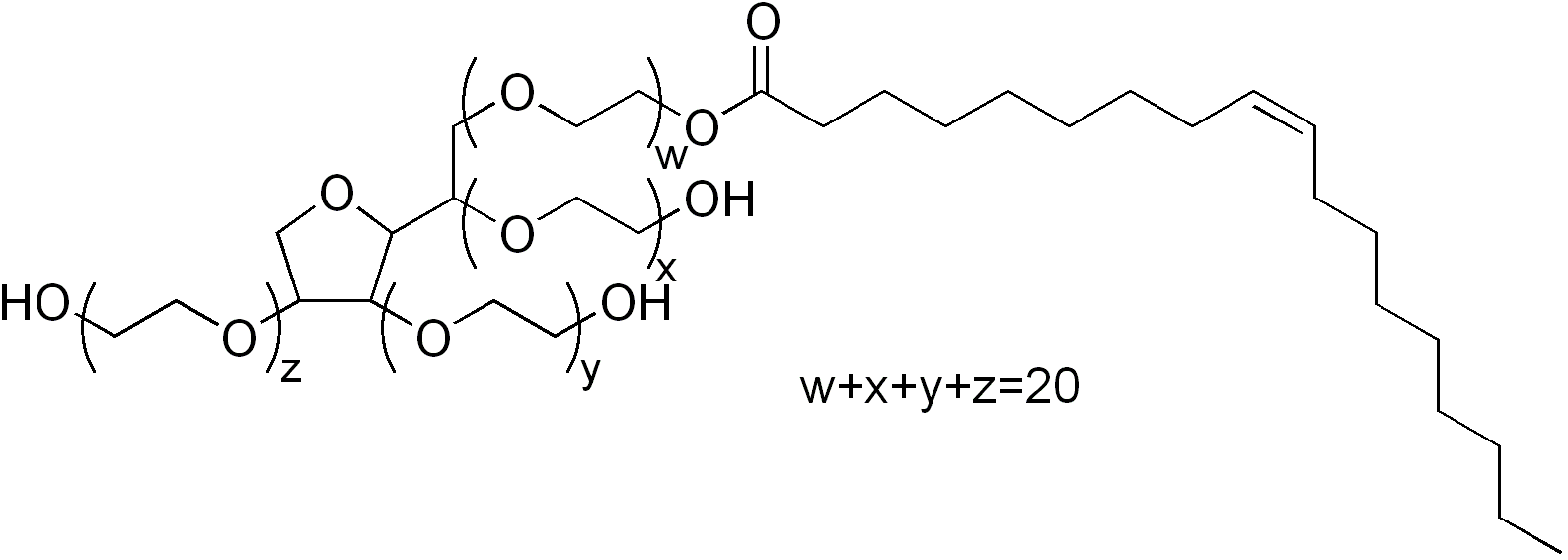
Tween 80 (Polysorbate 80; Montanox 80; Alkest TW 80; Tween 80; PS 80) is a surfactant, emulsifier, excipient and non-ionic detergent (for cell lysis), often used in foods and cosmetics. It is a synthetic compound and a viscous, water-soluble yellow liquid that can also reduce bacterial attachment and inhibit biofilm formation.
Physicochemical Properties
| Molecular Formula | C32H60O10 |
| Molecular Weight | 604.8128 |
| Exact Mass | 604.418 |
| Elemental Analysis | C, 63.55; H, 10.00; O, 26.45 |
| CAS # | 9005-65-6 |
| Related CAS # | 9005-65-6 |
| PubChem CID | 6364656 |
| Appearance | Colorless to light yellow liquid |
| Density | 1.1±0.1 g/cm3 |
| Boiling Point | 695.8±55.0 °C at 760 mmHg |
| Melting Point | -21ºC |
| Flash Point | 207.1±25.0 °C |
| Vapour Pressure | 0.0±5.0 mmHg at 25°C |
| Index of Refraction | 1.502 |
| LogP | 4.8 |
| Hydrogen Bond Donor Count | 3 |
| Hydrogen Bond Acceptor Count | 10 |
| Rotatable Bond Count | 31 |
| Heavy Atom Count | 42 |
| Complexity | 632 |
| Defined Atom Stereocenter Count | 0 |
| SMILES | CCCCCCCC/C=C\CCCCCCCC(=O)OCCOCC(C1C(C(CO1)OCCO)OCCO)OCCO |
| InChi Key | HDTIFOGXOGLRCB-KTKRTIGZSA-N |
| InChi Code | InChI=1S/C32H60O10/c1-2-3-4-5-6-7-8-9-10-11-12-13-14-15-16-17-30(36)40-25-24-37-26-28(38-21-18-33)32-31(41-23-20-35)29(27-42-32)39-22-19-34/h9-10,28-29,31-35H,2-8,11-27H2,1H3/b10-9- |
| Chemical Name | 2-[2-[3,4-bis(2-hydroxyethoxy)oxolan-2-yl]-2-(2-hydroxyethoxy)ethoxy]ethyl (Z)-octadec-9-enoate |
| Synonyms | Polysorbate 80; Montanox 80; sorbate80; DSSTox_CID_1175; DSSTox_RID_75992; DSSTox_GSID_21175; ...; CAS-9005-65-6; Alkest; TW 80; Tween 80; PS 80 |
| HS Tariff Code | 2934.99.9001 |
| Storage |
Powder-20°C 3 years 4°C 2 years In solvent -80°C 6 months -20°C 1 month |
| Shipping Condition | Room temperature (This product is stable at ambient temperature for a few days during ordinary shipping and time spent in Customs) |
Biological Activity
| ln Vitro |
Tween 80 (Polysorbate 80) is a surfactant that prevents the formation of biofilms and decreases cell division [1]. Solubility rose 100-fold in vitro when 1% Tween 80 was applied [2].
- Promoting bacterial cell dispersion: 0.05% Tween 80 can promote the dispersion of Salmonella enterica serovar Thompson cells in vitro. Digital image analysis of micrographs shows that in the leaf washes containing Tween 80, single - cell proportion in cell assemblages increases from 9.3% to 13.7%, and the percentage of the total cell population in aggregates equal to or larger than 64 cells decreases from 9.8% to 4.4%. It promotes the dispersal of cells from large aggregates into smaller ones and single cells [1] - Antagonizing smooth muscle contraction: Tween 80 has no direct stimulant or relaxant effect on guinea pig ileum or rat uterus in vitro, but it can antagonize the contractions induced by acetylcholine, histamine, barium, 5 - hydroxytryptamine and carbachol in a dose - dependent manner. It also has a direct relaxant effect on rabbit jejunum [4] - Myocardial depressant effect: On the electrically - driven guinea pig left atrial preparation, Tween 80 exhibits a dose - dependent negative inotropic action [4] |
| ln Vivo |
Tween 80 (Polysorbate 80) (IP; 10 mL/kg) lowers body weight by a large amount to 24–30 g[3].
- Central nervous system depression: Tween 80 can produce mild to moderate depression of the central nervous system in mice and rats, with a marked reduction in locomotor activity and rectal temperature, and can also exhibit ataxia and paralytic activity [4] - Hypotensive effect: Intravenous administration of Tween 80 in dogs has a dose - dependent hypotensive effect [4] |
| Animal Protocol |
- Mouse and rat experiments: In mice and rats, Tween 80 is administered intraperitoneally or orally to study its effect on the central nervous system, observing changes in locomotor activity, rectal temperature, ataxia and paralytic activity. The dosage should not exceed 1 ml/kg when used as a vehicle for neuropsychopharmacological experiments [4] - Dog experiment: Intravenous administration of Tween 80 to dogs, and then observing its blood pressure changes to study its hypotensive effect [4] |
| Toxicity/Toxicokinetics |
Interactions Effect of polysorbate 80 on the bioavailability and distribution of methotrexate (MTX) was studied in NMRI and Porton mice following oral administration. In these two strains of mice concentrations of MTX were increased in various organs by this nonionic surfactant. Tween 80 potentiated the antitumor effects of daunomycin both in rats with Ehrlich ascites tumor and in isolated tumor cells. At the subcellular level, Tween 80 increased binding of daunomycin to the nucleus and mitochondria. In cultures of Chinese hamster cell lines resistant to actinomycin D and daunomycin, treatment with the nonionic surfactant Tween 80 potentiated the effects of the 2 antibiotics in growth studies and enhanced uptake. Adriamycin in a 10% Tween 80 aqueous solution injected iv into sarcoma-bearing mice had higher antitumor activity and produced higher adriamycin levels in the spleen, lung, and kidney than did adriamycin given alone. For more Interactions (Complete) data for Polysorbate 80 (7 total), please visit the HSDB record page. Non-Human Toxicity Values LD50 Rat ip 6804 mg/kg LD50 Rat iv 1790 mg/kg LD50 Mouse oral 25000 mg/kg LD50 Mouse ip 7600 mg/kg For more Non-Human Toxicity Values (Complete) data for Polysorbate 80 (6 total), please visit the HSDB record page. Tween 80 has low - order toxicity when given by intraperitoneal and oral routes in mice and rats [4] |
| References |
[1]. Effect of the surfactant tween 80 on the detachment and dispersal of Salmonella enterica serovar Thompson single cells and aggregates from cilantro leaves as revealed by image analysis. Appl Environ Microbiol. 2014 Aug;80(16):5037-42. [2]. Pharmacokinetics study of ferulic acid in rats after oral administration of γ-oryzanol under combined use of Tween 80 by LC/MS/MS. Eur Rev Med Pharmacol Sci. 2014;18(2):143-50. [3]. Behavioral effects of vehicles: DMSO, ethanol, Tween-20, Tween-80, and emulphor-620. Pharmacol Biochem Behav. 1995 Apr;50(4):521-6. [4]. Polysorbate 80: a pharmacological study. Arzneimittelforschung. 1985;35(5):804-808. |
| Additional Infomation |
Tween 80 is a surfactant, which is widely used as a solvent in pharmacological experiments. But it is not suitable for use as a solvent for isolated tissue experiments or intravenous administration, and can be safely used as a vehicle for neuropsychopharmacological experiments in doses not exceeding 1 ml/kg [4] |
Solubility Data
| Solubility (In Vitro) | DMSO : ≥ 100 mg/mL |
| Solubility (In Vivo) |
Note: Listed below are some common formulations that may be used to formulate products with low water solubility (e.g. < 1 mg/mL), you may test these formulations using a minute amount of products to avoid loss of samples. Injection Formulations (e.g. IP/IV/IM/SC) Injection Formulation 1: DMSO : Tween 80: Saline = 10 : 5 : 85 (i.e. 100 μL DMSO stock solution → 50 μL Tween 80 → 850 μL Saline) *Preparation of saline: Dissolve 0.9 g of sodium chloride in 100 mL ddH ₂ O to obtain a clear solution. Injection Formulation 2: DMSO : PEG300 :Tween 80 : Saline = 10 : 40 : 5 : 45 (i.e. 100 μL DMSO → 400 μLPEG300 → 50 μL Tween 80 → 450 μL Saline) Injection Formulation 3: DMSO : Corn oil = 10 : 90 (i.e. 100 μL DMSO → 900 μL Corn oil) Example: Take the Injection Formulation 3 (DMSO : Corn oil = 10 : 90) as an example, if 1 mL of 2.5 mg/mL working solution is to be prepared, you can take 100 μL 25 mg/mL DMSO stock solution and add to 900 μL corn oil, mix well to obtain a clear or suspension solution (2.5 mg/mL, ready for use in animals). Injection Formulation 4: DMSO : 20% SBE-β-CD in saline = 10 : 90 [i.e. 100 μL DMSO → 900 μL (20% SBE-β-CD in saline)] *Preparation of 20% SBE-β-CD in Saline (4°C,1 week): Dissolve 2 g SBE-β-CD in 10 mL saline to obtain a clear solution. Injection Formulation 5: 2-Hydroxypropyl-β-cyclodextrin : Saline = 50 : 50 (i.e. 500 μL 2-Hydroxypropyl-β-cyclodextrin → 500 μL Saline) Injection Formulation 6: DMSO : PEG300 : castor oil : Saline = 5 : 10 : 20 : 65 (i.e. 50 μL DMSO → 100 μLPEG300 → 200 μL castor oil → 650 μL Saline) Injection Formulation 7: Ethanol : Cremophor : Saline = 10: 10 : 80 (i.e. 100 μL Ethanol → 100 μL Cremophor → 800 μL Saline) Injection Formulation 8: Dissolve in Cremophor/Ethanol (50 : 50), then diluted by Saline Injection Formulation 9: EtOH : Corn oil = 10 : 90 (i.e. 100 μL EtOH → 900 μL Corn oil) Injection Formulation 10: EtOH : PEG300:Tween 80 : Saline = 10 : 40 : 5 : 45 (i.e. 100 μL EtOH → 400 μLPEG300 → 50 μL Tween 80 → 450 μL Saline) Oral Formulations Oral Formulation 1: Suspend in 0.5% CMC Na (carboxymethylcellulose sodium) Oral Formulation 2: Suspend in 0.5% Carboxymethyl cellulose Example: Take the Oral Formulation 1 (Suspend in 0.5% CMC Na) as an example, if 100 mL of 2.5 mg/mL working solution is to be prepared, you can first prepare 0.5% CMC Na solution by measuring 0.5 g CMC Na and dissolve it in 100 mL ddH2O to obtain a clear solution; then add 250 mg of the product to 100 mL 0.5% CMC Na solution, to make the suspension solution (2.5 mg/mL, ready for use in animals). Oral Formulation 3: Dissolved in PEG400 Oral Formulation 4: Suspend in 0.2% Carboxymethyl cellulose Oral Formulation 5: Dissolve in 0.25% Tween 80 and 0.5% Carboxymethyl cellulose Oral Formulation 6: Mixing with food powders Note: Please be aware that the above formulations are for reference only. InvivoChem strongly recommends customers to read literature methods/protocols carefully before determining which formulation you should use for in vivo studies, as different compounds have different solubility properties and have to be formulated differently. (Please use freshly prepared in vivo formulations for optimal results.) |
| Preparing Stock Solutions | 1 mg | 5 mg | 10 mg | |
| 1 mM | 1.6534 mL | 8.2671 mL | 16.5341 mL | |
| 5 mM | 0.3307 mL | 1.6534 mL | 3.3068 mL | |
| 10 mM | 0.1653 mL | 0.8267 mL | 1.6534 mL |