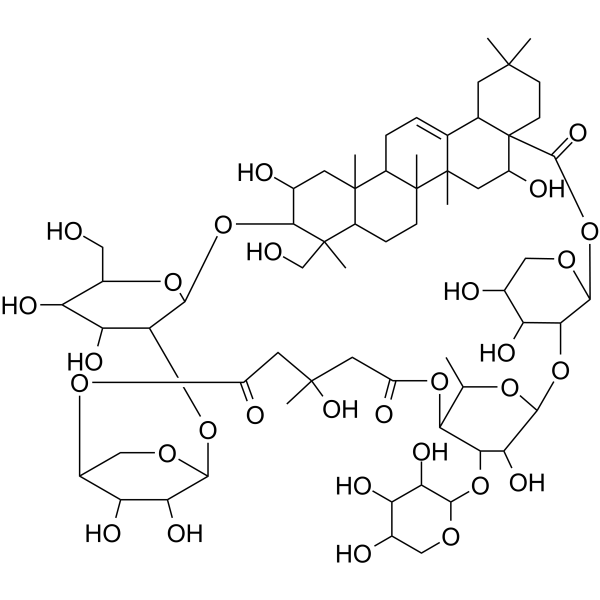
Physicochemical Properties
| Molecular Formula | C63H98O30 |
| Molecular Weight | 1335.43424367905 |
| Exact Mass | 1334.614 |
| CAS # | 115810-12-3 |
| PubChem CID | 14037387 |
| Appearance | White to off-white solid powder |
| Density | 1.5±0.1 g/cm3 |
| Index of Refraction | 1.643 |
| LogP | 4.36 |
| Hydrogen Bond Donor Count | 15 |
| Hydrogen Bond Acceptor Count | 30 |
| Rotatable Bond Count | 4 |
| Heavy Atom Count | 93 |
| Complexity | 2740 |
| Defined Atom Stereocenter Count | 0 |
| InChi Key | GBWAAJJGXQJTTA-UHFFFAOYSA-N |
| InChi Code | InChI=1S/C63H98O30/c1-25-46-47(89-51-43(77)38(72)29(67)21-82-51)45(79)53(85-25)91-48-39(73)30(68)22-83-54(48)93-56(80)63-14-13-57(2,3)15-27(63)26-9-10-34-59(5)16-28(66)50(60(6,24-65)33(59)11-12-61(34,7)62(26,8)17-35(63)69)92-55-49(42(76)40(74)31(20-64)87-55)90-52-44(78)41(75)32(23-84-52)86-36(70)18-58(4,81)19-37(71)88-46/h9,25,27-35,38-55,64-69,72-79,81H,10-24H2,1-8H3 |
| Chemical Name | 7,8,18,28,29,35,51,55,56,58-decahydroxy-30,54-bis(hydroxymethyl)-13,18,37,41,48,48,53,54-octamethyl-57-(3,4,5-trihydroxyoxan-2-yl)oxy-3,5,10,12,15,21,24,26,31,33-decaoxadecacyclo[39.9.3.211,14.222,25.134,38.01,46.04,9.027,32.037,42.045,53]octapentacont-44-ene-2,16,20-trione |
| HS Tariff Code | 2934.99.9001 |
| Storage |
Powder-20°C 3 years 4°C 2 years In solvent -80°C 6 months -20°C 1 month |
| Shipping Condition | Room temperature (This product is stable at ambient temperature for a few days during ordinary shipping and time spent in Customs) |
Biological Activity
| ln Vivo |
Tubeimoside II exhibited anti-inflammatory activity in a TPA-induced mouse ear edema model. When applied topically at doses of 0.0075, 0.037, 0.075, and 0.11 µmol per ear, it inhibited ear edema in a dose-dependent manner, with inhibition rates of 37.7%, 56.6%, 84.9%, and 100%, respectively. Its activity was stronger than that of tubeimoside I.[1] In an in vivo antitumor test against transplantable mouse sarcoma S180 in BALB/c mice, intraperitoneal administration of tubeimoside II at 12 mg/kg/day for 1, 2, and 3 consecutive days resulted in tumor inhibition rates of 43.3%, 49.8%, and 60.1%, respectively, showing stronger activity than tubeimoside I.[1] In a two-stage mouse skin carcinogenesis model (initiated by DMBA, promoted by TPA), topical application of tubeimoside II (0.5 mg per painting, simultaneously with TPA) completely inhibited tumor formation up to the 18th week. Mice treated with tubeimoside II had smooth skin, unlike the inflammatory foci seen in the control group. Oral administration of tubeimoside II (dissolved in drinking water at 0.1 g/L ad libitum throughout the promotion stage) reduced the average number of tumors per mouse from 15.5 (control) to 10.0 by the 18th week, although the percentage of tumor-bearing mice remained the same (93.3%).[1] |
| Animal Protocol |
For the anti-inflammatory test, tubeimoside II was dissolved in acetone and applied topically to both surfaces of each ear of male ICR mice 30 minutes before topical application of the irritant TPA (2 µg in 20 µL acetone). Ear thickness was measured 5 hours after TPA treatment.[1] For the in vivo antitumor test, BALB/c mice were inoculated subcutaneously with S180 tumor cells. Tubeimoside II was administered intraperitoneally at a dose of 12 mg/kg/day on the indicated days (1, 2, or 3 consecutive days post-inoculation). Tumors were excised and weighed 20 days after inoculation to calculate the inhibition rate.[1] For the two-stage skin carcinogenesis study, the backs of female ICR mice were shaved and initiated with a single topical dose of DMBA (100 µg). Promotion was performed by applying TPA (1 µg) topically twice a week starting one week after initiation. For topical intervention, tubeimoside II (0.5 mg in acetone) was applied simultaneously with each TPA treatment. For oral intervention, tubeimoside II was dissolved in drinking water at a concentration of 0.1 g/L and provided ad libitum to mice throughout the promotion stage. Tumor incidence and number were recorded weekly.[1] |
| Toxicity/Toxicokinetics |
The acute LD50 of tubeimoside II in ICR mice was determined to be 21 ± 3 mg/kg.[1] |
| References |
[1]. Structure-activity relationship of tubeimosides in anti-inflammatory, antitumor, and antitumor-promoting effects. Acta Pharmacol Sin. 2001 May;22(5):463-8. |
| Additional Infomation |
Tubeimoside II is a triterpenoid. Tubeimoside II has been reported in Bolbostemma paniculatum with data available. Tubeimoside II is an oleanane-type triterpenoid saponin (a cyclic bisdesmoside) isolated from the tuber of Bolbostemma paniculatum (Chinese folk medicine "Tubeimu"). The study concludes that the C-16 hydroxyl group in its structure plays an important role in enhancing its biological activity (anti-inflammatory, antitumor, antitumor-promoting) and in decreasing its acute toxicity compared to tubeimoside I. Tubeimoside II is suggested to be the most promising agent for cancer chemoprevention and chemotherapy among tubeimosides I, II, and III based on its stronger efficacy and lower toxicity profile in these models.[1] |
Solubility Data
| Solubility (In Vitro) | DMSO : ~100 mg/mL (~74.88 mM) |
| Solubility (In Vivo) |
Solubility in Formulation 1: ≥ 2.5 mg/mL (1.87 mM) (saturation unknown) in 10% DMSO + 40% PEG300 + 5% Tween80 + 45% Saline (add these co-solvents sequentially from left to right, and one by one), clear solution. For example, if 1 mL of working solution is to be prepared, you can add 100 μL of 25.0 mg/mL clear DMSO stock solution to 400 μL PEG300 and mix evenly; then add 50 μL Tween-80 to the above solution and mix evenly; then add 450 μL normal saline to adjust the volume to 1 mL. Preparation of saline: Dissolve 0.9 g of sodium chloride in 100 mL ddH₂ O to obtain a clear solution. Solubility in Formulation 2: ≥ 2.5 mg/mL (1.87 mM) (saturation unknown) in 10% DMSO + 90% (20% SBE-β-CD in Saline) (add these co-solvents sequentially from left to right, and one by one), clear solution. For example, if 1 mL of working solution is to be prepared, you can add 100 μL of 25.0 mg/mL clear DMSO stock solution to 900 μL of 20% SBE-β-CD physiological saline solution and mix evenly. Preparation of 20% SBE-β-CD in Saline (4°C,1 week): Dissolve 2 g SBE-β-CD in 10 mL saline to obtain a clear solution. Solubility in Formulation 3: ≥ 2.5 mg/mL (1.87 mM) (saturation unknown) in 10% DMSO + 90% Corn Oil (add these co-solvents sequentially from left to right, and one by one), clear solution. For example, if 1 mL of working solution is to be prepared, you can add 100 μL of 25.0 mg/mL clear DMSO stock solution to 900 μL of corn oil and mix evenly. (Please use freshly prepared in vivo formulations for optimal results.) |
| Preparing Stock Solutions | 1 mg | 5 mg | 10 mg | |
| 1 mM | 0.7488 mL | 3.7441 mL | 7.4882 mL | |
| 5 mM | 0.1498 mL | 0.7488 mL | 1.4976 mL | |
| 10 mM | 0.0749 mL | 0.3744 mL | 0.7488 mL |