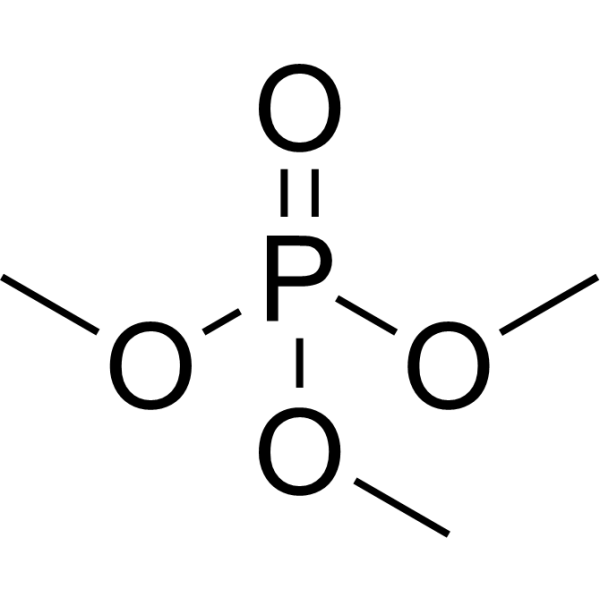
Physicochemical Properties
| Molecular Formula | C3H9O4P |
| Molecular Weight | 140.07 |
| Exact Mass | 140.023 |
| CAS # | 512-56-1 |
| PubChem CID | 10541 |
| Appearance |
Liquid Colorless liquid |
| Density | 1.2±0.1 g/cm3 |
| Boiling Point | 197.2±0.0 °C at 760 mmHg |
| Melting Point | -46 °C |
| Flash Point | 83.7±38.8 °C |
| Vapour Pressure | 0.5±0.3 mmHg at 25°C |
| Index of Refraction | 1.379 |
| LogP | -0.52 |
| Hydrogen Bond Donor Count | 0 |
| Hydrogen Bond Acceptor Count | 4 |
| Rotatable Bond Count | 3 |
| Heavy Atom Count | 8 |
| Complexity | 82.4 |
| Defined Atom Stereocenter Count | 0 |
| SMILES | COP(=O)(OC)OC |
| InChi Key | WVLBCYQITXONBZ-UHFFFAOYSA-N |
| InChi Code | InChI=1S/C3H9O4P/c1-5-8(4,6-2)7-3/h1-3H3 |
| Chemical Name | trimethyl phosphate |
| HS Tariff Code | 2934.99.9001 |
| Storage |
Powder-20°C 3 years 4°C 2 years In solvent -80°C 6 months -20°C 1 month Note: Please store this product in a sealed and protected environment, avoid exposure to moisture. |
| Shipping Condition | Room temperature (This product is stable at ambient temperature for a few days during ordinary shipping and time spent in Customs) |
Biological Activity
| ADME/Pharmacokinetics |
Absorption, Distribution and Excretion Most organophosphate compounds are ... absorbed from skin, conjunctiva, gastrointestinal tract, & lung. /Organophosphate compounds/ Metabolism / Metabolites Rats treated orally at 100 mg/kg and mice treated ip at 1000 mg/kg with (32)P-labeled trimethyl phosphate excreted primarily dimethyl phosphate in the urine. Only traces of the parent compound were detected, and only in the rats at less than 6 hr after treatment. S-Methyl cysteine and S-methyl cysteine N-acetate were also isolated. Small amounts of S-methyl glutathione were detected, presumably the initial methylation product in this series of metabolites ... . Metabolism of trimethyl phosphate was faster in the mouse than in the rat, but there was no evidence of further conversion to monomethyl phosphate in either species ... . |
| Toxicity/Toxicokinetics |
Toxicity Summary IDENTIFICATION AND USE: Trimethyl phosphate is a colorless liquid. It is used as a gasoline additive for controlling surface ignition and spark plug fouling; methylating agent, chemical intermediate in the production of polymethyl polyphosphates; flame retardant solvent for paints and polymers; catalyst in the preparation of polymers and resins. HUMAN EXPOSURE AND TOXICITY: Weakness and paralysis are neurotoxic effects of trimethyl phosphate. ANIMAL STUDIES: Trimethyl phosphate was a rabbit eye irritant. In rabbits oral or dermal administration produced flaccid and spastic paralysis. Trimethyl phosphate was neurotoxic in beagle dogs. After 4 wk, neurotoxicity was noted in impairment of hopping, tactile placing, and atactic gait. Electrophysiologic tests indicated a prolonged latency of neuromuscular impulse transmission after wk 9, followed by a decrease in maximum conduction velocity of sensory fibers. Peripheral nerve fibers also had abnormalities at this time, including paranodal and internodal swelling, paranodal demyelination, and distal fragmentation. Trimethyl phosphate induced sterility in mice, rats and rabbits. Trimethyl phosphate primarily affected epididymal spermatozoa, probably by action of sperm motility. Trimethyl phosphate causes aspermia in D. melanogaster males. Evidence from cytological studies of larval testes suggests that the chemosterilizing effect of the chemical is upon early primary spermatocytes. In developmental studies in mice, F1 male progeny were sterile or semi-sterile, resulting from heritable translocations. Thus, trimethyl phosphate is capable of causing chromosomal damage in mouse spermatids. in NTP carcinogenicity studies trimethyl phosphate was associated with the induction of benign fibromas of the subcutaneous tissue in male Fischer rats. No evidence of carcinogenicity of the compound was obtained in female rats. Trimethylphosphate was carcinogenic in female mice, inducing adenocarcinomas of the uterus/endometrium. No evidence of carcinogenicity of the compound was obtained in male mice. ECOTOXICITY STUDIES: In Japanese quail treated orally with trimethyl phosphate, there was rapid decline in the percentage of fertile eggs during the 10 day period following the first dose. In another study it was reported that only 81% of eggs laid between 1 and 35 days after treatment of male quail with trimethyl phosphate were fertile, significantly less than in the control group . Non-Human Toxicity Values LD50 Rabbit dermal 3388 mg/kg LD50 Rat oral 840 mg/kg LD50 Rabbit oral 1050 mg/kg LD50 Mouse oral 1470 mg/kg For more Non-Human Toxicity Values (Complete) data for TRIMETHYL PHOSPHATE (8 total), please visit the HSDB record page. |
| Additional Infomation |
Trimethyl Phosphate can cause cancer according to The Environmental Protection Agency (EPA). Trimethyl phosphate appears as a pale straw colored liquid. Inhalation may irritate respiratory tract. Vapor or liquid may irritate skin or eyes. Ingestion may irritate the mucous membranes of the gastrointestinal tract. Trimethyl phosphate is a trialkyl phosphate that is the trimethyl ester of phosphoric acid. It has a role as an insect attractant and a NMR chemical shift reference compound. |
Solubility Data
| Solubility (In Vitro) | DMSO: 100 mg/mL (713.93 mM) |
| Solubility (In Vivo) |
Note: Listed below are some common formulations that may be used to formulate products with low water solubility (e.g. < 1 mg/mL), you may test these formulations using a minute amount of products to avoid loss of samples. Injection Formulations (e.g. IP/IV/IM/SC) Injection Formulation 1: DMSO : Tween 80: Saline = 10 : 5 : 85 (i.e. 100 μL DMSO stock solution → 50 μL Tween 80 → 850 μL Saline) *Preparation of saline: Dissolve 0.9 g of sodium chloride in 100 mL ddH ₂ O to obtain a clear solution. Injection Formulation 2: DMSO : PEG300 :Tween 80 : Saline = 10 : 40 : 5 : 45 (i.e. 100 μL DMSO → 400 μLPEG300 → 50 μL Tween 80 → 450 μL Saline) Injection Formulation 3: DMSO : Corn oil = 10 : 90 (i.e. 100 μL DMSO → 900 μL Corn oil) Example: Take the Injection Formulation 3 (DMSO : Corn oil = 10 : 90) as an example, if 1 mL of 2.5 mg/mL working solution is to be prepared, you can take 100 μL 25 mg/mL DMSO stock solution and add to 900 μL corn oil, mix well to obtain a clear or suspension solution (2.5 mg/mL, ready for use in animals). Injection Formulation 4: DMSO : 20% SBE-β-CD in saline = 10 : 90 [i.e. 100 μL DMSO → 900 μL (20% SBE-β-CD in saline)] *Preparation of 20% SBE-β-CD in Saline (4°C,1 week): Dissolve 2 g SBE-β-CD in 10 mL saline to obtain a clear solution. Injection Formulation 5: 2-Hydroxypropyl-β-cyclodextrin : Saline = 50 : 50 (i.e. 500 μL 2-Hydroxypropyl-β-cyclodextrin → 500 μL Saline) Injection Formulation 6: DMSO : PEG300 : castor oil : Saline = 5 : 10 : 20 : 65 (i.e. 50 μL DMSO → 100 μLPEG300 → 200 μL castor oil → 650 μL Saline) Injection Formulation 7: Ethanol : Cremophor : Saline = 10: 10 : 80 (i.e. 100 μL Ethanol → 100 μL Cremophor → 800 μL Saline) Injection Formulation 8: Dissolve in Cremophor/Ethanol (50 : 50), then diluted by Saline Injection Formulation 9: EtOH : Corn oil = 10 : 90 (i.e. 100 μL EtOH → 900 μL Corn oil) Injection Formulation 10: EtOH : PEG300:Tween 80 : Saline = 10 : 40 : 5 : 45 (i.e. 100 μL EtOH → 400 μLPEG300 → 50 μL Tween 80 → 450 μL Saline) Oral Formulations Oral Formulation 1: Suspend in 0.5% CMC Na (carboxymethylcellulose sodium) Oral Formulation 2: Suspend in 0.5% Carboxymethyl cellulose Example: Take the Oral Formulation 1 (Suspend in 0.5% CMC Na) as an example, if 100 mL of 2.5 mg/mL working solution is to be prepared, you can first prepare 0.5% CMC Na solution by measuring 0.5 g CMC Na and dissolve it in 100 mL ddH2O to obtain a clear solution; then add 250 mg of the product to 100 mL 0.5% CMC Na solution, to make the suspension solution (2.5 mg/mL, ready for use in animals). Oral Formulation 3: Dissolved in PEG400 Oral Formulation 4: Suspend in 0.2% Carboxymethyl cellulose Oral Formulation 5: Dissolve in 0.25% Tween 80 and 0.5% Carboxymethyl cellulose Oral Formulation 6: Mixing with food powders Note: Please be aware that the above formulations are for reference only. InvivoChem strongly recommends customers to read literature methods/protocols carefully before determining which formulation you should use for in vivo studies, as different compounds have different solubility properties and have to be formulated differently. (Please use freshly prepared in vivo formulations for optimal results.) |
| Preparing Stock Solutions | 1 mg | 5 mg | 10 mg | |
| 1 mM | 7.1393 mL | 35.6964 mL | 71.3929 mL | |
| 5 mM | 1.4279 mL | 7.1393 mL | 14.2786 mL | |
| 10 mM | 0.7139 mL | 3.5696 mL | 7.1393 mL |