Physicochemical Properties
| CAS # | 1546799-45-4 |
| Appearance | Typically exists as solid at room temperature |
| HS Tariff Code | 2934.99.9001 |
| Storage |
Powder-20°C 3 years 4°C 2 years In solvent -80°C 6 months -20°C 1 month |
| Shipping Condition | Room temperature (This product is stable at ambient temperature for a few days during ordinary shipping and time spent in Customs) |
Biological Activity
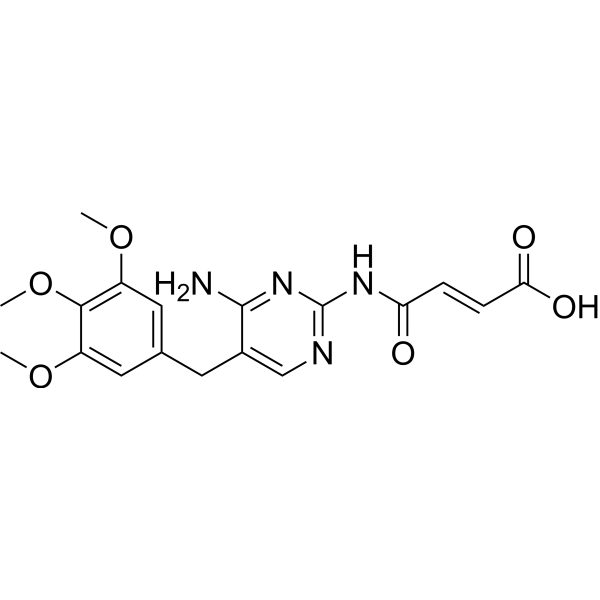
| Targets | Hapten for ASGs (Antibacterial synergists) |
| ln Vitro | The specificity of the icELISA was demonstrated by counting CRs against 19 compounds, including five ASGs, nine structurally related compounds, and five other antibiotics. It is not surprising that the icELISA showed no CRs (<0.002%) for other frequently used antibiotics such as sulfaguanidine, sulfamethizole, sulfamerazine, norfloxacin, and furazolidone. The IC50 values and CR of the icELISA for ASGs and other structurally related compounds are summarized in Table S5. It can be seen that mAb 5C4 only recognized the compounds that possessed both diaminopyrimidine and methoxybenzene, which was supported by observing the negligible CR for 3,4,5-trimethoxycinnamic acid, gallic acid trimethyl ether, 3-(3,4,5-trimethoxyphenyl)propionic acid, 3,4,5-trimethoxyphenylacetic acid, 2,4-diamino-6-(4-fluorophenyl)pyrimidine, pyrimethamine, and 2,4-diaminopyrimidine. These compounds only contained one moiety of TMP, i.e., diaminopyrimidine or methoxybenzene. It is reasonable that the mAb could not recognize the compounds only containing methoxybenzene as this moiety was used to conjugate with protein and then was blocked when exposed to the immune system. We thought that the mAb could recognize DAP which was fully exposed to the immune system; however, the unstable immune-complex of mAb-DAP may lead to a high dissociation rate constant resulting in very low affinity.[1] |
| ln Vivo | An antibody with broad specificity and principally depending on hapten structure and size is a key reagent for developing a class-selective immunoassay. In the present study, three new generic haptens of antibacterial synergists (ASGs) were proposed using trimethoprim as the starting molecule. These haptens contained carboxyl groups on the meta position of trimethoxybenzene for conjugating to protein, while, the common moiety of ASGs, i.e., diaminopyrimidine, was intentionally and maximally exposed to the immune system in animals in order to induce antibodies with broad specificity against ASGs. Five monoclonal antibodies (mAbs) were finally obtained, and 5C4 from the hapten with a short spacer arm, named Hapten A, showed not only uniform broad specificity but also high affinity to all five ASGs. We further determined the possible recognition mechanism of mAbs in terms of conformational and electronic aspects. An indirect competitive ELISA (icELISA)-based 5C4 was established and exhibited IC50 values of 0.067-0.139 μg L-1 with cross-reactivity of 48.2%-418.7% for the five ASGs in buffer under optimal conditions. The calculated limits of detection of the icELISA for chicken and milk were 0.06-0.8 μg kg-1 and 0.05-0.6 μg L-1, respectively. The recoveries in spiked chicken and milk samples were 75.2%-101.4% with a coefficient of variation less than 14.3%. In summary, we have developed, for the first time, a rapid and reliable icELISA for ASGs with significantly improved sensitivity and class selectivity.[1] |
| References |
[1].Generic Hapten Synthesis, Broad-Specificity Monoclonal Antibodies Preparation, and Ultrasensitive ELISA for Five Antibacterial Synergists in Chicken and Milk. J Agric Food Chem. 2018 Oct 24;66(42):11170-11179. |
Solubility Data
| Solubility (In Vitro) | Typically soluble in DMSO (e.g. 10 mM) |
| Solubility (In Vivo) |
Note: Listed below are some common formulations that may be used to formulate products with low water solubility (e.g. < 1 mg/mL), you may test these formulations using a minute amount of products to avoid loss of samples. Injection Formulations (e.g. IP/IV/IM/SC) Injection Formulation 1: DMSO : Tween 80: Saline = 10 : 5 : 85 (i.e. 100 μL DMSO stock solution → 50 μL Tween 80 → 850 μL Saline) *Preparation of saline: Dissolve 0.9 g of sodium chloride in 100 mL ddH ₂ O to obtain a clear solution. Injection Formulation 2: DMSO : PEG300 :Tween 80 : Saline = 10 : 40 : 5 : 45 (i.e. 100 μL DMSO → 400 μLPEG300 → 50 μL Tween 80 → 450 μL Saline) Injection Formulation 3: DMSO : Corn oil = 10 : 90 (i.e. 100 μL DMSO → 900 μL Corn oil) Example: Take the Injection Formulation 3 (DMSO : Corn oil = 10 : 90) as an example, if 1 mL of 2.5 mg/mL working solution is to be prepared, you can take 100 μL 25 mg/mL DMSO stock solution and add to 900 μL corn oil, mix well to obtain a clear or suspension solution (2.5 mg/mL, ready for use in animals). Injection Formulation 4: DMSO : 20% SBE-β-CD in saline = 10 : 90 [i.e. 100 μL DMSO → 900 μL (20% SBE-β-CD in saline)] *Preparation of 20% SBE-β-CD in Saline (4°C,1 week): Dissolve 2 g SBE-β-CD in 10 mL saline to obtain a clear solution. Injection Formulation 5: 2-Hydroxypropyl-β-cyclodextrin : Saline = 50 : 50 (i.e. 500 μL 2-Hydroxypropyl-β-cyclodextrin → 500 μL Saline) Injection Formulation 6: DMSO : PEG300 : castor oil : Saline = 5 : 10 : 20 : 65 (i.e. 50 μL DMSO → 100 μLPEG300 → 200 μL castor oil → 650 μL Saline) Injection Formulation 7: Ethanol : Cremophor : Saline = 10: 10 : 80 (i.e. 100 μL Ethanol → 100 μL Cremophor → 800 μL Saline) Injection Formulation 8: Dissolve in Cremophor/Ethanol (50 : 50), then diluted by Saline Injection Formulation 9: EtOH : Corn oil = 10 : 90 (i.e. 100 μL EtOH → 900 μL Corn oil) Injection Formulation 10: EtOH : PEG300:Tween 80 : Saline = 10 : 40 : 5 : 45 (i.e. 100 μL EtOH → 400 μLPEG300 → 50 μL Tween 80 → 450 μL Saline) Oral Formulations Oral Formulation 1: Suspend in 0.5% CMC Na (carboxymethylcellulose sodium) Oral Formulation 2: Suspend in 0.5% Carboxymethyl cellulose Example: Take the Oral Formulation 1 (Suspend in 0.5% CMC Na) as an example, if 100 mL of 2.5 mg/mL working solution is to be prepared, you can first prepare 0.5% CMC Na solution by measuring 0.5 g CMC Na and dissolve it in 100 mL ddH2O to obtain a clear solution; then add 250 mg of the product to 100 mL 0.5% CMC Na solution, to make the suspension solution (2.5 mg/mL, ready for use in animals). Oral Formulation 3: Dissolved in PEG400 Oral Formulation 4: Suspend in 0.2% Carboxymethyl cellulose Oral Formulation 5: Dissolve in 0.25% Tween 80 and 0.5% Carboxymethyl cellulose Oral Formulation 6: Mixing with food powders Note: Please be aware that the above formulations are for reference only. InvivoChem strongly recommends customers to read literature methods/protocols carefully before determining which formulation you should use for in vivo studies, as different compounds have different solubility properties and have to be formulated differently. (Please use freshly prepared in vivo formulations for optimal results.) |