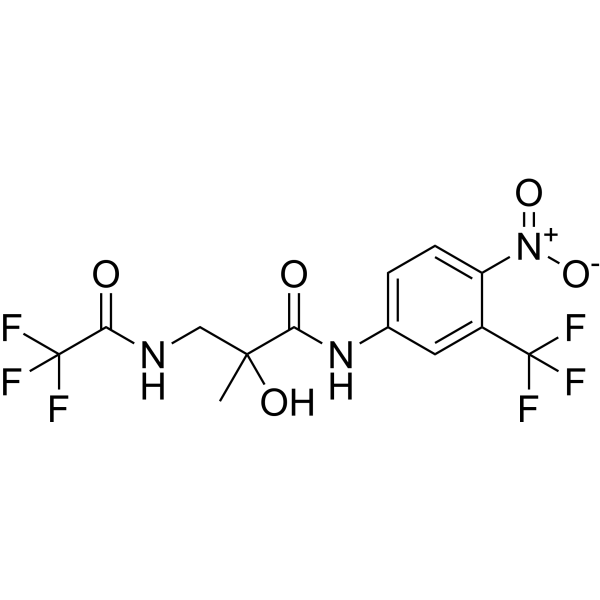
Physicochemical Properties
| Molecular Formula | C13H11F6N3O5 |
| Molecular Weight | 403.2340 |
| Exact Mass | 403.06 |
| CAS # | 260980-89-0 |
| PubChem CID | 9930988 |
| Appearance | White to off-white solid powder |
| LogP | 3.994 |
| Hydrogen Bond Donor Count | 3 |
| Hydrogen Bond Acceptor Count | 11 |
| Rotatable Bond Count | 4 |
| Heavy Atom Count | 27 |
| Complexity | 591 |
| Defined Atom Stereocenter Count | 0 |
| InChi Key | YCNCRLKXSLARFT-UHFFFAOYSA-N |
| InChi Code | InChI=1S/C13H11F6N3O5/c1-11(25,5-20-10(24)13(17,18)19)9(23)21-6-2-3-8(22(26)27)7(4-6)12(14,15)16/h2-4,25H,5H2,1H3,(H,20,24)(H,21,23) |
| Chemical Name | 2-hydroxy-2-methyl-N-[4-nitro-3-(trifluoromethyl)phenyl]-3-[(2,2,2-trifluoroacetyl)amino]propanamide |
| HS Tariff Code | 2934.99.9001 |
| Storage |
Powder-20°C 3 years 4°C 2 years In solvent -80°C 6 months -20°C 1 month |
| Shipping Condition | Room temperature (This product is stable at ambient temperature for a few days during ordinary shipping and time spent in Customs) |
Biological Activity
| Targets |
Topilutamide targets the androgen receptor (AR) with a Ki value of 0.5 μM (determined by competitive binding assay) [2] |
| ln Vitro |
Topilutamide competitively bound to the androgen receptor in vitro, inhibiting the binding of endogenous androgens to AR with a Ki value of 0.5 μM [2] It dose-dependently suppressed androgen-induced proliferation of androgen-sensitive cells, blocking the downstream signaling pathway mediated by AR activation [2] |
| ln Vivo | The most common cancer and one of the main reasons men die from cancer is prostate cancer. First-generation nonsteroidal antiandrogens (NSAA), such as flutamide, nilutamide, bicalutamide, and topilutamide, are frequently used to treat metastatic prostate cancer [1]. |
| Toxicity/Toxicokinetics |
Topilutamide showed good local tolerability in clinical use, with no significant systemic side effects reported [2] A small number of patients experienced mild local skin irritation, such as pruritus and erythema, which were transient and resolved spontaneously without treatment [2] |
| References |
[1]. Review of HPLC and LC-MS/MS assays for the determination of various nonsteroidal anti-androgens used in the treatment of prostate cancer. Biomed Chromatogr. 2017 Jun 21. [2]. Sovak M, Seligson AL, Kucerova R, Bienova M, Hajduch M, Bucek M. Fluridil, a rationally designed topical agent for androgenetic alopecia: first clinical experience [published correction appears in Dermatol Surg 2002 Oct;28(8):following 970]. Dermatol Surg. 2002;28(8):678-685. |
| Additional Infomation |
Topilutamide, also known as Fluridil, is a rationally designed topical nonsteroidal anti-androgen [2] It is indicated for the treatment of androgenetic alopecia (male pattern baldness) [2] Administered topically to the scalp, it acts locally on hair follicles to prevent the adverse effects of androgens on follicular function, delaying hair loss and promoting hair regrowth [2] Literature [1] is a review of HPLC and LC-MS/MS assays for nonsteroidal anti-androgens and does not provide specific pharmacological, experimental, or pharmacokinetic data of Topilutamide [1] |
Solubility Data
| Solubility (In Vitro) | DMSO : ~100 mg/mL (~248.00 mM) |
| Solubility (In Vivo) |
Solubility in Formulation 1: ≥ 2.5 mg/mL (6.20 mM) (saturation unknown) in 10% DMSO + 40% PEG300 + 5% Tween80 + 45% Saline (add these co-solvents sequentially from left to right, and one by one), clear solution. For example, if 1 mL of working solution is to be prepared, you can add 100 μL of 25.0 mg/mL clear DMSO stock solution to 400 μL PEG300 and mix evenly; then add 50 μL Tween-80 to the above solution and mix evenly; then add 450 μL normal saline to adjust the volume to 1 mL. Preparation of saline: Dissolve 0.9 g of sodium chloride in 100 mL ddH₂ O to obtain a clear solution. Solubility in Formulation 2: ≥ 2.5 mg/mL (6.20 mM) (saturation unknown) in 10% DMSO + 90% (20% SBE-β-CD in Saline) (add these co-solvents sequentially from left to right, and one by one), clear solution. For example, if 1 mL of working solution is to be prepared, you can add 100 μL of 25.0 mg/mL clear DMSO stock solution to 900 μL of 20% SBE-β-CD physiological saline solution and mix evenly. Preparation of 20% SBE-β-CD in Saline (4°C,1 week): Dissolve 2 g SBE-β-CD in 10 mL saline to obtain a clear solution. Solubility in Formulation 3: ≥ 2.5 mg/mL (6.20 mM) (saturation unknown) in 10% DMSO + 90% Corn Oil (add these co-solvents sequentially from left to right, and one by one), clear solution. For example, if 1 mL of working solution is to be prepared, you can add 100 μL of 25.0 mg/mL clear DMSO stock solution to 900 μL of corn oil and mix evenly. (Please use freshly prepared in vivo formulations for optimal results.) |
| Preparing Stock Solutions | 1 mg | 5 mg | 10 mg | |
| 1 mM | 2.4800 mL | 12.3999 mL | 24.7997 mL | |
| 5 mM | 0.4960 mL | 2.4800 mL | 4.9599 mL | |
| 10 mM | 0.2480 mL | 1.2400 mL | 2.4800 mL |