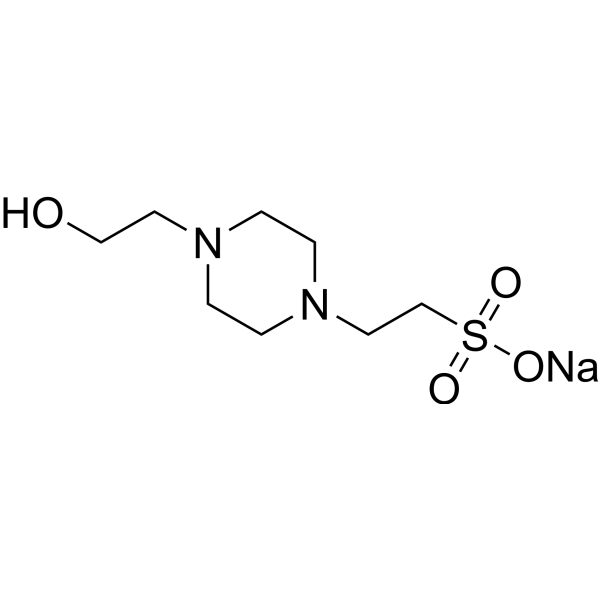
Physicochemical Properties
| Molecular Formula | C8H17N2NAO4S |
| Molecular Weight | 260.2864 |
| Exact Mass | 260.08 |
| CAS # | 75277-39-3 |
| Related CAS # | HEPES;7365-45-9 |
| PubChem CID | 2724248 |
| Appearance | White to off-white solid powder |
| Melting Point | 234ºC |
| Hydrogen Bond Donor Count | 1 |
| Hydrogen Bond Acceptor Count | 6 |
| Rotatable Bond Count | 5 |
| Heavy Atom Count | 16 |
| Complexity | 272 |
| Defined Atom Stereocenter Count | 0 |
| InChi Key | RDZTWEVXRGYCFV-UHFFFAOYSA-M |
| InChi Code | InChI=1S/C8H18N2O4S.Na/c11-7-5-9-1-3-10(4-2-9)6-8-15(12,13)14;/h11H,1-8H2,(H,12,13,14);/q;+1/p-1 |
| Chemical Name | sodium;2-[4-(2-hydroxyethyl)piperazin-1-yl]ethanesulfonate |
| HS Tariff Code | 2934.99.9001 |
| Storage |
Powder-20°C 3 years 4°C 2 years In solvent -80°C 6 months -20°C 1 month |
| Shipping Condition | Room temperature (This product is stable at ambient temperature for a few days during ordinary shipping and time spent in Customs) |
Biological Activity
| ln Vitro | For a minimum of three months, HEPES can preserve titanium's superhydrophilicity while preserving its bioactivity and osteoconductivity [1]. In cultivated RAW264.7 cells, HEPES promotes lysosomal biosynthesis, modifies the cytoplasmic-nuclear distribution of MiT/TFE, upends the global cellular transcriptional profile, and therefore activates the gene network for MiT/TFE-dependent lysosomal autophagy [3]. |
| References |
[1]. Nonvolatile buffer coating of titanium to prevent its biological aging and for drug delivery. Biomaterials. 2010;31(18):4818-4828. [2]. An experimental charge density of HEPES. Acta Crystallogr B. 2010;66(Pt 4):482-492. [3]. https://pubmed.ncbi.nlm.nih.gov/20631430/. |
| Additional Infomation | Sodium 2-[4-(2-hydroxyethyl)piperazin-1-yl]ethanesulfonate is an organic sodium salt, a N-(2-hydroxyethyl)piperazine and a N-(sulfoalkyl)piperazine. It contains a 2-[4-(2-hydroxyethyl)piperazin-1-yl]ethanesulfonate. |
Solubility Data
| Solubility (In Vitro) | DMSO : ~25 mg/mL (~96.05 mM) |
| Solubility (In Vivo) |
Solubility in Formulation 1: ≥ 2.5 mg/mL (9.60 mM) (saturation unknown) in 10% DMSO + 40% PEG300 + 5% Tween80 + 45% Saline (add these co-solvents sequentially from left to right, and one by one), clear solution. For example, if 1 mL of working solution is to be prepared, you can add 100 μL of 25.0 mg/mL clear DMSO stock solution to 400 μL PEG300 and mix evenly; then add 50 μL Tween-80 to the above solution and mix evenly; then add 450 μL normal saline to adjust the volume to 1 mL. Preparation of saline: Dissolve 0.9 g of sodium chloride in 100 mL ddH₂ O to obtain a clear solution. Solubility in Formulation 2: ≥ 2.5 mg/mL (9.60 mM) (saturation unknown) in 10% DMSO + 90% (20% SBE-β-CD in Saline) (add these co-solvents sequentially from left to right, and one by one), clear solution. For example, if 1 mL of working solution is to be prepared, you can add 100 μL of 25.0 mg/mL clear DMSO stock solution to 900 μL of 20% SBE-β-CD physiological saline solution and mix evenly. Preparation of 20% SBE-β-CD in Saline (4°C,1 week): Dissolve 2 g SBE-β-CD in 10 mL saline to obtain a clear solution. Solubility in Formulation 3: ≥ 2.5 mg/mL (9.60 mM) (saturation unknown) in 10% DMSO + 90% Corn Oil (add these co-solvents sequentially from left to right, and one by one), clear solution. For example, if 1 mL of working solution is to be prepared, you can add 100 μL of 25.0 mg/mL clear DMSO stock solution to 900 μL of corn oil and mix evenly. (Please use freshly prepared in vivo formulations for optimal results.) |
| Preparing Stock Solutions | 1 mg | 5 mg | 10 mg | |
| 1 mM | 3.8419 mL | 19.2093 mL | 38.4187 mL | |
| 5 mM | 0.7684 mL | 3.8419 mL | 7.6837 mL | |
| 10 mM | 0.3842 mL | 1.9209 mL | 3.8419 mL |