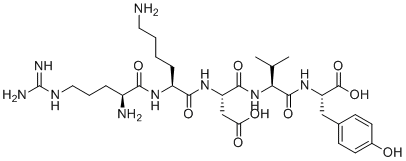
Thymopentin is a synthetic pentapeptide corresponding to the amino acids 32-36 of thymopoietin and exhibiting the full biological activity of the natural hormone. It is an immunomodulator which has been studied for possible use in the treatment of rheumatoid arthritis, AIDS, and other primary immunodeficiencies.
Physicochemical Properties
| Molecular Formula | C30H49N9O9 |
| Molecular Weight | 679.77 |
| Exact Mass | 679.365 |
| Elemental Analysis | C, 53.01; H, 7.27; N, 18.54; O, 21.18 |
| CAS # | 69558-55-0 |
| Related CAS # | Thymopentin acetate;89318-88-7 |
| PubChem CID | 451417 |
| Sequence | Arg-Lys-Asp-Val-Tyr; H-Arg-Lys-Asp-Val-Tyr-OH; L-arginyl-L-lysyl-L-alpha-aspartyl-L-valyl-L-tyrosine |
| SequenceShortening | RKDVY; H-RKDVY-OH |
| Appearance | White to off-white solid powder |
| Density | 1.4±0.1 g/cm3 |
| Index of Refraction | 1.636 |
| LogP | -0.89 |
| Hydrogen Bond Donor Count | 11 |
| Hydrogen Bond Acceptor Count | 12 |
| Rotatable Bond Count | 22 |
| Heavy Atom Count | 48 |
| Complexity | 1110 |
| Defined Atom Stereocenter Count | 5 |
| SMILES | CC(C)[C@@H](C(=O)N[C@@H](CC1=CC=C(C=C1)O)C(=O)O)NC(=O)[C@H](CC(=O)O)NC(=O)[C@H](CCCCN)NC(=O)[C@H](CCCN=C(N)N)N |
| InChi Key | PSWFFKRAVBDQEG-YGQNSOCVSA-N |
| InChi Code | InChI=1S/C30H49N9O9/c1-16(2)24(28(46)38-22(29(47)48)14-17-8-10-18(40)11-9-17)39-27(45)21(15-23(41)42)37-26(44)20(7-3-4-12-31)36-25(43)19(32)6-5-13-35-30(33)34/h8-11,16,19-22,24,40H,3-7,12-15,31-32H2,1-2H3,(H,36,43)(H,37,44)(H,38,46)(H,39,45)(H,41,42)(H,47,48)(H4,33,34,35)/t19-,20-,21-,22-,24-/m0/s1 |
| Chemical Name | (6S,9S,12S,15S,18S)-1,6-diamino-9-(4-aminobutyl)-12-(carboxymethyl)-18-(4-hydroxybenzyl)-1-imino-15-isopropyl-7,10,13,16-tetraoxo-2,8,11,14,17-pentaazanonadecan-19-oic acid |
| Synonyms | ORF-15244; Thymopoietin pentapeptide; Thymopentin; Thymopentine; ORF 15244; ORF15244; TP-5; THYMOPENTIN; 69558-55-0; Timunox; Arg-Lys-Asp-Val-Tyr; Sintomodulina; Timopentina; Thymopoietin 32-36; TP5; TP 5 |
| HS Tariff Code | 2934.99.9001 |
| Storage |
Powder-20°C 3 years 4°C 2 years In solvent -80°C 6 months -20°C 1 month Note: Please store this product in a sealed and protected environment, avoid exposure to moisture. |
| Shipping Condition | Room temperature (This product is stable at ambient temperature for a few days during ordinary shipping and time spent in Customs) |
Biological Activity
| Targets | Bioactive peptide |
| ln Vitro |
- Enhancement of T-cell lineage generation:Thymopentin (10–100 nM) significantly increases the proportion of CD3⁺, CD4⁺, and CD8⁺ T cells derived from human embryonic stem cells (hESCs) in vitro. Flow cytometry analysis shows a 2- to 3-fold increase in T-cell markers compared to untreated controls. [1] - Upregulation of T-cell differentiation genes:Quantitative PCR reveals that Thymopentin treatment upregulates the expression of T-cell-specific transcription factors (e.g., TCF7, GATA3) by 1.5–2.0-fold in hESC-derived hematopoietic progenitor cells. [1] Thymopentin promotes the in vitro development of T cell lineages produced from hESCs [1]. |
| ln Vivo |
- Enhanced immune response in mice:Subcutaneous administration of Thymopentin (0.1–1 mg/kg) in BALB/c mice increases splenic T-cell proliferation by 40–60% (measured via BrdU incorporation) and elevates serum interferon-γ levels by 2-fold. [2] - Improved skin permeation via microneedles:In a rat skin model, dissolving microneedle arrays encapsulating Thymopentin achieve 80–90% drug release within 30 minutes, with a skin penetration efficiency 5-fold higher than conventional topical administration. [2] |
| Cell Assay |
- T-cell differentiation assay:
1. hESCs are induced to differentiate into hematopoietic progenitor cells in serum-free medium supplemented with cytokines (e.g., SCF, IL-3).
2. Thymopentin (10–100 nM) is added during the T-cell specification phase.
3. After 14 days, cells are stained with anti-CD3, CD4, and CD8 antibodies and analyzed by flow cytometry. [1] - Microneedle drug release assay: 1. Dissolving microneedle arrays loaded with Thymopentin are incubated in phosphate-buffered saline (pH 7.4) at 37°C. 2. Drug release is monitored using HPLC, with cumulative release measured at 15, 30, 60, and 120 minutes. [2] |
| Animal Protocol |
- Immunomodulation study in mice:
1. BALB/c mice (6–8 weeks old) receive subcutaneous injections of Thymopentin (0.1–1 mg/kg) dissolved in saline every other day for 2 weeks.
2. Splenocytes are isolated and stimulated with concanavalin A to assess T-cell proliferation.
3. Serum cytokine levels are measured by ELISA. [2] - Skin permeation study in rats: 1. Sprague-Dawley rats are anesthetized, and dissolving microneedle arrays containing Thymopentin are applied to the dorsal skin for 30 minutes. 2. Skin samples and plasma are collected at various time points to quantify drug levels via HPLC. [2] |
| ADME/Pharmacokinetics |
- Rapid absorption via microneedles:In rats, Thymopentin administered via microneedles reaches peak plasma concentrations (Cmax) of 20–30 ng/mL within 1 hour, with a half-life of 2–3 hours. [2] - High skin retention:Approximately 30–40% of the administered dose remains in the skin tissue 24 hours post-application, indicating sustained local delivery. [2] |
| Toxicity/Toxicokinetics |
- No significant systemic toxicity:In mice, single doses of Thymopentin up to 10 mg/kg (microneedle administration) show no signs of acute toxicity, with normal liver and kidney function markers. [2] - Local skin tolerance:Histological analysis of rat skin treated with microneedle arrays reveals minimal inflammation and no epidermal damage. [2] |
| References |
[1]. Thymopentin enhances the generation of T-cell lineage derived from human embryonic stem cells in vitro. Exp Cell Res. 2015 Feb 15;331(2):387-98. [2]. Novel strategy for immunomodulation: Dissolving microneedle array encapsulating thymopentin fabricated by modified two-step molding technology. Eur J Pharm Biopharm. 2018 Jan;122:104-112. |
| Additional Infomation |
Thymopentin is an oligopeptide. Thymopentin has been used in trials studying the treatment and prevention of HIV Infections and Hepatocellular Carcinoma. Thymopentin is a synthetic pentapeptide which is the active site of the naturally occurring hormone thymopoietin with immunomodulating properties. Thymopentin enhances the production of thymic T cells and may help restore immunocompetence in immunosuppressed subjects. This agent also augments the effects of ionizing radiation by arresting cancer cells in the G2/M phase of the cell cycle. (NCI04) Synthetic pentapeptide corresponding to the amino acids 32-36 of thymopoietin and exhibiting the full biological activity of the natural hormone. It is an immunomodulator which has been studied for possible use in the treatment of rheumatoid arthritis, AIDS, and other primary immunodeficiencies. Mechanism of action:Thymopentin promotes T-cell differentiation by activating Notch signaling and upregulating T-cell lineage-specific genes in hESCs. [1] - Novel delivery system:The dissolving microneedle array enhances transdermal delivery of Thymopentin, overcoming the low bioavailability of traditional subcutaneous injections. [2] - Therapeutic potential:Investigated for immune restoration in immunocompromised conditions and as an adjuvant for cancer immunotherapy. [1][2] |
Solubility Data
| Solubility (In Vitro) |
H2O : ~50 mg/mL (~73.55 mM) DMSO : ~20.83 mg/mL (~30.64 mM) |
| Solubility (In Vivo) |
Solubility in Formulation 1: ≥ 2.08 mg/mL (3.06 mM) (saturation unknown) in 10% DMSO + 40% PEG300 + 5% Tween80 + 45% Saline (add these co-solvents sequentially from left to right, and one by one), clear solution. For example, if 1 mL of working solution is to be prepared, you can add 100 μL of 20.8 mg/mL clear DMSO stock solution to 400 μL PEG300 and mix evenly; then add 50 μL Tween-80 to the above solution and mix evenly; then add 450 μL normal saline to adjust the volume to 1 mL. Preparation of saline: Dissolve 0.9 g of sodium chloride in 100 mL ddH₂ O to obtain a clear solution. Solubility in Formulation 2: ≥ 2.08 mg/mL (3.06 mM) (saturation unknown) in 10% DMSO + 90% (20% SBE-β-CD in Saline) (add these co-solvents sequentially from left to right, and one by one), clear solution. For example, if 1 mL of working solution is to be prepared, you can add 100 μL of 20.8 mg/mL clear DMSO stock solution to 900 μL of 20% SBE-β-CD physiological saline solution and mix evenly. Preparation of saline: Dissolve 0.9 g of sodium chloride in 100 mL ddH₂ O to obtain a clear solution. Solubility in Formulation 3: 2.08 mg/mL (3.06 mM) in 10% DMSO + 90% Corn Oil (add these co-solvents sequentially from left to right, and one by one), suspension solution; with ultrasonication. For example, if 1 mL of working solution is to be prepared, you can add 100 μL of 20.8 mg/mL clear DMSO stock solution to 900 μL of corn oil and mix evenly. (Please use freshly prepared in vivo formulations for optimal results.) |
| Preparing Stock Solutions | 1 mg | 5 mg | 10 mg | |
| 1 mM | 1.4711 mL | 7.3554 mL | 14.7109 mL | |
| 5 mM | 0.2942 mL | 1.4711 mL | 2.9422 mL | |
| 10 mM | 0.1471 mL | 0.7355 mL | 1.4711 mL |