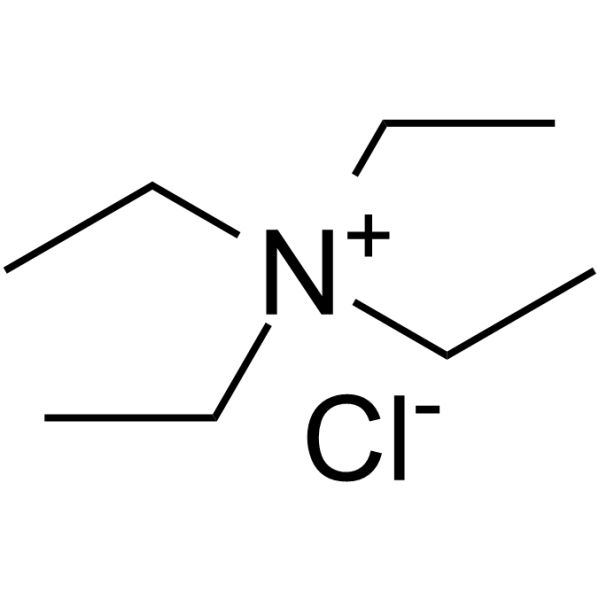
Physicochemical Properties
| Molecular Formula | C8H20CLN |
| Molecular Weight | 165.70 |
| Exact Mass | 165.128 |
| CAS # | 56-34-8 |
| Related CAS # | 66-40-0 (Parent) |
| PubChem CID | 5946 |
| Appearance | White to off-white solid powder |
| Density | 1.08 |
| Melting Point | 39°C |
| Hydrogen Bond Donor Count | 0 |
| Hydrogen Bond Acceptor Count | 1 |
| Rotatable Bond Count | 4 |
| Heavy Atom Count | 10 |
| Complexity | 47.5 |
| Defined Atom Stereocenter Count | 0 |
| InChi Key | YMBCJWGVCUEGHA-UHFFFAOYSA-M |
| InChi Code | InChI=1S/C8H20N.ClH/c1-5-9(6-2,7-3)8-4;/h5-8H2,1-4H3;1H/q+1;/p-1 |
| Chemical Name | tetraethylazanium;chloride |
| HS Tariff Code | 2934.99.9001 |
| Storage |
Powder-20°C 3 years 4°C 2 years In solvent -80°C 6 months -20°C 1 month Note: Please store this product in a sealed and protected environment, avoid exposure to moisture. |
| Shipping Condition | Room temperature (This product is stable at ambient temperature for a few days during ordinary shipping and time spent in Customs) |
Biological Activity
| ln Vitro | The treatment of C6 and 9L glioma cells with tetraethylammonium (0.2-60 mM; 24-72 hours) reduces their proliferation in a dose- and time-dependent manner [1]. Apoptosis is markedly increased by tetraethylammonium (40 mM; 24-72 hours; C6 and 9L glioma cells) therapy [1]. Treatment of C6 and 9L glioma cells with 40 mM tetraethylammonium for 12–48 hours dramatically raises the Bax/Bcl-2 protein ratio in a time-dependent manner [1]. After adding 20 and 40 mM tetraethylammonium to C6 and 9L cells, intracellular ROS generation increased [1]. |
| ln Vivo | In the rat colon and rectum, tetraethylammonium (1 mM, 3 mM, and 5 mM) dramatically enhances the amplitude and frequency of longitudinal and circular contractions. For ten days, tetraethylammonium was applied topically from the anus into the intestinal lumen. Rat colon and rectum histology was unaffected by tetraethylammonium at doses of 5 mM and 15 mM [2]. |
| Cell Assay |
Cell Proliferation Assay[1] Cell Types: Rat C6 and 9L glioma cells Tested Concentrations: 0.2mM, 2mM, 20mM, 40mM and 60mM Incubation Duration: 24 hrs (hours), 48 hrs (hours) and 72 hrs (hours) Experimental Results: Inhibited the proliferation of C6 and 9L cells in a dose- and time-dependent manner. Apoptosis Analysis[1] Cell Types: Rat C6 and 9L glioma cells Tested Concentrations: 40 mM Incubation Duration: 24 hrs (hours), 48 hrs (hours) and 72 hrs (hours) Experimental Results: Dramatically increased apoptosis in cells. Western Blot Analysis[1] Cell Types: Rat C6 and 9L glioma cells Tested Concentrations: 40 mM Incubation Duration: 12 hrs (hours), 24 hrs (hours), 48 hrs (hours) Experimental Results: The expression of Bax was markedly increased, while that of Bcl-2 demonstrated a decreasing trend 12 , 24 and 48 h. |
| References |
[1]. Tetraethylammonium inhibits glioma cells via increasing production of intracellular reactive oxygen species. Chemotherapy. 2009;55(5):372-80. [2]. Tetraethylammonium enhances the rectal and colonic motility in rats and human in vitro. Naunyn Schmiedebergs Arch Pharmacol. 2011 Aug;384(2):147-55. |
| Additional Infomation |
Tetraethylammonium chloride is a quarternary ammonium chloride salt in which the cation has four ethyl substituents around the central nitrogen. It has a role as a potassium channel blocker. It is a quaternary ammonium salt and an organic chloride salt. It contains a tetraethylammonium. A potassium-selective ion channel blocker. (From J Gen Phys 1994;104(1):173-90) |
Solubility Data
| Solubility (In Vitro) |
DMSO: 100 mg/mL (603.50 mM) H2O: ≥ 100 mg/mL (603.50 mM) |
| Solubility (In Vivo) |
Solubility in Formulation 1: ≥ 2.5 mg/mL (15.09 mM) (saturation unknown) in 10% DMSO + 40% PEG300 + 5% Tween80 + 45% Saline (add these co-solvents sequentially from left to right, and one by one), clear solution. For example, if 1 mL of working solution is to be prepared, you can add 100 μL of 25.0 mg/mL clear DMSO stock solution to 400 μL PEG300 and mix evenly; then add 50 μL Tween-80 to the above solution and mix evenly; then add 450 μL normal saline to adjust the volume to 1 mL. Preparation of saline: Dissolve 0.9 g of sodium chloride in 100 mL ddH₂ O to obtain a clear solution. Solubility in Formulation 2: ≥ 2.5 mg/mL (15.09 mM) (saturation unknown) in 10% DMSO + 90% (20% SBE-β-CD in Saline) (add these co-solvents sequentially from left to right, and one by one), clear solution. For example, if 1 mL of working solution is to be prepared, you can add 100 μL of 25.0 mg/mL clear DMSO stock solution to 900 μL of 20% SBE-β-CD physiological saline solution and mix evenly. Preparation of 20% SBE-β-CD in Saline (4°C,1 week): Dissolve 2 g SBE-β-CD in 10 mL saline to obtain a clear solution. Solubility in Formulation 3: ≥ 2.5 mg/mL (15.09 mM) (saturation unknown) in 10% DMSO + 90% Corn Oil (add these co-solvents sequentially from left to right, and one by one), clear solution. For example, if 1 mL of working solution is to be prepared, you can add 100 μL of 25.0 mg/mL clear DMSO stock solution to 900 μL of corn oil and mix evenly. Solubility in Formulation 4: 100 mg/mL (603.50 mM) in PBS (add these co-solvents sequentially from left to right, and one by one), clear solution; with ultrasonication. (Please use freshly prepared in vivo formulations for optimal results.) |
| Preparing Stock Solutions | 1 mg | 5 mg | 10 mg | |
| 1 mM | 6.0350 mL | 30.1750 mL | 60.3500 mL | |
| 5 mM | 1.2070 mL | 6.0350 mL | 12.0700 mL | |
| 10 mM | 0.6035 mL | 3.0175 mL | 6.0350 mL |