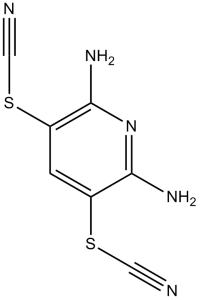
PR-619 (PR619; PR 619) is a novel, cell-permeable, non-selective and reversible inhibitor of the deubiquitinylating enzymes (DUBs) with potential antineoplastic activity. It inhibits DUB with an EC50 of 1-20 μM in a cell-free assay. PR-619 has a broad-range activity against DUBs and potently suppresses the activity of almost all cysteine protease DUBs, but shows high selectivity toward DUBs over other proteases, such as calpain 1, or cathepsins. PR-619 induces (tumor) cell death with EC50 values in the low micromolar range.
Physicochemical Properties
| Molecular Formula | C7H5N5S2 | |
| Molecular Weight | 223.28 | |
| Exact Mass | 222.998 | |
| Elemental Analysis | C, 37.66; H, 2.26; N, 31.37; S, 28.72 | |
| CAS # | 2645-32-1 | |
| Related CAS # |
|
|
| PubChem CID | 2817763 | |
| Appearance | Dark mustard yellow fluffy powder | |
| Density | 1.6±0.1 g/cm3 | |
| Boiling Point | 406.0±45.0 °C at 760 mmHg | |
| Melting Point | 210℃ | |
| Flash Point | 199.3±28.7 °C | |
| Vapour Pressure | 0.0±0.9 mmHg at 25°C | |
| Index of Refraction | 1.764 | |
| LogP | 2.05 | |
| Hydrogen Bond Donor Count | 2 | |
| Hydrogen Bond Acceptor Count | 7 | |
| Rotatable Bond Count | 2 | |
| Heavy Atom Count | 14 | |
| Complexity | 261 | |
| Defined Atom Stereocenter Count | 0 | |
| SMILES | S(C#N)C1C(N([H])[H])=NC(=C(C=1[H])SC#N)N([H])[H] |
|
| InChi Key | ZXOBLNBVNROVLC-UHFFFAOYSA-N | |
| InChi Code | InChI=1S/C7H5N5S2/c8-2-13-4-1-5(14-3-9)7(11)12-6(4)10/h1H,(H4,10,11,12) | |
| Chemical Name | (2,6-diamino-5-thiocyanatopyridin-3-yl) thiocyanate | |
| Synonyms |
|
|
| HS Tariff Code | 2934.99.9001 | |
| Storage |
Powder-20°C 3 years 4°C 2 years In solvent -80°C 6 months -20°C 1 month |
|
| Shipping Condition | Room temperature (This product is stable at ambient temperature for a few days during ordinary shipping and time spent in Customs) |
Biological Activity
| Targets |
USP4(EC50= 3.93 μM);USP8(EC50= 4.9 μM);USP7(EC50= 6.86 μM);USP2(EC50= 7.2 μM);USP5(EC50= 8.61 μM) PR-619 is a pan-inhibitor of deubiquitinating enzymes (DUBs), with IC50 values for key subtypes: USP1 (0.3 μM), USP2 (0.5 μM), USP5 (0.7 μM), USP7 (1.2 μM), USP14 (0.9 μM), and UCH-L1 (1.5 μM) [1] PR-619 shows no significant inhibition of proteasomal catalytic subunits (IC50 > 50 μM) [1] |
| ln Vitro |
PR-619 is a cell-permeable pyridinamine class broad-spectrum DUB inhibitor whose known targets include ATXN3, BAP1, JOSD2, OTUD5, UCH-L1, UCH-L3, UCH-L5/UCH37, USP1, 2, 4, 5, 7, 8, 9X, 10, 14, 15, 16, 19, 20, 22, 24, 28, 47, 48, VCIP135, YOD1, as well as deISGylase PLpro, deNEDDylase DEN1, and deSUMOlyase SENP6. PR-619 are shown to increase overall protein polyubiquitination in HEK293T cells in a dose- and time-dependent manner (20 to 150 μM, 0.5 to 20 h). PR619 treatment results in upregulation of both K 48 - and K63-linked polyUb chains. PR-619 induces HCT116 cell death with EC50 values of 6.3 μM. PR-619 induces the accumulation of polyubiquitinated proteins in cells without directly affecting proteasome activity. In recombinant DUB enzyme assays, PR-619 dose-dependently inhibited the deubiquitinating activity of multiple USP family members (USP1, USP2, USP5, USP7, USP14) and UCH-L1, with IC50 values ranging from 0.3 to 1.5 μM. It had no effect on proteasomal β5 subunit activity at concentrations up to 50 μM [1] - In a panel of human cancer cell lines (HCT116, HeLa, A549, MDA-MB-231, U2OS), PR-619 exhibited antiproliferative activity with IC50 values ranging from 2 to 8 μM. After 72 hours of treatment, the 5 μM concentration reduced cell viability by 55-70% across different cell lines [3] - In HCT116 colon cancer cells, PR-619 (4 μM) induced accumulation of polyubiquitinated proteins (3.2-fold increase vs. control) and ER stress, as evidenced by upregulation of CHOP (2.9-fold) and BIP (2.5-fold) protein levels after 24 hours [1] - In HeLa cells, PR-619 (6 μM) induced G2/M cell cycle arrest (G2/M phase cells increased from 11% to 36% after 18 hours) and apoptosis (Annexin V-positive cells increased from 4% to 33% after 48 hours), with caspase-3/7 activity elevated by 2.8-fold [3] - In human embryonic kidney (HEK293T) cells transfected with ubiquitin-GFP reporter, PR-619 (3 μM) increased GFP-positive puncta (4.1-fold vs. control) after 12 hours, confirming inhibition of DUB-mediated deubiquitination [2] |
| ln Vivo |
Cisplatin's antitumor effect is enhanced by PR-619 (10 mg/kg/day) in a Cisplatin-Na ve and Cisplatin-resistant UC Xenograft of nude mice[2]. PR-619 Enhanced the Antitumor Effect of Cisplatin on a Cisplatin-Naïve and Cisplatin-Resistant UC Xenograft of Nude Mice [2] Researchers evaluated the antitumor effects of treatment with cisplatin, PR-619, or combined treatment with cisplatin and PR-619 in vivo by using a xenograft mouse model. T24 and BFTC-905UC cells were mixed with Matrigel and injected subcutaneously into flanks of nude mice. As we described in the Methods section, mice were divided into four groups based on different treatment: DMSO (control, n = 5), cisplatin (n = 5), PR-619 (10 mg/kg/day, n = 5), or cisplatin combined with PR-619 (n = 5) for three weeks. Combined treatment with cisplatin and PR-619 showed the most significant antitumor effect on xenograft tumors of both T24 and BFTC-905 compared to single agent (cisplatin or PR-619) treatment (Figure 6A,B). In addition to drug combination treatment for improving the efficacy of chemotherapy, a novel agent for circumventing cisplatin resistance provided other solutions for this clinically unsolved issue. We further examined the antitumor effect of PR-619 on cisplatin-resistant UCs (T24/R) in vitro and in vivo. PR-619 induced cytotoxicity and apoptosis in a dose-dependent manner after 24 h treatment. The in vivo data exhibited using the xenograft mice model showed that PR-619 (10 mg/kg/day) inhibited tumor growth during a 28-day period of treatment. In nude mice bearing HCT116 colon cancer xenografts, intraperitoneal administration of PR-619 (15 mg/kg, twice weekly for 3 weeks) significantly inhibited tumor growth. Tumor volume was reduced by 65% compared to vehicle-treated mice, with no significant loss of body weight [3] - In the same xenograft model, PR-619 (15 mg/kg) treatment led to accumulation of polyubiquitinated proteins (2.7-fold vs. vehicle) and activation of caspase-3 (cleaved caspase-3 levels increased by 2.3-fold) in tumor tissues, confirming on-target DUB inhibition and apoptotic induction [3] |
| Enzyme Assay |
Recombinant enzymes in 20 mM Tris-HCl, pH 8.0, 2 mM CaCl2 and 2 mM β-mercaptoethanol (DUB assay buffer) are preincubated with single doses or dose ranges of PR-619 or P22077 for 30 minutes in a 96 well plate before the addition of Ub-PLA2 and NBD C6-HPC. The liberation of a fluorescent product within the linear range of the assay is monitored at room temperature using a fluorescence plate reader. Vehicle (2%(v/v) DMSO) and 10 mM N-ethylmaleimide are included as controls. Where ≥60% inhibition is observed, EC50 values are determined using a sigmoidal dose response equation. Determination of degradation rate for plasma membrane of KCa3.1 [3] The degradation rate for endocytosed membrane KCa3.1 was determined as described. Briefly, KCa3.1 in polarized MDCK, Caco-2 or FRT cells was specifically biotinylated using BirA and labeled with non-conjugated streptavidin after which the cells were incubated for various periods of time at 37°C, as indicated. In some experiments, the lysosomal protease inhibitors leupeptin (100 μM) and pepstatin (1 μg/ml; Leu/Pep) , the proteasome inhibitor lactacystin (10 μM, Lacta) or a general deubiquitylase (DUB) inhibitor PR-619 (50 μM) were added to both apical and BL membranes prior to the 37°C incubation step. The cells were then lysed and equivalent amounts of total protein were separated by SDS-PAGE, followed by IB for streptavidin. Bands were quantified by densitometry using ImageJ software. The obtained band intensities for the various time points were normalized relative to the intensity at time 0 (T = 0) and are reported. The blots were also probed for α-tubulin and β-actin as a protein-loading control. Recombinant DUB activity assay: Purified recombinant USP1, USP2, USP5, USP7, USP14, or UCH-L1 was incubated with ubiquitin-AMC (fluorogenic substrate) and PR-619 (0.01-20 μM) in assay buffer at 37°C for 60 minutes. Fluorescence intensity (excitation 360 nm, emission 460 nm) was measured to assess deubiquitinating activity. IC50 values were calculated from dose-response inhibition curves [1] - Proteasome selectivity assay: Purified 20S proteasome was incubated with Suc-LLVY-AMC (proteasome β5 subunit substrate) and PR-619 (0.1-50 μM) at 37°C for 60 minutes. Fluorescence intensity was measured to evaluate proteasome activity, and IC50 was determined if inhibition was observed [1] - DUB specificity assay: A panel of 20 recombinant DUBs was incubated with their respective fluorogenic substrates and PR-619 (1 μM) under optimal conditions. Deubiquitinating activity was quantified to assess pan-inhibitory profile [1] |
| Cell Assay |
Combination Effect of PR-619 and Cisplatin [2] The combined effects of PR-619 and cisplatin were determined using the CalcuSyn software. The combination effect was evaluated with the treatment of PR-619 and cisplatin at the ratio of 1:2. The median-effect and combination index (CI) were analyzed as previously described. CI values of less than one, equal to one, and greater than one were defined as synergistic, additive, and antagonistic, respectively. Apoptosis Assay [2] An apoptosis assay was performed using a Muse® Annexin V and Dead Cell Assay Kit in accordance with the manufacturer’s protocol. The stained apoptotic cells were then examined and quantified by a Muse® Cell Analyzer and equipped with the Muse Analysis software (version 1.6.0.0). Cell Cycle Analysis by Flow Cytometry [2] Cells were seeded until 40% confluency was reached. Cells were then treated with DMSO (control) or PR-169 for 24 h. The cells were subjected to the Muse® Cell Cycle Assay Kit for cell cycle analysis using the Muse® Cell Analyzer and equipped with the Muse Analysis software. 72 h hours later, 0.2 mg/mL resazurin prepared in phosphate-buffered saline is added to each well and the cells are incubated for an additional 3-6 h. The fluorescence of the resazurin reduction product is measured using Ex=535 nm and Em=590 nm filters on a fluorimeter. The EC50 values are calculated in Prism. Antiproliferation assay: Cancer cell lines (HCT116, HeLa, A549, MDA-MB-231, U2OS) were seeded in 96-well plates at 3×10³ cells/well and cultured for 24 hours. PR-619 was added at concentrations of 0.5-50 μM, and cells were incubated for 72 hours. Cell viability was assessed by MTT assay, and IC50 values were derived [3] - Polyubiquitination and ER stress assay: HCT116 cells were seeded in 6-well plates at 2×10⁵ cells/well and treated with PR-619 (4 μM) for 24 hours. Cells were lysed, and polyubiquitinated proteins, CHOP, and BIP levels were analyzed by Western blot using specific antibodies [1] - Cell cycle and apoptosis assay: HeLa cells were treated with PR-619 (6 μM) for 18 hours (cell cycle) or 48 hours (apoptosis). For cell cycle analysis, cells were fixed, stained with propidium iodide, and analyzed by flow cytometry. For apoptosis, Annexin V-FITC/PI staining was performed, and caspase-3/7 activity was measured by luminescent assay [3] - Deubiquitination reporter assay: HEK293T cells were transfected with ubiquitin-GFP plasmid and cultured for 24 hours. Cells were treated with PR-619 (3 μM) for 12 hours, then fixed and stained with DAPI. GFP-positive puncta (ubiquitin aggregates) were counted by fluorescence microscopy [2] |
| Animal Protocol |
Nude mice (HCT116 xenograft model): 6-8 weeks old nude mice were subcutaneously inoculated with HCT116 colon cancer cells (5×10⁶ cells/mouse). When tumors reached a volume of ~120 mm³, mice were randomly divided into vehicle and PR-619 groups. PR-619 was dissolved in DMSO and diluted with saline (final DMSO concentration ≤5%) and administered intraperitoneally at 15 mg/kg twice weekly for 3 weeks. Vehicle-treated mice received DMSO/saline mixture. Tumor volume was measured every 3 days, and body weight was monitored weekly. Tumors were excised for Western blot analysis of polyubiquitinated proteins and cleaved caspase-3 [3] |
| Toxicity/Toxicokinetics |
In the in vivo xenograft study, PR-619 (15 mg/kg, ip, twice weekly for 3 weeks) did not cause significant body weight loss (≤5% change vs. baseline) or overt toxicity in nude mice [3] - In vitro, PR-619 showed reduced toxicity to normal human fibroblasts (IC50 > 30 μM), indicating a therapeutic window between cancer cells and normal cells [3] - No significant changes in liver function (ALT, AST) or renal function (creatinine, BUN) were observed in PR-619-treated mice compared to vehicle controls [3] |
| References |
[1]. Chem Biol.2011 Nov 23;18(11):1401-12. [2]. Cells. 2019 Oct 17;8(10):1268. [3]. PLoS One. 2014 Mar 14;9(3):e92013. . |
| Additional Infomation |
PR-619 has been used for: 1) As a component of lysis buffer and as a deubiquitinase inhibitor for processing proteins derived from SILAC labeled Jurkat cells. 2) As a deubiquitinase inhibitor for studying its effect on adeno-associated virus (AAV) transduction. 3) Radioimmunoprecipitation assay buffer (RIPA) for ubiquitination detection. Converting lead compounds into drug candidates is a crucial step in drug development, requiring early assessment of potency, selectivity, and off-target effects. We have utilized activity-based chemical proteomics to determine the potency and selectivity of deubiquitylating enzyme (DUB) inhibitors in cell culture models. Importantly, we characterized the small molecule PR-619 as a broad-range DUB inhibitor, and P22077 as a USP7 inhibitor with potential for further development as a chemotherapeutic agent in cancer therapy. A striking accumulation of polyubiquitylated proteins was observed after both selective and general inhibition of cellular DUB activity without direct impairment of proteasomal proteolysis. The repertoire of ubiquitylated substrates was analyzed by tandem mass spectrometry, identifying distinct subsets for general or specific inhibition of DUBs. This enabled identification of previously unknown functional links between USP7 and enzymes involved in DNA repair.[1] After chemotherapy for the treatment of metastatic bladder urothelial carcinoma (UC), most patients inevitably encounter drug resistance and resultant treatment failure. Deubiquitinating enzymes (DUBs) remove ubiquitin from target proteins and play a critical role in maintaining protein homeostasis. This study investigated the antitumor effect of PR-619, a DUBs inhibitor, in combination with cisplatin, for bladder UC treatment. Our results showed that PR-619 effectively induced dose- and time-dependent cytotoxicity, apoptosis, and ER-stress related apoptosis in human UC (T24 and BFTC-905) cells. Additionally, co-treatment of PR-619 with cisplatin potentiated cisplatin-induced cytotoxicity in UC cells and was accompanied by the concurrent suppression of Bcl-2. We also proved that Bcl-2 overexpression is related to the chemo-resistant status in patients with metastatic UC by immunohistochemistry (IHC) staining. In a xenograft mice model, we confirmed that PR-619 enhanced the antitumor effect of cisplatin on cisplatin-naïve and cisplatin-resistant UCs. Our results demonstrated that PR-619 effectively enhanced the cisplatin-induced antitumor effect via concurrent suppression of the Bcl-2 level. These findings provide promising insight for developing a therapeutic strategy for UC treatment.[2] The intermediate conductance, Ca2+-activated K+ channel (KCa3.1) targets to the basolateral (BL) membrane in polarized epithelia where it plays a key role in transepithelial ion transport. However, there are no studies defining the anterograde and retrograde trafficking of KCa3.1 in polarized epithelia. Herein, we utilize Biotin Ligase Acceptor Peptide (BLAP)-tagged KCa3.1 to address these trafficking steps in polarized epithelia, using MDCK, Caco-2 and FRT cells. We demonstrate that KCa3.1 is exclusively targeted to the BL membrane in these cells when grown on filter supports. Following endocytosis, KCa3.1 degradation is prevented by inhibition of lysosomal/proteosomal pathways. Further, the ubiquitylation of KCa3.1 is increased following endocytosis from the BL membrane and PR-619, a deubiquitylase inhibitor, prevents degradation, indicating KCa3.1 is targeted for degradation by ubiquitylation. We demonstrate that KCa3.1 is targeted to the BL membrane in polarized LLC-PK1 cells which lack the μ1B subunit of the AP-1 complex, indicating BL targeting of KCa3.1 is independent of μ1B. As Rabs 1, 2, 6 and 8 play roles in ER/Golgi exit and trafficking of proteins to the BL membrane, we evaluated the role of these Rabs in the trafficking of KCa3.1. In the presence of dominant negative Rab1 or Rab8, KCa3.1 cell surface expression was significantly reduced, whereas Rabs 2 and 6 had no effect. We also co-immunoprecipitated KCa3.1 with both Rab1 and Rab8. These results suggest these Rabs are necessary for the anterograde trafficking of KCa3.1. Finally, we determined whether KCa3.1 traffics directly to the BL membrane or through recycling endosomes in MDCK cells. For these studies, we used either recycling endosome ablation or dominant negative RME-1 constructs and determined that KCa3.1 is trafficked directly to the BL membrane rather than via recycling endosomes. These results are the first to describe the anterograde and retrograde trafficking of KCa3.1 in polarized epithelia cells.[3] PR-619 is a cell-permeable, reversible pan-inhibitor of deubiquitinating enzymes (DUBs), with preferential activity against USP family members and UCH-L1 [1] - Its mechanism of action involves inhibiting DUB-mediated deubiquitination, leading to accumulation of polyubiquitinated proteins, ER stress, cell cycle arrest, and ultimately cancer cell apoptosis [1][3] - PR-619 is widely used as a tool compound for studying the role of DUBs in protein homeostasis, cell cycle regulation, and cancer biology [1][2] - It exhibits in vivo antitumor activity against colon cancer xenografts, supporting DUB inhibition as a potential therapeutic strategy for cancer treatment [3] |
Solubility Data
| Solubility (In Vitro) | DMSO : 3~21 mg/mL ( 13.43~94.05 mM) |
| Solubility (In Vivo) |
Solubility in Formulation 1: 2.5 mg/mL (11.20 mM) in 10% DMSO + 40% PEG300 +5% Tween-80 + 45% Saline (add these co-solvents sequentially from left to right, and one by one), suspension solution; with sonication. For example, if 1 mL of working solution is to be prepared, you can add 100 μL of 25.0 mg/mL clear DMSO stock solution to 400 μL PEG300 and mix evenly; then add 50 μL Tween-80 + to the above solution and mix evenly; then add 450 μL normal saline to adjust the volume to 1 mL. Preparation of saline: Dissolve 0.9 g of sodium chloride in 100 mL ddH₂ O to obtain a clear solution. (Please use freshly prepared in vivo formulations for optimal results.) |
| Preparing Stock Solutions | 1 mg | 5 mg | 10 mg | |
| 1 mM | 4.4787 mL | 22.3934 mL | 44.7868 mL | |
| 5 mM | 0.8957 mL | 4.4787 mL | 8.9574 mL | |
| 10 mM | 0.4479 mL | 2.2393 mL | 4.4787 mL |