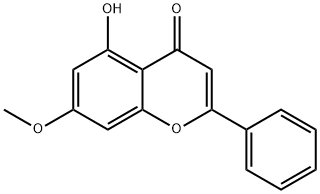
Physicochemical Properties
| Molecular Formula | C16H12O4 |
| Molecular Weight | 268.26408 |
| Exact Mass | 268.073 |
| Elemental Analysis | C, 71.64; H, 4.51; O, 23.86 |
| CAS # | 520-28-5 |
| Related CAS # | 520-28-5 |
| PubChem CID | 5281954 |
| Appearance | Light yellow to yellow solid powder |
| Density | 1.3±0.1 g/cm3 |
| Boiling Point | 487.4±45.0 °C at 760 mmHg |
| Melting Point | 166-168ºC |
| Flash Point | 186.8±22.2 °C |
| Vapour Pressure | 0.0±1.3 mmHg at 25°C |
| Index of Refraction | 1.641 |
| Source | Pongamia pinnata var. pinnata, Apis |
| LogP | 3.13 |
| Hydrogen Bond Donor Count | 1 |
| Hydrogen Bond Acceptor Count | 4 |
| Rotatable Bond Count | 2 |
| Heavy Atom Count | 20 |
| Complexity | 397 |
| Defined Atom Stereocenter Count | 0 |
| SMILES | OC1=C2C(OC(C3=CC=CC=C3)=CC2=O)=CC(OC)=C1 |
| InChi Key | IRZVHDLBAYNPCT-UHFFFAOYSA-N |
| InChi Code | InChI=1S/C16H12O4/c1-19-11-7-12(17)16-13(18)9-14(20-15(16)8-11)10-5-3-2-4-6-10/h2-9,17H,1H3 |
| Chemical Name | 5-hydroxy-7-methoxy-2-phenylchromen-4-one |
| Synonyms | 5-Hydroxy-7-methoxyflavone; 5Hydroxy-7-methoxyflavone; 5 Hydroxy-7-methoxyflavone; NSC 80687; Tectochrysin; 520-28-5; 5-Hydroxy-7-methoxyflavone; 5-Hydroxy-7-methoxy-2-phenyl-4H-chromen-4-one; Techtochrysin; 7-Methoxy-5-hydroxyflavone; 7-O-METHYLCHRYSIN; 4H-1-Benzopyran-4-one, 5-hydroxy-7-methoxy-2-phenyl-; Tectochrysin; NSC-80687; NSC80687 |
| HS Tariff Code | 2934.99.9001 |
| Storage |
Powder-20°C 3 years 4°C 2 years In solvent -80°C 6 months -20°C 1 month Note: This product requires protection from light (avoid light exposure) during transportation and storage. |
| Shipping Condition | Room temperature (This product is stable at ambient temperature for a few days during ordinary shipping and time spent in Customs) |
Biological Activity
| Targets |
p50; p65 1. Nuclear Factor κB (NF-κB) [1] 2. Death Receptors (DR4, DR5) [1] |
| ln Vitro |
Tectochrysin (Techtochrysin) prevents NF-κB from functioning. Direct binding of Tectochrysin (Techtochrysin) to the p50 unit. By preventing the phosphorylation of IκB, tectochrysin (techtochrysin) inhibits the translocation of p50 and p65 into the nucleus in a concentration-dependent manner. Cell viability is examined using the MTT assay to determine the inhibitory effect of Tectochrysin on the growth of colon cancer cells (SW480, HCT116). Tectochrysin (Techtochrysin) is applied to the cells in a range of concentrations (1, 5, or 10 μg/mL) for 24 hours. In a concentration-dependent manner, tectochrysin (Techtochrysin) prevents colon cancer cells from proliferating. Tectochrysin (Techtochrysin) has an IC50 value of 6.3 μg/mL for SW480 cells and an IC50 value of 8.4 μg/mL for HCT116 cells. When NSC 80687 (10 g/mL) is treated on SW480 cells and HCT116 cells, morphological analysis demonstrates that the cells' size is decreased. Tectochrysin (Techtochrysin), however, is not cytotoxic in the normal CCD-18co cells at the tested concentration as determined by the MTT assay. Using DAPI staining, changes in the chromatin morphology of cells are assessed in order to determine whether the induction of apoptotic cell death is necessary for the inhibition of cell growth by NSC 80687. TUNEL staining assays are carried out, and the labeled cells are subsequently examined by fluorescence microscopy, in order to further characterize the apoptotic cell death caused by Tectochrysin (Techtochrysin). In SW480 cells, 0 and 10 g/mL NSC 80687, respectively, increase the number of apoptotic cells (DAPI-positive TUNEL stained cells) to 1 and 58%, while 0 and 10 μg/mL Tectochrysin, in HCT116, increase the number to 1 and 54%. 1. In colon cancer cell lines (HCT-116, HT-29), Tectochrysin (10–50 μM) inhibited cell proliferation in a concentration-dependent manner, with IC50 values of 25.3 μM (HCT-116) and 32.8 μM (HT-29). [1] 2. Tectochrysin (20 μM) suppressed NF-κB transcriptional activity by blocking its nuclear translocation, reducing NF-κB DNA-binding capacity and IκBα phosphorylation. [1] 3. Tectochrysin (20–40 μM) upregulated DR4/DR5 expression, activated caspase-8 and caspase-3/7, and induced apoptosis (Annexin V-positive cells increased from 12% to 45% at 40 μM). [1] 4. Tectochrysin (30 μM) downregulated Bcl-2/Bcl-xL (anti-apoptotic proteins) and upregulated Bax/cleaved PARP (pro-apoptotic proteins) (Western blot analysis). [1] |
| ln Vivo |
The tumor growth in colon cancer xenograft-bearing nude mice after Tectochrysin (NSC 80687) treatments is examined to clarify the antitumor effects of this drug in vivo. Mice with tumors ranging in size from 200 to 300 mm3 are given Tectochrysin (NSC 80687) intraperitoneally twice a week for three weeks in HCT116 xenograft studies. Twice weekly, the mice are weighed. During the experiment, there aren't any noticeably different body weight changes between the control and Tectochrysin (NSC 80687)-treated mice (n = 10). However, the final tumor weights are recorded on day 21. The tumor weights and volumes in mice given Tectochrysin (NSC 80687) at doses of 5 mg/kg are, respectively, 57.9% and 46.4% of those in the vehicle group[1]. 1. In nude mice with HCT-116 xenografts, intraperitoneal injection of Tectochrysin (20 mg/kg/day for 14 days) reduced tumor volume by 40% (p < 0.05 vs vehicle control). [1] 2. Tectochrysin (20 mg/kg) decreased tumor NF-κB activity and increased DR4/DR5 expression in xenografts. [1] 3. Tectochrysin (20 mg/kg) did not cause significant weight loss, abnormal hematological/biochemical parameters, or organ damage in mice. [1] |
| Enzyme Assay |
1. NF-κB DNA-binding assay: Nuclear extracts from Tectochrysin-treated HCT-116 cells were incubated with biotin-labeled NF-κB oligonucleotide. Bound complexes were captured on streptavidin plates and detected via chemiluminescence; Tectochrysin (10–30 μM) dose-dependently reduced NF-κB binding. [1] 2. Caspase-3/7 activity assay: Lysates from Tectochrysin-treated HT-29 cells were incubated with DEVD-AFC (fluorogenic substrate). Fluorescence intensity showed Tectochrysin (20 μM) increased caspase-3/7 activity by 2.8-fold. [1] |
| Cell Assay |
In a 96-well flat-bottomed plate, each SW480, HCT116, HT-29, A549, and MCF-7 cell line (1×10⁴ cells) is incubated in 200 L of RPMI 1640, DMEM medium with NSC 80687 (concentrations ranging from 1, 5, and 10 μg/mL). MTT diluted in RPMI 1640 and DMEM medium are added to each well after 72 hours of incubation at 37°C, followed by 90 minutes of incubation. After that, the supernatant is discarded, and DMSO (200 μL/well) is used to elute the crystal products. A spectrophotometer is used for colorimetric evaluation at 540 nm. Using DAPI staining, the apoptosis assay is first carried out. NSC 80687 (5 μg/mL) concentrations are used to cultivate SW480 and HCT116 human colon cancer cells, and the induction of apoptotic cell death is assessed after 24 hours. Tunel analysis is completed[1]. 1. Cell proliferation assay: HCT-116 cells were seeded in 96-well plates, treated with Tectochrysin (0–50 μM) for 72 hours, and viability was measured via MTT assay to calculate IC50. [1] 2. Apoptosis assay: HT-29 cells treated with Tectochrysin (20–40 μM) for 24 hours were stained with Annexin V-FITC/PI and analyzed by flow cytometry; Sub-G1 phase accumulation was detected via DNA content analysis. [1] 3. Western blot assay: Protein extracts from Tectochrysin-treated cells were separated by SDS-PAGE, transferred to membranes, and probed with antibodies against NF-κB p65, IκBα, DR4, DR5, Bcl-2, Bax, and cleaved PARP (β-actin as loading control). [1] |
| Animal Protocol |
Mice: Male BALB/c athymic nude mice aged five weeks are used (n = 10 per group). Mice's lower right flanks are injected subcutaneously with HCT116 cancer cells (1×10⁷ cells/0.1 mL PBS/animal). The tumor-bearing nude mice are intraperitoneally injected with Tectochrysin (NSC 80687) (5 mg/kg dissolved in 0.1% DMSO) twice weekly for three weeks after the tumors have grown to an average volume of 200-300 mm3 after 14 days. Vernier calipers are used to measure and calculate the tumor volumes[1]. 1. Xenograft model: Female nude mice (6–8 weeks old) were subcutaneously injected with HCT-116 cells (5×10⁶ cells/mouse). When tumors reached ~100 mm³, mice received Tectochrysin (20 mg/kg, dissolved in DMSO/saline 1:9 v/v) via daily intraperitoneal injection for 14 days; tumor volume (length×width²×0.5) was measured every 3 days. [1] 2. Toxicity assessment: Blood samples were collected to test hematological (WBC, RBC, platelets) and biochemical (ALT, AST, creatinine) parameters; liver, kidney, and spleen were harvested for histopathological analysis. [1] |
| Toxicity/Toxicokinetics |
1. In vitro, Tectochrysin (up to 50 μM) showed minimal cytotoxicity in normal human colon epithelial cells (CCD-18Co) with viability >85%. [1] 2. In vivo, Tectochrysin (20 mg/kg) did not alter mouse body weight, organ weight, or histological features of liver, kidney, or heart. [1] |
| References |
[1]. Anticancer effect of Tectochrysin in colon cancer cell via suppression of NF-kappaB activity and enhancement of death receptor expression. Mol Cancer. 2015 Jun 30;14:124. |
| Additional Infomation |
Tectochrysin is a monohydroxyflavone that is flavone substituted by a hydroxy group at position 4 and a methoxy group at position 7 respectively. It has a role as a plant metabolite, an antidiarrhoeal drug and an antineoplastic agent. It is a monohydroxyflavone and a monomethoxyflavone. It is functionally related to a flavone. Tectochrysin has been reported in Pongamia pinnata var. pinnata, Apis, and other organisms with data available. 1. Tectochrysin is a flavonoid isolated from Selaginella doederleinii with anticancer potential. [1] 2. Tectochrysin exerts anticancer effects via dual mechanisms: suppressing NF-κB-driven survival signaling and enhancing death receptor-mediated apoptosis. [1] 3. Preclinical data suggest Tectochrysin is a promising candidate for colorectal cancer therapy. [1] |
Solubility Data
| Solubility (In Vitro) | DMSO: 7~10 mg/mL (26.1~37.3 mM) |
| Solubility (In Vivo) |
Solubility in Formulation 1: ≥ 1.67 mg/mL (6.23 mM) (saturation unknown) in 10% DMSO + 90% Corn Oil (add these co-solvents sequentially from left to right, and one by one), clear solution. For example, if 1 mL of working solution is to be prepared, you can add 100 μL of 16.7 mg/mL clear DMSO stock solution to 900 μL of corn oil and mix evenly. (Please use freshly prepared in vivo formulations for optimal results.) |
| Preparing Stock Solutions | 1 mg | 5 mg | 10 mg | |
| 1 mM | 3.7277 mL | 18.6386 mL | 37.2773 mL | |
| 5 mM | 0.7455 mL | 3.7277 mL | 7.4555 mL | |
| 10 mM | 0.3728 mL | 1.8639 mL | 3.7277 mL |