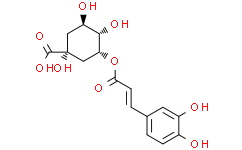
Neochlorogenic acid is a natural polyphenolic substance that has anti-inflammatory properties. It can be separated from plants and dried fruits. Neochlorogenic acid has the ability to block TNF-α and IL-1β production as well as COX-2 and iNOS expression.
Physicochemical Properties
| Molecular Formula | C₁₆H₁₈O₉ |
| Molecular Weight | 354.31 |
| Exact Mass | 354.095 |
| CAS # | 906-33-2 |
| Related CAS # | Chlorogenic acid;327-97-9 |
| PubChem CID | 5280633 |
| Appearance | White to off-white solid |
| Density | 1.7±0.1 g/cm3 |
| Boiling Point | 665.0±55.0 °C at 760 mmHg |
| Flash Point | 245.5±25.0 °C |
| Vapour Pressure | 0.0±2.1 mmHg at 25°C |
| Index of Refraction | 1.690 |
| LogP | -0.36 |
| Hydrogen Bond Donor Count | 6 |
| Hydrogen Bond Acceptor Count | 9 |
| Rotatable Bond Count | 5 |
| Heavy Atom Count | 25 |
| Complexity | 534 |
| Defined Atom Stereocenter Count | 4 |
| SMILES | O([C@H]1[C@@H](O)[C@H](O)C[C@](O)(C(=O)O)C1)C(=O)/C=C/C1C=CC(O)=C(O)C=1 |
| InChi Key | CWVRJTMFETXNAD-NXLLHMKUSA-N |
| InChi Code | InChI=1S/C16H18O9/c17-9-3-1-8(5-10(9)18)2-4-13(20)25-12-7-16(24,15(22)23)6-11(19)14(12)21/h1-5,11-12,14,17-19,21,24H,6-7H2,(H,22,23)/b4-2+/t11-,12-,14+,16-/m1/s1 |
| Chemical Name | (1R,3R,4S,5R)-3-[(E)-3-(3,4-dihydroxyphenyl)prop-2-enoyl]oxy-1,4,5-trihydroxycyclohexane-1-carboxylic acid |
| Synonyms | Neochlorogenate; 5-O-Caffeoylquinic acid; trans-5-O-Caffeoylquinic acid; Neochlorogenic acid |
| HS Tariff Code | 2934.99.9001 |
| Storage |
Powder-20°C 3 years 4°C 2 years In solvent -80°C 6 months -20°C 1 month |
| Shipping Condition | Room temperature (This product is stable at ambient temperature for a few days during ordinary shipping and time spent in Customs) |
Biological Activity
| Targets | p65; IL-1; IL-1β; COX-2 |
| ln Vitro | Neochlorogenic acid (NCA) inhibits the expression of the proteins iNOS and COX-2 as well as the production of pro-inflammatory cytokines like TNF-α and IL-1β in BV2 microglia cells, thereby reducing the NO production caused by lipopolysaccharide (LPS). Neochlorogenic acid also inhibits phosphorylated p38 MAPK and NF-κB p65 in activated microglia. In LPS-induced BV2 cells, iNOS and COX-2 levels rise; however, after being treated with 50 and 100 μM Neochlorogenic acid, this rise is markedly inhibited[1]. |
| Cell Assay | Mouse BV2 microglial cells are maintained in DMEM supplemented with 5% FBS and 1% antibiotic-antimycotic in a humidified incubator with 5% CO2 at 37°C. Neochlorogenic acid and Dexamethasone are dissolved in DMSO to a final concentration of 10 mM for the stock solution. Neochlorogenic acid and/or LPS treatments are performed in a serum-free environment. Neochlorogenic acid's effects on lipopolysaccharide (LPS)-stimulated BV2 microglial cells' ability to survive are evaluated. Neochlorogenic acid (10, 50, and 100 μM) and LPS (4 μg/ml) are applied to the cells either alone or in combination for 24 hours. The positive control is dexamethasone (10 μM). The MTT assay is used to confirm cell viability. The samples were incubated for 3 hours at 37°C after the medium was taken out of the wells and MTT was added. DMSO was used to dissolve the formazan crystals, and a microplate reader was used to measure the absorbance values at 540 nm[1]. |
| References |
[1].Neochlorogenic Acid Inhibits Lipopolysaccharide-Induced Activation and Pro-inflammatory Responses in BV2 Microglial Cells. Neurochem Res. 2015 Sep;40(9):1792-8. |
| Additional Infomation |
Trans-5-O-caffeoyl-D-quinic acid is a cinnamate ester obtained by formal condensation of the carboxy group of trans-caffeic acid with the 5-hydroxy group of quinic acid. It has a role as a plant metabolite. It is a cyclitol carboxylic acid and a cinnamate ester. It is functionally related to a (-)-quinic acid and a trans-caffeic acid. It is a conjugate acid of a trans-5-O-caffeoyl-D-quinate. Neochlorogenic acid has been reported in Camellia sinensis, Hydrastis canadensis, and other organisms with data available. See also: Lonicera japonica flower (part of); Moringa oleifera leaf (part of); Stevia rebaudiuna Leaf (has part). |
Solubility Data
| Solubility (In Vitro) |
DMSO: 70~100 mg/mL (197.6~282.2 mM) H2O: 2 mg/mL (~5.6 mM) |
| Solubility (In Vivo) |
Solubility in Formulation 1: 2.08 mg/mL (5.87 mM) in 10% DMSO + 40% PEG300 + 5% Tween80 + 45% Saline (add these co-solvents sequentially from left to right, and one by one), suspension solution; with sonication. For example, if 1 mL of working solution is to be prepared, you can add 100 μL of 20.8 mg/mL clear DMSO stock solution to 400 μL PEG300 and mix evenly; then add 50 μL Tween-80 to the above solution and mix evenly; then add 450 μL normal saline to adjust the volume to 1 mL. Preparation of saline: Dissolve 0.9 g of sodium chloride in 100 mL ddH₂ O to obtain a clear solution. Solubility in Formulation 2: ≥ 2.08 mg/mL (5.87 mM) (saturation unknown) in 10% DMSO + 90% (20% SBE-β-CD in Saline) (add these co-solvents sequentially from left to right, and one by one), clear solution. For example, if 1 mL of working solution is to be prepared, you can add 100 μL of 20.8 mg/mL clear DMSO stock solution to 900 μL of 20% SBE-β-CD physiological saline solution and mix evenly. Preparation of 20% SBE-β-CD in Saline (4°C,1 week): Dissolve 2 g SBE-β-CD in 10 mL saline to obtain a clear solution. Solubility in Formulation 3: ≥ 2.08 mg/mL (5.87 mM) (saturation unknown) in 10% DMSO + 90% Corn Oil (add these co-solvents sequentially from left to right, and one by one), clear solution. For example, if 1 mL of working solution is to be prepared, you can add 100 μL of 20.8 mg/mL clear DMSO stock solution to 900 μL of corn oil and mix evenly. Solubility in Formulation 4: 4 mg/mL (11.29 mM) in PBS (add these co-solvents sequentially from left to right, and one by one), clear solution; with ultrasonication (<60°C). (Please use freshly prepared in vivo formulations for optimal results.) |
| Preparing Stock Solutions | 1 mg | 5 mg | 10 mg | |
| 1 mM | 2.8224 mL | 14.1119 mL | 28.2239 mL | |
| 5 mM | 0.5645 mL | 2.8224 mL | 5.6448 mL | |
| 10 mM | 0.2822 mL | 1.4112 mL | 2.8224 mL |