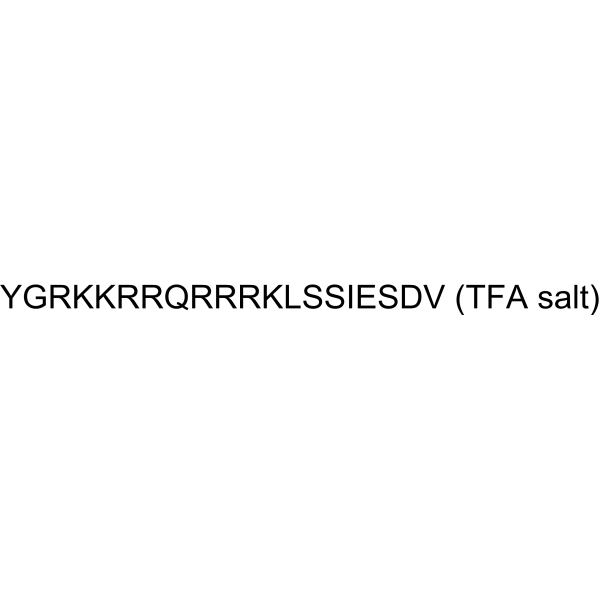
Physicochemical Properties
| Molecular Formula | C107H189F3N42O32 |
| Molecular Weight | 2632.90299105644 |
| Exact Mass | 2518.451 |
| CAS # | 1834571-04-8 |
| Related CAS # | Tat-NR2B9c;500992-11-0 |
| PubChem CID | 44568939 |
| Appearance | White to off-white solid powder |
| LogP | -19.3 |
| Hydrogen Bond Donor Count | 49 |
| Hydrogen Bond Acceptor Count | 40 |
| Rotatable Bond Count | 99 |
| Heavy Atom Count | 177 |
| Complexity | 5380 |
| Defined Atom Stereocenter Count | 20 |
| SMILES | C(F)(F)(F)C(=O)O.[C@H](CCCNC(N)=N)(C(=O)N[C@@H](CCCNC(N)=N)C(=O)N[C@@H](CCCCN)C(=O)N[C@@H](CC(C)C)C(=O)N[C@@H](CO)C(=O)N[C@@H](CO)C(=O)N[C@@H]([C@@H](C)CC)C(=O)N[C@@H](CCC(=O)O)C(=O)N[C@@H](CO)C(=O)N[C@@H](CC(=O)O)C(=O)N[C@H](C(=O)O)C(C)C)NC(=O)[C@H](CCCNC(N)=N)NC(=O)[C@H](CCC(=O)N)NC(=O)[C@H](CCCNC(N)=N)NC(=O)[C@H](CCCNC(N)=N)NC(=O)[C@H](CCCCN)NC(=O)[C@H](CCCCN)NC(=O)[C@H](CCCNC(N)=N)NC(=O)CNC(=O)[C@@H](N)CC1C=CC(O)=CC=1 |
| InChi Key | XWQVQFBTSBCKLI-FKXNDIMNSA-N |
| InChi Code | InChI=1S/C105H188N42O30/c1-7-55(6)80(98(175)140-69(34-36-77(154)155)92(169)143-72(50-148)95(172)142-71(48-78(156)157)94(171)146-79(54(4)5)99(176)177)147-97(174)74(52-150)145-96(173)73(51-149)144-93(170)70(46-53(2)3)141-90(167)62(22-10-13-39-108)133-85(162)63(24-15-41-124-101(113)114)135-87(164)65(26-17-43-126-103(117)118)136-88(165)66(27-18-44-127-104(119)120)138-91(168)68(33-35-75(110)152)139-89(166)67(28-19-45-128-105(121)122)137-86(163)64(25-16-42-125-102(115)116)134-84(161)61(21-9-12-38-107)132-83(160)60(20-8-11-37-106)131-82(159)59(23-14-40-123-100(111)112)130-76(153)49-129-81(158)58(109)47-56-29-31-57(151)32-30-56/h29-32,53-55,58-74,79-80,148-151H,7-28,33-52,106-109H2,1-6H3,(H2,110,152)(H,129,158)(H,130,153)(H,131,159)(H,132,160)(H,133,162)(H,134,161)(H,135,164)(H,136,165)(H,137,163)(H,138,168)(H,139,166)(H,140,175)(H,141,167)(H,142,172)(H,143,169)(H,144,170)(H,145,173)(H,146,171)(H,147,174)(H,154,155)(H,156,157)(H,176,177)(H4,111,112,123)(H4,113,114,124)(H4,115,116,125)(H4,117,118,126)(H4,119,120,127)(H4,121,122,128)/t55-,58-,59-,60-,61-,62-,63-,64-,65-,66-,67-,68-,69-,70-,71-,72-,73-,74-,79-,80-/m0/s1 |
| Chemical Name | (4S)-4-[[(2S,3S)-2-[[(2S)-2-[[(2S)-2-[[(2S)-2-[[(2S)-6-amino-2-[[(2S)-2-[[(2S)-2-[[(2S)-2-[[(2S)-5-amino-2-[[(2S)-2-[[(2S)-2-[[(2S)-6-amino-2-[[(2S)-6-amino-2-[[(2S)-2-[[2-[[(2S)-2-amino-3-(4-hydroxyphenyl)propanoyl]amino]acetyl]amino]-5-carbamimidamidopentanoyl]amino]hexanoyl]amino]hexanoyl]amino]-5-carbamimidamidopentanoyl]amino]-5-carbamimidamidopentanoyl]amino]-5-oxopentanoyl]amino]-5-carbamimidamidopentanoyl]amino]-5-carbamimidamidopentanoyl]amino]-5-carbamimidamidopentanoyl]amino]hexanoyl]amino]-4-methylpentanoyl]amino]-3-hydroxypropanoyl]amino]-3-hydroxypropanoyl]amino]-3-methylpentanoyl]amino]-5-[[(2S)-1-[[(2S)-3-carboxy-1-[[(1S)-1-carboxy-2-methylpropyl]amino]-1-oxopropan-2-yl]amino]-3-hydroxy-1-oxopropan-2-yl]amino]-5-oxopentanoic acid |
| HS Tariff Code | 2934.99.9001 |
| Storage |
Powder-20°C 3 years 4°C 2 years In solvent -80°C 6 months -20°C 1 month Note: Please store this product in a sealed and protected environment, avoid exposure to moisture. |
| Shipping Condition | Room temperature (This product is stable at ambient temperature for a few days during ordinary shipping and time spent in Customs) |
Biological Activity
| ln Vitro | Tat-NR2B9c, a PSD-95 benchmark, exhibits domain affinity in comparison to PSD-95d1 (EC 50, 0.67 μM) with an EC50 of 6.7 nM for PSD-95d2. With an IC50 of 0.5 μM, approximately 8 μM, and 0.75 μM, respectively, Tat-NR2B9c inhibits the binding of NMDAR2A, NMDAR2B, and NMDAR2C to PSD-95. Moreover, Tat-NR2B9c, with an IC50 of around 0.2 μM, inhibits the PSD-95 and nNOS interaction [1]. While NMDA-induced p38 activation in YAC128 striatum is reduced by around 50% when Tat-NR2B9c lowers PSD-95 binding to GluN2B in YAC128 striatum, NMDA-induced JNK activation is unaffected [2]. |
| ln Vivo | Tat-NR2B9c (10 nmol/g, iv) did not affect infarct volume at 3 nmol/g, but it did diminish it with C57BL/6 nozzles [3]. |
| References |
[1]. PDZ protein interactions underlying NMDA receptor-mediated excitotoxicity and neuroprotection by PSD-95 inhibitors. J Neurosci. 2007 Sep 12;27(37):9901-15. [2]. P38 MAPK is involved in enhanced NMDA receptor-dependent excitotoxicity in YAC transgenic mouse model of Huntington disease. Neurobiol Dis. 2012 Mar;45(3):999-1009. |
| Additional Infomation | Na 1 is under investigation in clinical trial NCT00728182 (Evaluating Neuroprotection in Aneurysm Coiling Therapy). |
Solubility Data
| Solubility (In Vitro) | H2O : ≥ 50 mg/mL (~18.99 mM) |
| Solubility (In Vivo) |
Solubility in Formulation 1: 100 mg/mL (37.98 mM) in PBS (add these co-solvents sequentially from left to right, and one by one), clear solution; with sonication. (Please use freshly prepared in vivo formulations for optimal results.) |
| Preparing Stock Solutions | 1 mg | 5 mg | 10 mg | |
| 1 mM | 0.3798 mL | 1.8990 mL | 3.7981 mL | |
| 5 mM | 0.0760 mL | 0.3798 mL | 0.7596 mL | |
| 10 mM | 0.0380 mL | 0.1899 mL | 0.3798 mL |