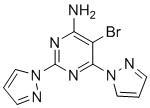
Taminadenant (PBF-509; NIR-178) is a novel, oral and potent adenosine receptor antagonist used as an immunotherapy agent. It functions as a strong and specific antagonist of the human A2A (adenosine 2A) receptor, binding to the receptor with a Ki value of 12 nM. It prevents A2AR from being expressed on T cells, negating the effect of adenosine and A2AR on T cell suppression. Additionally, it triggers an immune response by T cells against tumor cells, which in turn slows the growth of tumor cells that are vulnerable to it. It is also mentioned as a possible pro-dopaminergic medication for the treatment of Parkinson's disease (PD).
Physicochemical Properties
| Molecular Formula | C10H8BRN7 |
| Molecular Weight | 306.127 |
| Exact Mass | 305.002 |
| Elemental Analysis | C, 39.24; H, 2.63; Br, 26.10; N, 32.03 |
| CAS # | 1337962-47-6 |
| Related CAS # | 2253894-78-7 (HCl hydrate); 1337962-47-6; 2253894-81-2 (mesylate); 2253894-80-1 (sulfate); 2253894-79-8 (HCl dihydrate) |
| PubChem CID | 53466958 |
| Appearance | Solid powder |
| Density | 1.9±0.1 g/cm3 |
| Boiling Point | 574.9±60.0 °C at 760 mmHg |
| Flash Point | 301.5±32.9 °C |
| Vapour Pressure | 0.0±1.6 mmHg at 25°C |
| Index of Refraction | 1.851 |
| LogP | -0.47 |
| Hydrogen Bond Donor Count | 1 |
| Hydrogen Bond Acceptor Count | 5 |
| Rotatable Bond Count | 2 |
| Heavy Atom Count | 18 |
| Complexity | 291 |
| Defined Atom Stereocenter Count | 0 |
| SMILES | BrC1=C(N)N=C(N=C1N1C=CC=N1)N1C=CC=N1 |
| InChi Key | ATFXVNUWQOXRRU-UHFFFAOYSA-N |
| InChi Code | InChI=1S/C10H8BrN7/c11-7-8(12)15-10(18-6-2-4-14-18)16-9(7)17-5-1-3-13-17/h1-6H,(H2,12,15,16) |
| Chemical Name | 5-bromo-2,6-di(pyrazol-1-yl)pyrimidin-4-amine |
| Synonyms | PBF 509; NIR178; PBF509; NIR 178; Taminadenant; PBF-509; NIR-178 |
| HS Tariff Code | 2934.99.9001 |
| Storage |
Powder-20°C 3 years 4°C 2 years In solvent -80°C 6 months -20°C 1 month |
| Shipping Condition | Room temperature (This product is stable at ambient temperature for a few days during ordinary shipping and time spent in Customs) |
Biological Activity
| Targets | Adenosine receptor |
| ln Vitro | Taminadenant (PBF509) completely blocks agonist-mediated cAMP accumulation, with an IC50 of 72.8 ± 17.4 nM i HEK cells that express human A2ARSNAP permanently[1]. However, it does not demonstrate any agonist efficacy in these cells. |
| ln Vivo | Taminadenant (PBF509) (0.3, 3, 7.5, 10, or 30 mg/kg; p.o.; single dosage) increases the effects of L-DOPA, exhibits a strong antiparkinsonian activity, and reduces the cataleptic effects of haloperidol[1]. It also lessens the tremulous jaw movement caused by pilocarpine. |
| Animal Protocol |
Sprague-Dawley rats (240-250 g; induced catalepsy by s.c. with 1 mg/kg Haloperidol (HY-14538)) 3, 10, or 30 mg/kg p.o.; single dosage |
| References |
[1]. D1 Agonist Improved Movement of Parkinsonian Nonhuman Primates with Limited DyskinesiaSide Effects. ACS Chem Neurosci. 2020 Feb 19;11(4):560-566. |
| Additional Infomation | Taminadenant is an orally bioavailable adenosine A2A receptor (A2AR) antagonist, with potential antineoplastic activity. Upon administration, A2AR antagonist PBF-509 selectively binds to and inhibits A2AR expressed on T-lymphocytes. This abrogates the adenosine/A2AR-mediated inhibition of T-lymphocytes and activates a T-cell-mediated immune response against tumor cells, thereby reducing proliferation of susceptible tumor cells. A2AR, a G protein-coupled receptor, is highly expressed on the cell surfaces of T-cells and, upon activation by adenosine, inhibits their proliferation and activation. Adenosine is often produced in excess by cancer cells. |
Solubility Data
| Solubility (In Vitro) | DMSO: ~125 mg/mL (~408.3 mM) |
| Solubility (In Vivo) |
Solubility in Formulation 1: ≥ 2.08 mg/mL (6.79 mM) (saturation unknown) in 10% DMSO + 40% PEG300 + 5% Tween80 + 45% Saline (add these co-solvents sequentially from left to right, and one by one), clear solution. For example, if 1 mL of working solution is to be prepared, you can add 100 μL of 20.8 mg/mL clear DMSO stock solution to 400 μL PEG300 and mix evenly; then add 50 μL Tween-80 to the above solution and mix evenly; then add 450 μL normal saline to adjust the volume to 1 mL. Preparation of saline: Dissolve 0.9 g of sodium chloride in 100 mL ddH₂ O to obtain a clear solution. Solubility in Formulation 2: ≥ 2.08 mg/mL (6.79 mM) (saturation unknown) in 10% DMSO + 90% (20% SBE-β-CD in Saline) (add these co-solvents sequentially from left to right, and one by one), clear solution. For example, if 1 mL of working solution is to be prepared, you can add 100 μL of 20.8 mg/mL clear DMSO stock solution to 900 μL of 20% SBE-β-CD physiological saline solution and mix evenly. Preparation of 20% SBE-β-CD in Saline (4°C,1 week): Dissolve 2 g SBE-β-CD in 10 mL saline to obtain a clear solution. Solubility in Formulation 3: ≥ 2.08 mg/mL (6.79 mM) (saturation unknown) in 10% DMSO + 90% Corn Oil (add these co-solvents sequentially from left to right, and one by one), clear solution. For example, if 1 mL of working solution is to be prepared, you can add 100 μL of 20.8 mg/mL clear DMSO stock solution to 900 μL of corn oil and mix evenly. (Please use freshly prepared in vivo formulations for optimal results.) |
| Preparing Stock Solutions | 1 mg | 5 mg | 10 mg | |
| 1 mM | 3.2666 mL | 16.3329 mL | 32.6659 mL | |
| 5 mM | 0.6533 mL | 3.2666 mL | 6.5332 mL | |
| 10 mM | 0.3267 mL | 1.6333 mL | 3.2666 mL |