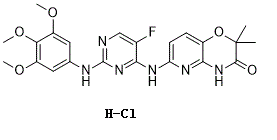
Tamatinib HCl (formerly known as R406 HCl) is a novel potent and ATP competitive Syk inhibitor with IC50 of 41 nM in cell-free assays, it strongly inhibits Syk but not Lyn, 5-fold less potent to Flt3. R406 impairs platelet activation and monocyte tissue factor expression triggered by heparin-PF4 complex directed antibodies. R406 blocks fc receptor signaling and reduces immune complex-mediated inflammation. R406 inhibited phosphorylation of Syk substrate linker for activation of T cells in mast cells and B-cell linker protein/SLP65 in B cells. R406 bound to the ATP binding pocket of Syk and inhibited its kinase activity as an ATP-competitive inhibitor (Ki = 30 nM). R406 blocked Syk-dependent FcR-mediated activation of monocytes/macrophages and neutrophils and BCR-mediated activation of B lymphocytes.
Physicochemical Properties
| Related CAS # | 841290-81-1;841290-80-0;R406 |
| Appearance | Typically exists as solid at room temperature |
| HS Tariff Code | 2934.99.9001 |
| Storage |
Powder-20°C 3 years 4°C 2 years In solvent -80°C 6 months -20°C 1 month |
| Shipping Condition | Room temperature (This product is stable at ambient temperature for a few days during ordinary shipping and time spent in Customs) |
Biological Activity
| Targets | Syk (Ki = 30 nM); Syk (IC50 = 41 nM); Lyn (IC50 = 63 nM); Lck (IC50 = 37 nM); FLT3 | ||
| ln Vitro |
|
||
| ln Vivo |
|
||
| Enzyme Assay | R406 is serially diluted in DMSO, diluted in kinase buffer (20 mM HEPES, pH 7.4, 5 mM MgCl2, 2 mM MnCl2, 1 mM DTT, 0.1 mg/mL acetylated BGG) and finally diluted to 1% DMSO by volume. After adding ATP and substrate to kinase buffer at room temperature, the final DMSO concentration is 0.2%. 0.125 ng of Syk is added to kinase buffer to initiate the kinase reactions, which are carried out in a final volume of 20 mL with 5 mM HS1 peptide substrate and 4 mM ATP. The reaction is left to continue at room temperature for forty minutes. 20 mL of PTK quench mix containing EDTA, anti-phosphotyrosine antibody (1X final), and fluorescent phosphopeptide tracer (0.5X final) diluted in FP Dilution Buffer is added to stop the reaction. A Polarion fluorescence polarization plate reader is used to read the plate after it has been incubated for 30 minutes at room temperature in the dark. Through competition with the phosphopeptide competitor included in the Tyrosine Kinase Assay Kit, a calibration curve is created that is used to convert data into the amount of phosphopeptide present. Non-linear regression analysis is used to fit the curve and test R406 at eleven different concentrations in order to determine the IC50. | ||
| Animal Protocol |
|
||
| References | J Pharmacol Exp Ther.2006 Dec;319(3):998-1008;Blood.2008 Feb 15;111(4):2230-7. |
Solubility Data
| Solubility (In Vitro) | May dissolve in DMSO (in most cases), if not, try other solvents such as H2O, Ethanol, or DMF with a minute amount of products to avoid loss of samples |
| Solubility (In Vivo) |
Note: Listed below are some common formulations that may be used to formulate products with low water solubility (e.g. < 1 mg/mL), you may test these formulations using a minute amount of products to avoid loss of samples. Injection Formulations (e.g. IP/IV/IM/SC) Injection Formulation 1: DMSO : Tween 80: Saline = 10 : 5 : 85 (i.e. 100 μL DMSO stock solution → 50 μL Tween 80 → 850 μL Saline) *Preparation of saline: Dissolve 0.9 g of sodium chloride in 100 mL ddH ₂ O to obtain a clear solution. Injection Formulation 2: DMSO : PEG300 :Tween 80 : Saline = 10 : 40 : 5 : 45 (i.e. 100 μL DMSO → 400 μLPEG300 → 50 μL Tween 80 → 450 μL Saline) Injection Formulation 3: DMSO : Corn oil = 10 : 90 (i.e. 100 μL DMSO → 900 μL Corn oil) Example: Take the Injection Formulation 3 (DMSO : Corn oil = 10 : 90) as an example, if 1 mL of 2.5 mg/mL working solution is to be prepared, you can take 100 μL 25 mg/mL DMSO stock solution and add to 900 μL corn oil, mix well to obtain a clear or suspension solution (2.5 mg/mL, ready for use in animals). Injection Formulation 4: DMSO : 20% SBE-β-CD in saline = 10 : 90 [i.e. 100 μL DMSO → 900 μL (20% SBE-β-CD in saline)] *Preparation of 20% SBE-β-CD in Saline (4°C,1 week): Dissolve 2 g SBE-β-CD in 10 mL saline to obtain a clear solution. Injection Formulation 5: 2-Hydroxypropyl-β-cyclodextrin : Saline = 50 : 50 (i.e. 500 μL 2-Hydroxypropyl-β-cyclodextrin → 500 μL Saline) Injection Formulation 6: DMSO : PEG300 : castor oil : Saline = 5 : 10 : 20 : 65 (i.e. 50 μL DMSO → 100 μLPEG300 → 200 μL castor oil → 650 μL Saline) Injection Formulation 7: Ethanol : Cremophor : Saline = 10: 10 : 80 (i.e. 100 μL Ethanol → 100 μL Cremophor → 800 μL Saline) Injection Formulation 8: Dissolve in Cremophor/Ethanol (50 : 50), then diluted by Saline Injection Formulation 9: EtOH : Corn oil = 10 : 90 (i.e. 100 μL EtOH → 900 μL Corn oil) Injection Formulation 10: EtOH : PEG300:Tween 80 : Saline = 10 : 40 : 5 : 45 (i.e. 100 μL EtOH → 400 μLPEG300 → 50 μL Tween 80 → 450 μL Saline) Oral Formulations Oral Formulation 1: Suspend in 0.5% CMC Na (carboxymethylcellulose sodium) Oral Formulation 2: Suspend in 0.5% Carboxymethyl cellulose Example: Take the Oral Formulation 1 (Suspend in 0.5% CMC Na) as an example, if 100 mL of 2.5 mg/mL working solution is to be prepared, you can first prepare 0.5% CMC Na solution by measuring 0.5 g CMC Na and dissolve it in 100 mL ddH2O to obtain a clear solution; then add 250 mg of the product to 100 mL 0.5% CMC Na solution, to make the suspension solution (2.5 mg/mL, ready for use in animals). Oral Formulation 3: Dissolved in PEG400 Oral Formulation 4: Suspend in 0.2% Carboxymethyl cellulose Oral Formulation 5: Dissolve in 0.25% Tween 80 and 0.5% Carboxymethyl cellulose Oral Formulation 6: Mixing with food powders Note: Please be aware that the above formulations are for reference only. InvivoChem strongly recommends customers to read literature methods/protocols carefully before determining which formulation you should use for in vivo studies, as different compounds have different solubility properties and have to be formulated differently. (Please use freshly prepared in vivo formulations for optimal results.) |