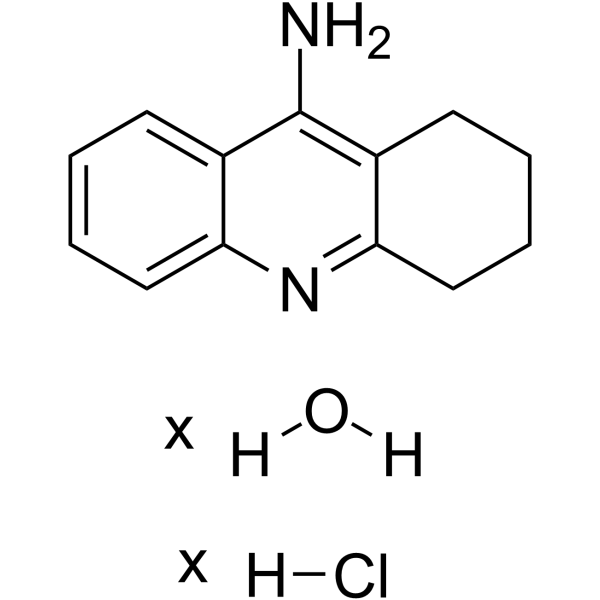
Physicochemical Properties
| Molecular Formula | C13H17CLN2O |
| Molecular Weight | 252.739882230759 |
| Exact Mass | 252.102 |
| CAS # | 206658-92-6 |
| Related CAS # | Tacrine hydrochloride;1684-40-8 |
| PubChem CID | 6420002 |
| Appearance | White to off-white solid powder |
| Hydrogen Bond Donor Count | 3 |
| Hydrogen Bond Acceptor Count | 3 |
| Rotatable Bond Count | 0 |
| Heavy Atom Count | 17 |
| Complexity | 229 |
| Defined Atom Stereocenter Count | 0 |
| InChi Key | PXGRMZYJAOQPNZ-UHFFFAOYSA-N |
| InChi Code | InChI=1S/C13H14N2.ClH.H2O/c14-13-9-5-1-3-7-11(9)15-12-8-4-2-6-10(12)13;;/h1,3,5,7H,2,4,6,8H2,(H2,14,15);1H;1H2 |
| Chemical Name | 1,2,3,4-tetrahydroacridin-9-amine;hydrate;hydrochloride |
| HS Tariff Code | 2934.99.9001 |
| Storage |
Powder-20°C 3 years 4°C 2 years In solvent -80°C 6 months -20°C 1 month Note: Please store this product in a sealed and protected environment, avoid exposure to moisture. |
| Shipping Condition | Room temperature (This product is stable at ambient temperature for a few days during ordinary shipping and time spent in Customs) |
Biological Activity
| Targets |
- Tacrine hydrochloride hydrate targets acetylcholinesterase (AChE) with a Ki value of 0.045 μM and butyrylcholinesterase (BChE) with a Ki value of 0.37 μM [1] |
| ln Vitro |
In a suspended concentration manner, tacrine hydrochloride (aqueous complex) (12.5 to 37.5 nM) inhibits both human blood butylacetylcholinesterase and venom acetatecholinesterase. AChE from snake venom has an IC50 of 31 nM, while BChE from humans has an IC50 of 25.6 nM[1]. - Tacrine hydrochloride hydrate potently inhibited the activity of human erythrocyte AChE and equine serum BChE in a concentration-dependent manner. Kinetic analysis revealed it acted as a mixed-type inhibitor for both enzymes, with higher affinity for AChE (Ki = 0.045 μM) than BChE (Ki = 0.37 μM). The inhibition curves showed concentration-response relationships, with IC₅₀ values consistent with the Ki values, confirming its specific inhibitory effect on cholinesterases [1] |
| ln Vivo |
During reacquisition, administration of tacrine hydrochloride (hydrate) can also change the absolute levels of cocaine self-regulation. Body weight was regained by roughly 0.5% four days following intravenous tacrine hydrochloride hydrate therapy. The osmotic pump conduit method of tacrine hydrochloride (hydrate) does not change the linear or repeated cocaine-induced locomotor activity. During recovery, there was no discernible primary effect or reaction from tacrine hydrochloride (hydrate) therapy on active lever responses. Conditioned place preference was used to measure phosphatase levels, and post hoc comparisons revealed that self-prepared cocaine had much lower levels than phosphoric acid treated with saline [2]. - In male Wistar rats, Tacrine hydrochloride hydrate exhibited enduring effects on cocaine-reinforced behavior: (1) Conditioned-place preference (CPP) assay: Cocaine (15 mg/kg, i.p.) induced significant CPP. Co-administration of Tacrine hydrochloride hydrate (1, 3, 10 mg/kg, i.p.) during CPP training dose-dependently attenuated cocaine-induced CPP, with the 10 mg/kg dose showing the most potent effect. (2) Temporal separation experiment: Administering Tacrine hydrochloride hydrate (10 mg/kg, i.p.) 24 hours after cocaine training still reduced CPP expression, indicating a long-lasting effect independent of immediate drug reward association. (3) Reinstatement assay: After extinguishing cocaine-induced CPP, priming with cocaine (7.5 mg/kg, i.p.) reinstated CPP. Pretreatment with Tacrine hydrochloride hydrate (10 mg/kg, i.p.) significantly blocked this reinstatement, suggesting it modulates cocaine's motivational properties [2] |
| Enzyme Assay |
- Cholinesterase activity inhibition assay: Human erythrocyte AChE and equine serum BChE were purified and prepared into reaction systems with appropriate buffers. Different concentrations of Tacrine hydrochloride hydrate were added to the systems, followed by the addition of specific substrates (acetylthiocholine for AChE, butyrylthiocholine for BChE). The reaction was incubated at 37°C for a fixed time, and the formation of thiocholine (product) was detected by a colorimetric method using a chromogenic reagent. The enzyme activity was calculated based on absorbance values, and the inhibition rate was determined relative to the control group. Kinetic parameters (Ki values) were derived from Lineweaver-Burk plots to identify the inhibition type [1] |
| Animal Protocol |
- Cocaine-induced CPP model in Wistar rats: Male Wistar rats were randomly divided into control, cocaine-only, and Tacrine hydrochloride hydrate + cocaine groups (n=8–10 per group). The CPP apparatus consisted of two distinct compartments with different visual and tactile cues. (1) Training phase: Rats in the cocaine group received cocaine (15 mg/kg, i.p.) before being placed in the drug-paired compartment for 30 minutes, while the control group received saline. The Tacrine hydrochloride hydrate groups were administered Tacrine hydrochloride hydrate (1, 3, 10 mg/kg, i.p.) 30 minutes before cocaine injection, followed by placement in the drug-paired compartment. This training was repeated for 4 days. (2) Testing phase: 24 hours after the last training, rats were allowed free access to both compartments for 15 minutes, and the time spent in each compartment was recorded to calculate CPP scores. (3) Temporal separation experiment: Rats were trained with cocaine for 4 days, then administered Tacrine hydrochloride hydrate (10 mg/kg, i.p.) 24 hours after the last training, followed by the CPP test 24 hours later. (4) Reinstatement experiment: After CPP extinction (daily saline injections in both compartments for 5 days), rats were pretreated with Tacrine hydrochloride hydrate (10 mg/kg, i.p.) 30 minutes before cocaine priming (7.5 mg/kg, i.p.), and the CPP test was conducted 24 hours later [2] |
| References |
[1]. Inhibition of two different cholinesterases by tacrine. Chem Biol Interact. 2006 Aug 25;162(2):165-71. [2]. Enduring effects of tacrine on cocaine-reinforced behavior: Analysis by conditioned-place preference, temporal separation from drug reward, and reinstatement. Pharmacol Res. 2015 Jul;97:40-7. |
| Additional Infomation |
See also: Tacrine Hydrochloride (annotation moved to); Tacrine (annotation moved to). - Tacrine hydrochloride hydrate is a cholinesterase inhibitor that exerts its pharmacological effects by blocking AChE and BChE, thereby increasing acetylcholine levels in the synaptic cleft [1] - Its enduring effects on cocaine-reinforced behavior suggest it modulates the cholinergic system's involvement in drug reward and addiction-related processes, potentially via interactions with central cholinergic receptors or downstream signaling pathways related to motivation and reward [2] - The mixed-type inhibition of cholinesterases by Tacrine hydrochloride hydrate indicates it binds to both the active site and an allosteric site of the enzymes, contributing to its potent inhibitory activity [1] |
Solubility Data
| Solubility (In Vitro) |
H2O : ~100 mg/mL DMSO : ~32 mg/mL |
| Solubility (In Vivo) |
Solubility in Formulation 1: ≥ 2.5 mg/mL (Infinity mM) (saturation unknown) in 10% DMSO + 40% PEG300 + 5% Tween80 + 45% Saline (add these co-solvents sequentially from left to right, and one by one), clear solution. For example, if 1 mL of working solution is to be prepared, you can add 100 μL of 25.0 mg/mL clear DMSO stock solution to 400 μL PEG300 and mix evenly; then add 50 μL Tween-80 to the above solution and mix evenly; then add 450 μL normal saline to adjust the volume to 1 mL. Preparation of saline: Dissolve 0.9 g of sodium chloride in 100 mL ddH₂ O to obtain a clear solution. Solubility in Formulation 2: ≥ 2.5 mg/mL (Infinity mM) (saturation unknown) in 10% DMSO + 90% (20% SBE-β-CD in Saline) (add these co-solvents sequentially from left to right, and one by one), clear solution. For example, if 1 mL of working solution is to be prepared, you can add 100 μL of 25.0 mg/mL clear DMSO stock solution to 900 μL of 20% SBE-β-CD physiological saline solution and mix evenly. Preparation of 20% SBE-β-CD in Saline (4°C,1 week): Dissolve 2 g SBE-β-CD in 10 mL saline to obtain a clear solution. Solubility in Formulation 3: ≥ 2.5 mg/mL (Infinity mM) (saturation unknown) in 10% DMSO + 90% Corn Oil (add these co-solvents sequentially from left to right, and one by one), clear solution. For example, if 1 mL of working solution is to be prepared, you can add 100 μL of 25.0 mg/mL clear DMSO stock solution to 900 μL of corn oil and mix evenly. Solubility in Formulation 4: 100 mg/mL (Infinity mM) in PBS (add these co-solvents sequentially from left to right, and one by one), clear solution; with ultrasonication. (Please use freshly prepared in vivo formulations for optimal results.) |
| Preparing Stock Solutions | 1 mg | 5 mg | 10 mg | |
| 1 mM | 3.9566 mL | 19.7832 mL | 39.5664 mL | |
| 5 mM | 0.7913 mL | 3.9566 mL | 7.9133 mL | |
| 10 mM | 0.3957 mL | 1.9783 mL | 3.9566 mL |