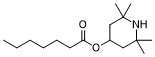
Physicochemical Properties
| Molecular Formula | C16H31NO2 |
| Molecular Weight | 269.429 |
| Exact Mass | 305.212 |
| Elemental Analysis | C, 71.33; H, 11.60; N, 5.20; O, 11.88 |
| CAS # | 849461-90-1 |
| Related CAS # | nAChR-IN-1 hydrochloride;849461-91-2 |
| PubChem CID | 11207937 |
| Appearance | Colorless to light yellow liquid |
| Boiling Point | 356.5ºC at 760 mmHg |
| Flash Point | 169.4ºC |
| LogP | 4.94 |
| Hydrogen Bond Donor Count | 1 |
| Hydrogen Bond Acceptor Count | 3 |
| Rotatable Bond Count | 7 |
| Heavy Atom Count | 19 |
| Complexity | 281 |
| Defined Atom Stereocenter Count | 0 |
| SMILES | Cl.CCCCCCC(OC1CC(C)(C)NC(C)(C)C1)=O |
| InChi Key | PWWKJRFUJIFGGD-UHFFFAOYSA-N |
| InChi Code | InChI=1S/C16H31NO2/c1-6-7-8-9-10-14(18)19-13-11-15(2,3)17-16(4,5)12-13/h13,17H,6-12H2,1-5H3 |
| Chemical Name | (2,2,6,6-tetramethylpiperidin-4-yl) heptanoate |
| Synonyms | nAChR-IN-1 ;TMPH; TMPH inhibitor; |
| HS Tariff Code | 2934.99.9001 |
| Storage |
Powder-20°C 3 years 4°C 2 years In solvent -80°C 6 months -20°C 1 month Note: This product requires protection from light (avoid light exposure) during transportation and storage. |
| Shipping Condition | Room temperature (This product is stable at ambient temperature for a few days during ordinary shipping and time spent in Customs) |
Biological Activity
| ln Vitro | Based on the reduction of net value of three distinct paired combinations (α3β4, α4β2), α3β2), and α7 homomeric neurons (nAChR), the IC50 (area) were 390, 1.2, 110, 75, 440, 460, 430, 2.7, 1.0, respectively. nAChR-IN-1 (100 nM) suppresses nAChR by 90%. accountable for the ACh responses at 1.4 and 18.3 nM [1]. |
| ln Vivo | In a time-dependent way, nAChR-IN-1 (20 mg/kg; subcutaneous injection; single dosage) improves mice's hypokinesia and hypothermia caused by nicotine [1]. |
| Animal Protocol |
Animal/Disease Models: Nicotine-induced mouse model [1] Doses: 20 mg/kg Route of Administration: subcutaneous injection; single dose; 15 minutes before injection of nicotine (1.5 mg/kg) Experimental Results: Mouse activity increased even with nicotine Caused reduction in motor activity. Has no effect on body temperature. Animal/Disease Models: Mouse tail flick and hot plate model [1] Doses: 0, 0.1, 1, 5 mg/kg Route of Administration: subcutaneous injection; single dose Experimental Results: block the analgesic effect of nicotine in the hot plate. Time-dependent blockade of nicotine-induced analgesia. |
| References |
[1]. Compositions et methodes d'inhibition selective des recepteurs nicotiniques de l'acetylcholine. WO2005032479A2. |
| Additional Infomation | Heptanoic acid (2,2,6,6-tetramethyl-4-piperidinyl) ester is a fatty acid ester. |
Solubility Data
| Solubility (In Vitro) | DMSO : ~100 mg/mL (~371.17 mM) |
| Solubility (In Vivo) |
Solubility in Formulation 1: ≥ 2.5 mg/mL (9.28 mM) (saturation unknown) in 10% DMSO + 40% PEG300 + 5% Tween80 + 45% Saline (add these co-solvents sequentially from left to right, and one by one), clear solution. For example, if 1 mL of working solution is to be prepared, you can add 100 μL of 25.0 mg/mL clear DMSO stock solution to 400 μL PEG300 and mix evenly; then add 50 μL Tween-80 to the above solution and mix evenly; then add 450 μL normal saline to adjust the volume to 1 mL. Preparation of saline: Dissolve 0.9 g of sodium chloride in 100 mL ddH₂ O to obtain a clear solution. Solubility in Formulation 2: ≥ 2.5 mg/mL (9.28 mM) (saturation unknown) in 10% DMSO + 90% (20% SBE-β-CD in Saline) (add these co-solvents sequentially from left to right, and one by one), clear solution. For example, if 1 mL of working solution is to be prepared, you can add 100 μL of 25.0 mg/mL clear DMSO stock solution to 900 μL of 20% SBE-β-CD physiological saline solution and mix evenly. Preparation of 20% SBE-β-CD in Saline (4°C,1 week): Dissolve 2 g SBE-β-CD in 10 mL saline to obtain a clear solution. Solubility in Formulation 3: ≥ 2.5 mg/mL (9.28 mM) (saturation unknown) in 10% DMSO + 90% Corn Oil (add these co-solvents sequentially from left to right, and one by one), clear solution. For example, if 1 mL of working solution is to be prepared, you can add 100 μL of 25.0 mg/mL clear DMSO stock solution to 900 μL of corn oil and mix evenly. (Please use freshly prepared in vivo formulations for optimal results.) |
| Preparing Stock Solutions | 1 mg | 5 mg | 10 mg | |
| 1 mM | 3.7115 mL | 18.5577 mL | 37.1154 mL | |
| 5 mM | 0.7423 mL | 3.7115 mL | 7.4231 mL | |
| 10 mM | 0.3712 mL | 1.8558 mL | 3.7115 mL |