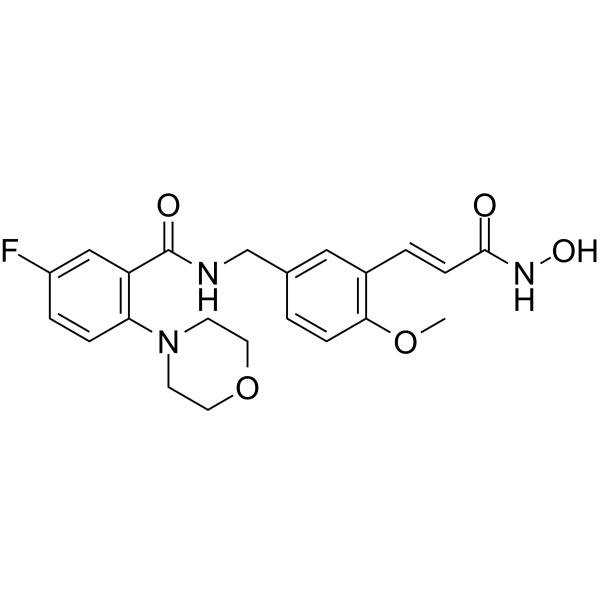
Physicochemical Properties
| Molecular Formula | C22H24FN3O5 |
| Molecular Weight | 429.44 |
| CAS # | 3031349-25-1 |
| Appearance | Light yellow to khaki solid powder |
| HS Tariff Code | 2934.99.9001 |
| Storage |
Powder-20°C 3 years 4°C 2 years In solvent -80°C 6 months -20°C 1 month Note: This product requires protection from light (avoid light exposure) during transportation and storage. |
| Shipping Condition | Room temperature (This product is stable at ambient temperature for a few days during ordinary shipping and time spent in Customs) |
Biological Activity
| ln Vitro | In both normal human lung cells and cancer cell lines, TH-6 (0-2 µM) has antiproliferative properties[1]. With an IC50 value of 4.06 µM, TH-6 (0-10 µM) inhibits tubulin polymerization[1]. HepG2 cells express more Ac-α-Tubulin and AC-Histone H3 when exposed to 6 (0.03, 0.1, 0.3 1 µM; 24 h)[1]. Cell cycle arrest and apoptosis are induced by TH-6 (7.5, 15, 30 nM) at the G2/M phase[1]. HepG2 cells' MMP is decreased and their ROS levels are raised in a dose-dependent manner by TH-6 (0-30 nM)[1]. TH-6 (7.5, 15, 30 nM; 48 h) suppresses HUVEC migration in a concentration-dependent manner and prevents MDA-MB-231 cell migration and invasion[1]. TH-6 exhibits a t1/2 of 50.3 min in vitro, indicating favorable liver microsomal stability[1]. |
| ln Vivo | In mice, TH-6 (10, 20 mg/kg; intravenous; daily for 21 days) exhibits anti-tumor activity[1]. In mice, TH-6 (20 mg/kg) exhibits good cardiovascular safety profile and antivascular activity[1]. |
| Cell Assay |
Cell Viability Assay[1] Cell Types: K562, GepG2, HCT-116, MDA-MB-231, H22, MCF-7, HFL-1 cells Tested Concentrations: 0-2 µM Incubation Duration: Experimental Results: demonstrated antiproliferative activities with an IC50 values of 18, 29, 28, 30, 26, 27, 134 nM for K562, GepG2, HCT-116, MDA-MB-231, H22, MCF-7, HFL-1 cells, respectively. Western Blot Analysis[1] Cell Types: HepG2 cells Tested Concentrations: 0.03, 0.1, 0.3 1 µM Incubation Duration: 24 h Experimental Results: Increased the intracellular levels of HDAC6 substrate acetyl-α-tubulin and the HDAC1/2/3 substrate acetyl-histone H3 in a dose -dependent manner. Cell Cycle Analysis[1] Cell Types: HepG2 cells Tested Concentrations: 7.5, 15, 30 nM Incubation Duration: Experimental Results: Induced cell cycle arrest at G2/M phase with diminished the expression of Cdc2, Cdc25c, and Cyclin B1 proteins in a dose dependent manner. Apoptosis Analysis[1] Cell Types: HepG2 cells Tested Concentrations: 7.5, 15, 30 nM Incubation Duration: Experimental Results: demonstrated an accumulation of apoptotic cells from 27.04 to 50.54% and upregulated the expression o |
| Animal Protocol |
Animal/Disease Models: 4-5 weeks, 18-22 g female ICR mice (H22 allograft mouse model)[1] Doses: 10, 20 mg/kg Route of Administration: Iv; daily for 21 days Experimental Results: decreased tumor weights at day 21 by 82% and did not affect body weight during treatment, indicating the low toxicity. |
| References |
[1]. Discovery of a Novel Vascular Disrupting Agent Inhibiting Tubulin Polymerization and HDACs with Potent Antitumor Effects. J Med Chem. 2022 Aug 4. |
Solubility Data
| Solubility (In Vitro) | May dissolve in DMSO (in most cases), if not, try other solvents such as H2O, Ethanol, or DMF with a minute amount of products to avoid loss of samples |
| Solubility (In Vivo) |
Note: Listed below are some common formulations that may be used to formulate products with low water solubility (e.g. < 1 mg/mL), you may test these formulations using a minute amount of products to avoid loss of samples. Injection Formulations (e.g. IP/IV/IM/SC) Injection Formulation 1: DMSO : Tween 80: Saline = 10 : 5 : 85 (i.e. 100 μL DMSO stock solution → 50 μL Tween 80 → 850 μL Saline) *Preparation of saline: Dissolve 0.9 g of sodium chloride in 100 mL ddH ₂ O to obtain a clear solution. Injection Formulation 2: DMSO : PEG300 :Tween 80 : Saline = 10 : 40 : 5 : 45 (i.e. 100 μL DMSO → 400 μLPEG300 → 50 μL Tween 80 → 450 μL Saline) Injection Formulation 3: DMSO : Corn oil = 10 : 90 (i.e. 100 μL DMSO → 900 μL Corn oil) Example: Take the Injection Formulation 3 (DMSO : Corn oil = 10 : 90) as an example, if 1 mL of 2.5 mg/mL working solution is to be prepared, you can take 100 μL 25 mg/mL DMSO stock solution and add to 900 μL corn oil, mix well to obtain a clear or suspension solution (2.5 mg/mL, ready for use in animals). Injection Formulation 4: DMSO : 20% SBE-β-CD in saline = 10 : 90 [i.e. 100 μL DMSO → 900 μL (20% SBE-β-CD in saline)] *Preparation of 20% SBE-β-CD in Saline (4°C,1 week): Dissolve 2 g SBE-β-CD in 10 mL saline to obtain a clear solution. Injection Formulation 5: 2-Hydroxypropyl-β-cyclodextrin : Saline = 50 : 50 (i.e. 500 μL 2-Hydroxypropyl-β-cyclodextrin → 500 μL Saline) Injection Formulation 6: DMSO : PEG300 : castor oil : Saline = 5 : 10 : 20 : 65 (i.e. 50 μL DMSO → 100 μLPEG300 → 200 μL castor oil → 650 μL Saline) Injection Formulation 7: Ethanol : Cremophor : Saline = 10: 10 : 80 (i.e. 100 μL Ethanol → 100 μL Cremophor → 800 μL Saline) Injection Formulation 8: Dissolve in Cremophor/Ethanol (50 : 50), then diluted by Saline Injection Formulation 9: EtOH : Corn oil = 10 : 90 (i.e. 100 μL EtOH → 900 μL Corn oil) Injection Formulation 10: EtOH : PEG300:Tween 80 : Saline = 10 : 40 : 5 : 45 (i.e. 100 μL EtOH → 400 μLPEG300 → 50 μL Tween 80 → 450 μL Saline) Oral Formulations Oral Formulation 1: Suspend in 0.5% CMC Na (carboxymethylcellulose sodium) Oral Formulation 2: Suspend in 0.5% Carboxymethyl cellulose Example: Take the Oral Formulation 1 (Suspend in 0.5% CMC Na) as an example, if 100 mL of 2.5 mg/mL working solution is to be prepared, you can first prepare 0.5% CMC Na solution by measuring 0.5 g CMC Na and dissolve it in 100 mL ddH2O to obtain a clear solution; then add 250 mg of the product to 100 mL 0.5% CMC Na solution, to make the suspension solution (2.5 mg/mL, ready for use in animals). Oral Formulation 3: Dissolved in PEG400 Oral Formulation 4: Suspend in 0.2% Carboxymethyl cellulose Oral Formulation 5: Dissolve in 0.25% Tween 80 and 0.5% Carboxymethyl cellulose Oral Formulation 6: Mixing with food powders Note: Please be aware that the above formulations are for reference only. InvivoChem strongly recommends customers to read literature methods/protocols carefully before determining which formulation you should use for in vivo studies, as different compounds have different solubility properties and have to be formulated differently. (Please use freshly prepared in vivo formulations for optimal results.) |
| Preparing Stock Solutions | 1 mg | 5 mg | 10 mg | |
| 1 mM | 2.3286 mL | 11.6431 mL | 23.2861 mL | |
| 5 mM | 0.4657 mL | 2.3286 mL | 4.6572 mL | |
| 10 mM | 0.2329 mL | 1.1643 mL | 2.3286 mL |