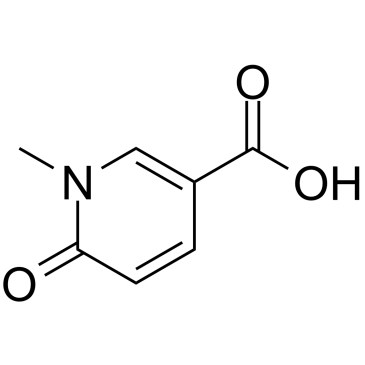
1-Methyl-6-oxo-1,6-dihydropyridine-3-carboxylic acid is a natural product isolated from Cordyceps bassiana with various bioactivities such as anti-cancer, anti-oxidative, anti-inflammatory, anti-angiogenic, anti-obesity, anti-diabetic, and anti-nociceptive activities. It can block AP-1-mediated luciferase activity.
Physicochemical Properties
| Molecular Formula | C7H7NO3 |
| Molecular Weight | 153.1354 |
| Exact Mass | 153.043 |
| CAS # | 3719-45-7 |
| PubChem CID | 592704 |
| Appearance | White to off-white solid powder |
| Density | 1.381g/cm3 |
| Boiling Point | 329.6ºC at 760mmHg |
| Flash Point | 153.2ºC |
| Index of Refraction | 1.577 |
| LogP | 0.083 |
| Hydrogen Bond Donor Count | 1 |
| Hydrogen Bond Acceptor Count | 3 |
| Rotatable Bond Count | 1 |
| Heavy Atom Count | 11 |
| Complexity | 265 |
| Defined Atom Stereocenter Count | 0 |
| InChi Key | RGZCKPXTNJAWMR-UHFFFAOYSA-N |
| InChi Code | InChI=1S/C7H7NO3/c1-8-4-5(7(10)11)2-3-6(8)9/h2-4H,1H3,(H,10,11) |
| Chemical Name | 1-methyl-6-oxopyridine-3-carboxylic acid |
| HS Tariff Code | 2934.99.9001 |
| Storage |
Powder-20°C 3 years 4°C 2 years In solvent -80°C 6 months -20°C 1 month Note: Please store this product in a sealed and protected environment (e.g. under nitrogen), avoid exposure to moisture. |
| Shipping Condition | Room temperature (This product is stable at ambient temperature for a few days during ordinary shipping and time spent in Customs) |
Biological Activity
| ln Vitro |
- Anti-inflammatory activity in RAW 264.7 macrophages: 1-Methyl-6-oxo-1,6-dihydropyridine-3-carboxylic acid inhibited lipopolysaccharide (LPS)-induced nitric oxide (NO) production in RAW 264.7 murine macrophage cells, with an IC50 value of 25.6 μM. At concentrations of 10 μM, 20 μM, and 40 μM, it reduced NO production by 22%, 45%, and 78% respectively, compared to the LPS-treated control group. Additionally, the compound decreased the secretion of pro-inflammatory cytokines: at 20 μM, it inhibited LPS-induced interleukin-6 (IL-6) production by 40% and tumor necrosis factor-α (TNF-α) production by 35% [1] |
| Cell Assay |
- NO production inhibition assay in RAW 264.7 cells: RAW 264.7 cells were seeded in 96-well plates at a density of 1×10⁴ cells per well and incubated overnight at 37°C (5% CO₂). The cells were pretreated with different concentrations of 1-Methyl-6-oxo-1,6-dihydropyridine-3-carboxylic acid (5 μM, 10 μM, 20 μM, 40 μM) for 1 hour, then stimulated with LPS (1 μg/mL) and incubated for another 24 hours. After incubation, 100 μL of cell culture supernatant was mixed with an equal volume of Griess reagent, and the absorbance was measured at 540 nm to calculate NO concentration. The IC50 value for NO inhibition was determined from the dose-response curve [1] - Pro-inflammatory cytokine detection assay: RAW 264.7 cells were seeded in 24-well plates (5×10⁵ cells per well) and treated as described for the NO assay (pretreatment with the compound for 1 hour, then LPS stimulation for 24 hours). The culture supernatant was collected, and the levels of IL-6 and TNF-α were measured using a sandwich enzyme-linked immunosorbent assay (ELISA). The inhibition rate of cytokine production was calculated by comparing the cytokine levels in the compound-treated groups with the LPS-only control group [1] |
| References |
[1]. Chemical Constituents Identified from Fruit Body of Cordyceps bassiana and Their Anti-Inflammatory Activity. Biomol Ther (Seoul). 2017 Mar 1;25(2):165-170. |
| Additional Infomation |
- 1-Methyl-6-oxo-1,6-dihydropyridine-3-carboxylic acid is a small-molecule compound isolated from the fruit body of Cordyceps bassiana , a fungus with traditional medicinal uses [1] |
Solubility Data
| Solubility (In Vitro) | DMSO : ~100 mg/mL (~653.00 mM) |
| Solubility (In Vivo) |
Solubility in Formulation 1: ≥ 2.5 mg/mL (16.32 mM) (saturation unknown) in 10% DMSO + 40% PEG300 + 5% Tween80 + 45% Saline (add these co-solvents sequentially from left to right, and one by one), clear solution. For example, if 1 mL of working solution is to be prepared, you can add 100 μL of 25.0 mg/mL clear DMSO stock solution to 400 μL PEG300 and mix evenly; then add 50 μL Tween-80 to the above solution and mix evenly; then add 450 μL normal saline to adjust the volume to 1 mL. Preparation of saline: Dissolve 0.9 g of sodium chloride in 100 mL ddH₂ O to obtain a clear solution. Solubility in Formulation 2: ≥ 2.5 mg/mL (16.32 mM) (saturation unknown) in 10% DMSO + 90% (20% SBE-β-CD in Saline) (add these co-solvents sequentially from left to right, and one by one), clear solution. For example, if 1 mL of working solution is to be prepared, you can add 100 μL of 25.0 mg/mL clear DMSO stock solution to 900 μL of 20% SBE-β-CD physiological saline solution and mix evenly. Preparation of 20% SBE-β-CD in Saline (4°C,1 week): Dissolve 2 g SBE-β-CD in 10 mL saline to obtain a clear solution. Solubility in Formulation 3: ≥ 2.5 mg/mL (16.32 mM) (saturation unknown) in 10% DMSO + 90% Corn Oil (add these co-solvents sequentially from left to right, and one by one), clear solution. For example, if 1 mL of working solution is to be prepared, you can add 100 μL of 25.0 mg/mL clear DMSO stock solution to 900 μL of corn oil and mix evenly. (Please use freshly prepared in vivo formulations for optimal results.) |
| Preparing Stock Solutions | 1 mg | 5 mg | 10 mg | |
| 1 mM | 6.5300 mL | 32.6499 mL | 65.2997 mL | |
| 5 mM | 1.3060 mL | 6.5300 mL | 13.0599 mL | |
| 10 mM | 0.6530 mL | 3.2650 mL | 6.5300 mL |