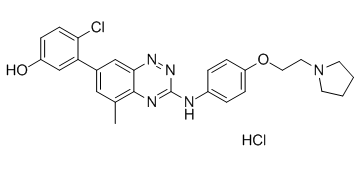
TG 100572 HCl (TG-100572; TG100572), the hydrochloride salt of TG100572, is a novel, potent and selective multi-targeted kinase (receptor tyrosine kinases and Src kinases) inhibitor with anti-proliferative activity and is being developed for the treatment of AMD (age-related macular degeneration). With IC50s of 2, 7, 2, 16, 13, 5, 0.5, 6, 0.1, 0.4, 1, 0.2 nM, respectively, it inhibits VEGFR1, VEGFR2, FGFR1, FGFR2, PDGFRβ, Fgr, Fyn, Hck, Lck, Lyn, Src, Yup. TG100572 caused proliferating endothelial cells to undergo apoptosis in vitro by blocking Src kinases and specific receptor tyrosine kinases. Significantly less HSV-induced angiogenesis and a marked decrease in the severity of SK lesions are the results of TG100572's inhibition of downstream molecules in the vascular endothelial growth factor (VEGF) signalling pathway.
Physicochemical Properties
| Molecular Formula | C26H27CL2N5O2 |
| Molecular Weight | 512.43088 |
| Exact Mass | 511.154 |
| Elemental Analysis | C, 60.94; H, 5.31; Cl, 13.84; N, 13.67; O, 6.24 |
| CAS # | 867331-64-4 |
| Related CAS # | TG 100572;867334-05-2 |
| PubChem CID | 24823567 |
| Appearance | Pink to red solid powder |
| LogP | 6.39 |
| Hydrogen Bond Donor Count | 3 |
| Hydrogen Bond Acceptor Count | 7 |
| Rotatable Bond Count | 7 |
| Heavy Atom Count | 35 |
| Complexity | 630 |
| Defined Atom Stereocenter Count | 0 |
| SMILES | Cl.ClC1C(C2C=C(C)C3C(=NN=C(NC4C=CC(OCCN5CCCC5)=CC=4)N=3)C=2)=CC(O)=CC=1 |
| InChi Key | NVINBIHNVAYEND-UHFFFAOYSA-N |
| InChi Code | InChI=1S/C26H26ClN5O2.ClH/c1-17-14-18(22-16-20(33)6-9-23(22)27)15-24-25(17)29-26(31-30-24)28-19-4-7-21(8-5-19)34-13-12-32-10-2-3-11-32;/h4-9,14-16,33H,2-3,10-13H2,1H3,(H,28,29,31);1H |
| Chemical Name | 4-chloro-3-[5-methyl-3-[4-(2-pyrrolidin-1-ylethoxy)anilino]-1,2,4-benzotriazin-7-yl]phenol;hydrochloride |
| Synonyms | TG100572 HCl; TG 100572; TG100572; TG-100572 HCl |
| HS Tariff Code | 2934.99.9001 |
| Storage |
Powder-20°C 3 years 4°C 2 years In solvent -80°C 6 months -20°C 1 month Note: Please store this product in a sealed and protected environment, avoid exposure to moisture. |
| Shipping Condition | Room temperature (This product is stable at ambient temperature for a few days during ordinary shipping and time spent in Customs) |
Biological Activity
| Targets | VEGFR1 (IC50 = 2 nM); VEGFR2 (IC50 = 7 nM); FGFR1 (IC50 = 2 nM); FGFR2 (IC50 = 16 nM); PDGFRβ (IC50 = 13 nM) |
| ln Vitro | Subnanomolar action is demonstrated by TG 100572 HCl against the Src family and RTKs, including VEGFR1 and R2, FGFR1 and R2, and PDGFRβ. The hydrochloric acid TG 100572 inhibits the reproduction of vascular endothelial cells (ED50=610±71 nM) and prevents the phosphorylation of extracellular signals that regulate telogen. With an IC50 of 610±72 nM, TG 100572 Hydrochronide suppresses the growth of hRMVEC cells. This implies that TG 100572 Hydrochronide may be able to prevent ocular endothelial cells—which are the starting points for aberrant angiogenesis in conditions like AMD and PDR—from functioning as VEGF [2]. |
| ln Vivo | In a laser-induced choroidal neovascularization (CNV) model, systemic intravenous TG 100572 Hydrochronide can significantly inhibit CNV; however, weight loss suggests systemic toxicity [1]. Within half an hour, the concentration of TG 100572 Hydrochronide in the choroid and sclera reaches 23.4 μM (Cmax) (Tmax) = 0.5 h. On the other hand, there wasn't much TG 100572 hydrochloride in the acceleration. Because TG 100572 hydrochloride has a brief half-life in ocular tissue, it must be applied topically with little time interval in order to keep the right amount of medication in the eye. TG 100572 Hydrochloride formulations can achieve a maximum concentration of 0.7% w/v[2]. |
| Cell Assay | In order to perform proliferation assays, human retinal microvascular EC plated in 96-well cluster plates are cultured for 48 hours with 10% FBS, 50 µg/mL heparin, and 50 ng/mL rhVEGF in the presence of either TG 100572 (2 nM–5 µM) or DMSO. After that, an XTT-based assay is used to determine the number of cells[1]. |
| Animal Protocol | Mice: C57BL/6 mice (15–20 g) are given 5 mg/kg TG 100572 intraperitoneally (i.p.) twice a day for 4 days. On Day 5, 5 hours later, a single dose is given, plasma samples are collected, the animals are put to sleep, and their eyes are removed. As an alternative, mice receive a single 10 µL drop applied topically to each eye for a total of two days, either with TG 100572 or related prodrugs (e.g., TG 100801), and both the eyes and plasma are harvested before or 0.5, 1, 3, 5, or 7 hours after the Day 2 dosing[1]. |
| References |
[1]. Topical administration of a multi-targeted kinase inhibitor suppresses choroidal neovascularization and retinal edema. J Cell Physiol. 2008 Jul;216(1):29-37. [2]. Development of prodrug 4-chloro-3-(5-methyl-3-{[4-(2-pyrrolidin-1-ylethoxy)phenyl]amino}-1,2,4-benzotriazin-7-yl)phenyl benzoate (TG100801): a topically administered therapeutic candidate in clinical trials for the treatment of age-related macular degeneration. J Med Chem. 2008 Mar 27;51(6):1546-59. |
Solubility Data
| Solubility (In Vitro) | DMSO: ~25 mg/mL (~48.8 mM) |
| Solubility (In Vivo) |
Solubility in Formulation 1: ≥ 2.5 mg/mL (4.88 mM) (saturation unknown) in 10% DMSO + 90% (20% SBE-β-CD in Saline) (add these co-solvents sequentially from left to right, and one by one), clear solution. For example, if 1 mL of working solution is to be prepared, you can add 100 μL of 25.0 mg/mL clear DMSO stock solution to 900 μL of 20% SBE-β-CD physiological saline solution and mix evenly. Preparation of 20% SBE-β-CD in Saline (4°C,1 week): Dissolve 2 g SBE-β-CD in 10 mL saline to obtain a clear solution. (Please use freshly prepared in vivo formulations for optimal results.) |
| Preparing Stock Solutions | 1 mg | 5 mg | 10 mg | |
| 1 mM | 1.9515 mL | 9.7574 mL | 19.5149 mL | |
| 5 mM | 0.3903 mL | 1.9515 mL | 3.9030 mL | |
| 10 mM | 0.1951 mL | 0.9757 mL | 1.9515 mL |