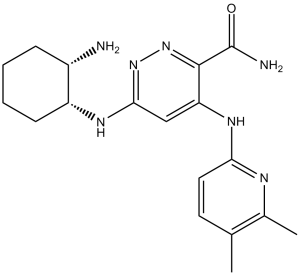
RO9021 (RO-9021) is a potent, orally bioavailavle, ATP-competative and selective inhibitor of spleen tyrosine kinase (SYK) with usefulness in autoimmune disease therapy, such as arthritis. It suppresses B-cell receptor signaling and inhibits SYK kinase activity with an average IC50 of 5.6 nM. An earlier investigation discovered that RO9021 could inhibit mouse bone marrow macrophage in vitro osteoclastogenesis in addition to suppressing Bcell receptor signaling in human peripheral blood mononuclear cells and whole blood, FcγR signaling in human monocytes, and Fc R signaling in human mast cells. Furthermore, it has been observed that RO9021 may inhibit the Toll-like Receptor 9 signaling in human B cells. This could result in a reduction of plasmablasts, immunoglobulin (Ig) G, and IgM levels following B-cell differentiation.
Physicochemical Properties
| Molecular Formula | C18H25N7O | |
| Molecular Weight | 355.44 | |
| Exact Mass | 355.212 | |
| Elemental Analysis | C, 60.82; H, 7.09; N, 27.58; O, 4.50 | |
| CAS # | 1446790-62-0 | |
| Related CAS # |
|
|
| PubChem CID | 71626896 | |
| Appearance | White to off-white solid powder | |
| Density | 1.3±0.1 g/cm3 | |
| Boiling Point | 618.5±55.0 °C at 760 mmHg | |
| Flash Point | 327.9±31.5 °C | |
| Vapour Pressure | 0.0±1.8 mmHg at 25°C | |
| Index of Refraction | 1.667 | |
| LogP | 4.97 | |
| Hydrogen Bond Donor Count | 4 | |
| Hydrogen Bond Acceptor Count | 7 | |
| Rotatable Bond Count | 5 | |
| Heavy Atom Count | 26 | |
| Complexity | 477 | |
| Defined Atom Stereocenter Count | 2 | |
| SMILES | O=C(C1C(=C([H])C(=NN=1)N([H])[C@]1([H])C([H])([H])C([H])([H])C([H])([H])C([H])([H])[C@]1([H])N([H])[H])N([H])C1C([H])=C([H])C(C([H])([H])[H])=C(C([H])([H])[H])N=1)N([H])[H] |
|
| InChi Key | XJZVCDVZCRLIKN-QWHCGFSZSA-N | |
| InChi Code | InChI=1S/C18H25N7O/c1-10-7-8-15(21-11(10)2)23-14-9-16(24-25-17(14)18(20)26)22-13-6-4-3-5-12(13)19/h7-9,12-13H,3-6,19H2,1-2H3,(H2,20,26)(H2,21,22,23,24)/t12-,13+/m0/s1 | |
| Chemical Name | 6-[[(1R,2S)-2-aminocyclohexyl]amino]-4-[(5,6-dimethylpyridin-2-yl)amino]pyridazine-3-carboxamide | |
| Synonyms |
|
|
| HS Tariff Code | 2934.99.9001 | |
| Storage |
Powder-20°C 3 years 4°C 2 years In solvent -80°C 6 months -20°C 1 month |
|
| Shipping Condition | Room temperature (This product is stable at ambient temperature for a few days during ordinary shipping and time spent in Customs) |
Biological Activity
| Targets |
SYK (IC50 = 5.6 nM)
Spleen Tyrosine Kinase (SYK) (IC50 = 4.1 nM); ZAP-70 (IC50 = 320 nM); ITK (IC50 = 450 nM); BTK (IC50 = 620 nM) [1] |
| ln Vitro |
RO9021 inhibits FcγR signaling in human monocytes, FcεR signaling in human mast cells, and BCR signaling in human peripheral blood mononuclear cells (PBMC) and whole blood. It also prevents mouse bone marrow macrophages from promoting osteoclastogenesis in vitro. Following B-cell differentiation, RO9021 inhibited Toll-like Receptor (TLR) 9 signaling in human B cells, which led to decreased levels of plasmablasts, immunoglobulin (Ig)M, and IgG. Moreover, when TLR9 was activated, RO9021 significantly reduced the production of type I interferon by human plasmacytoid dendritic cells (pDC). Since RO9021 did not impede JAK-STAT or TLR4-mediated signaling, this effect is unique to TLR9. RO9021 doesn't significantly block the JAK-STAT pathway [1]. RO9021 inhibited anti-IgM-induced B cell receptor (BCR) signaling in primary mouse B cells, blocking phosphorylation of SYK and downstream PLCγ2 with an IC50 of 12 nM [1] It suppressed LPS-induced TNFα production in mouse bone marrow-derived macrophages (BMDMs) with an IC50 of 18 nM [1] In human peripheral blood mononuclear cells (PBMCs), RO9021 reduced anti-CD3/CD28-stimulated IL-2 secretion (IC50 = 23 nM) and IFNγ production (IC50 = 27 nM) [1] The compound inhibited FcγR-mediated phagocytosis in mouse peritoneal macrophages, with 50% inhibition at 30 nM [1] It blocked IgE-mediated degranulation in rat basophilic leukemia (RBL-2H3) cells, as measured by β-hexosaminidase release, with an IC50 of 15 nM [1] Western blot analysis showed reduced phosphorylation of ERK1/2 and AKT in BCR-stimulated B cells treated with RO9021 (100 nM) [1] |
| ln Vivo |
In the mCIA model, oral RO9021 administration slows the progression of arthritis[1]. Oral administration of RO9021 at 30 mg/kg twice daily inhibited ovalbumin-induced delayed-type hypersensitivity (DTH) response in mice by 65% [1] In a mouse collagen-induced arthritis (CIA) model, 10, 30, and 100 mg/kg daily oral dosing reduced paw swelling by 38%, 59%, and 76%, respectively, compared to vehicle controls [1] Treatment with 50 mg/kg RO9021 (oral, twice daily) suppressed anti-IgM-induced B cell activation in mice, as evidenced by reduced splenic B cell proliferation and serum IgM levels [1] In a rat adjuvant-induced arthritis (AIA) model, 25 and 75 mg/kg oral doses (once daily) reduced joint inflammation scores by 42% and 68% after 14 days of treatment [1] |
| Enzyme Assay |
Among the 392 kinases that have been tested, SYK is the only kinase that exhibits 99% competition with RO9021. RO9021 is a highly selective SYK inhibitor, with low S-scores of 0.003 for S(99) and 0.015 for S(90). As a result of blocking SYK kinase activity, RO9021 attenuates the downstream signaling cascade of the BCR. This is demonstrated by the fact that RO9021 inhibits the phosphorylation of BTK, PLCγ2, AKT, and ERK induced by antibodies. Recombinant SYK, ZAP-70, ITK, and BTK kinases were used to assess inhibitory activity. The assay was performed in a buffer containing ATP, MgCl2, and a biotinylated peptide substrate. Serial dilutions of RO9021 were incubated with enzyme, substrate, and ATP at 37°C for 45 minutes. The reaction was terminated, and phosphorylated substrate was captured using streptavidin-coated plates, detected with a phosphospecific antibody, and quantified to calculate IC50 values [1] Homogeneous Time-Resolved Fluorescence (HTRF) assay was used for SYK binding validation: SYK kinase domain was incubated with RO9021 and a fluorescently labeled ATP-competitive probe. Displacement of the probe by the compound was measured, confirming direct binding to the ATP pocket with a Ki of 2.8 nM [1] |
| Cell Assay |
The human B-cell line Ramos was pretreated with 1 μM RO9021 before the BCR was cross-linked by an anti-IgM antibody. Using phosphospecific antibodies, a western blot was used to evaluate the activation of different BCR signaling components. Primary mouse B cells were isolated from spleens and stimulated with anti-IgM (10 μg/mL) in the presence of RO9021 serial dilutions. After 24 hours of incubation at 37°C in 5% CO2, cells were lysed, and phosphorylation of SYK and PLCγ2 was detected by Western blot [1] Mouse BMDMs were differentiated in culture medium for 7 days, then stimulated with LPS (1 μg/mL) plus RO9021. Supernatants were collected after 24 hours, and TNFα levels were measured by ELISA to determine IC50 [1] RBL-2H3 cells were sensitized with anti-DNP IgE overnight, washed, and challenged with DNP-BSA in the presence of RO9021. β-hexosaminidase release was quantified after 1 hour to assess degranulation inhibition [1] Human PBMCs were isolated from healthy donors and stimulated with anti-CD3/CD28 beads. RO9021 was added at various concentrations, and after 48 hours, IL-2 and IFNγ in supernatants were measured by multiplex immunoassay [1] |
| Animal Protocol |
C57BL/6 and DBA/1J adult mice 5 and 45 mg/kg daily oral administration Ovalbumin-induced DTH model: Mice were sensitized with ovalbumin emulsified in complete Freund's adjuvant on day 0. On day 7, mice were challenged with ovalbumin via footpad injection. RO9021 was formulated in 0.5% methylcellulose + 0.1% Tween 80 and administered orally at 30 mg/kg twice daily from day 5 to day 7. Footpad swelling was measured 24 hours after challenge [1] Mouse CIA model: DBA/1 mice were immunized with bovine type II collagen on day 0 and boosted on day 21. RO9021 was given orally at 10, 30, 100 mg/kg once daily from day 21 to day 35. Paw volume was measured every 3 days, and joint histopathology was evaluated at study end [1] Rat AIA model: Male Lewis rats were immunized with Mycobacterium tuberculosis in mineral oil on day 0. RO9021 was administered orally at 25 and 75 mg/kg once daily from day 14 to day 28. Joint inflammation scores were assessed twice weekly based on erythema, swelling, and function [1] B cell activation model: Mice were injected intraperitoneally with anti-IgM (20 μg/mouse) and dosed orally with RO9021 (50 mg/kg twice daily) for 3 days. Splenocytes were isolated for proliferation assay, and serum IgM levels were measured by ELISA [1] |
| ADME/Pharmacokinetics |
Oral bioavailability of RO9021 in mice was 52% after a single 10 mg/kg dose [1] The compound had a plasma half-life (t1/2) of 3.5 hours in mice following intravenous administration at 5 mg/kg [1] In rats, oral bioavailability was 47% (10 mg/kg dose) with a plasma t1/2 of 4.1 hours [1] RO9021 showed good tissue penetration, with concentrations in spleen, lymph nodes, and joints of rats being 2.8, 3.1, and 1.5 times higher than plasma concentrations 3 hours after oral dosing [1] Metabolic stability in human liver microsomes was moderate, with a half-life of 72 minutes [1] |
| Toxicity/Toxicokinetics |
In a 28-day repeated-dose toxicity study in rats, oral doses of RO9021 up to 100 mg/kg/day did not cause significant changes in body weight, hematology, or clinical chemistry (liver/kidney function markers) [1] Plasma protein binding of RO9021 was 93% in human plasma, 91% in mouse plasma, and 89% in rat plasma [1] No significant off-target toxicity was observed in a panel of 50 kinases at 1 μM RO9021 [1] |
| References |
[1]. Selective inhibition of spleen tyrosine kinase (SYK) with a novel orally bioavailable small molecule inhibitor, RO9021, impinges on various innate and adaptive immune responses: implications for SYK inhibitors in autoimmune disease therapy. [2]. Selective inhibition of spleen tyrosine kinase (SYK) with a novel orally bioavailable small molecule inhibitor, RO9021, impinges on various innate and adaptive immune responses: implications for SYK inhibitors in autoimmune disease therapy. |
| Additional Infomation |
RO9021 is a novel, orally bioavailable, and selective SYK inhibitor developed for the treatment of autoimmune diseases [1] It acts by inhibiting SYK-mediated signaling pathways in innate and adaptive immune cells, suppressing pro-inflammatory cytokine production, B cell activation, T cell proliferation, and Fc receptor-mediated responses [1] The compound shows therapeutic potential in autoimmune disease models, targeting pathways involved in arthritis and hypersensitivity reactions [1] |
Solubility Data
| Solubility (In Vitro) |
|
|||
| Solubility (In Vivo) |
|
| Preparing Stock Solutions | 1 mg | 5 mg | 10 mg | |
| 1 mM | 2.8134 mL | 14.0671 mL | 28.1341 mL | |
| 5 mM | 0.5627 mL | 2.8134 mL | 5.6268 mL | |
| 10 mM | 0.2813 mL | 1.4067 mL | 2.8134 mL |